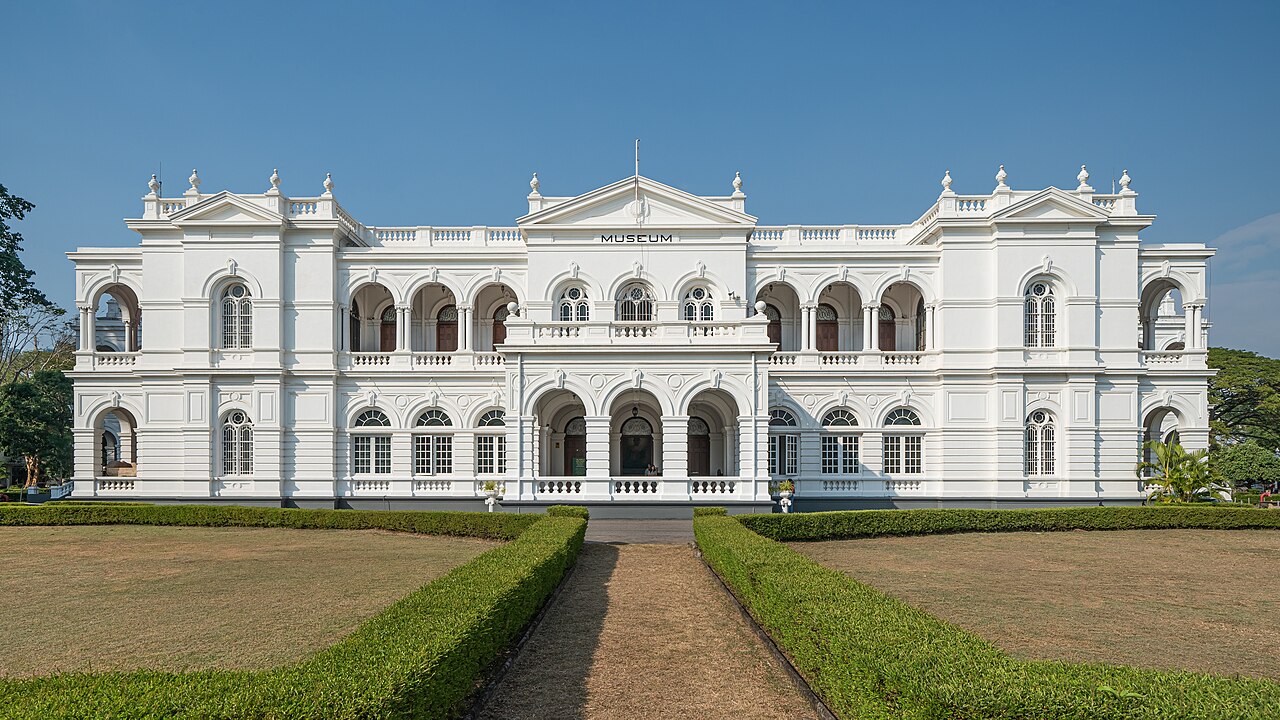
The Colombo National Museum is the best single place to understand the island before you travel it. It opened as the Colombo Museum on 1 January 1877, founded by Sir William Henry Gregory, then Governor of Ceylon, in a handsome white building in Italian style designed by J.G. Smither of the Public Works Department and finished in 1876. Galleries run in rough chronological order, from prehistoric finds and the stone sculpture of the ancient capitals of Anuradhapura and Polonnaruwa, through exquisite Hindu and Buddhist bronzes, to the Kandyan period, with royal regalia, weapons, textiles and paintings. There are rooms of traditional masks used in healing rituals and folk theatre, colonial-era furniture and coins. The National Museum of Natural History shares the same leafy grounds off Ananda Coomaraswamy Mawatha, with displays that include a notorious man-eating leopard from 1924. Seeing the sculpture here before Sigiriya or Kandy makes both far richer.
How it works: the museum stands in Colombo 7, on the edge of Viharamahadevi Park, a short tuk-tuk ride from Galle Face or Kollupitiya. Sri Lanka Tourism lists opening hours of nine in the morning to six in the evening, except public holidays. Foreign visitors pay a ticket at the entrance that is higher than the local rate, with a separate fee for cameras; there is no need to book ahead.
What to expect: the main building is on two floors around a central hall, with high ceilings and fans rather than strong air-conditioning, so it can be warm. Allow ninety minutes for the main galleries and another half hour for the Natural History Museum. Labels are in English, Sinhala and Tamil, though some are brief and dated, so a little background reading helps.
Making the most of it: come in the morning or on a rainy November afternoon, when the museum makes an ideal shelter. Remember that public holidays include every monthly full moon Poya day, when the museum is closed. Afterwards, walk across to Viharamahadevi Park for shade, or head on to Gangaramaya.
What to expect
The experience
A self-guided visit to Sri Lanka’s national history museum and the Natural History Museum in the same grounds.
Best time
A weekday morning, or a showery November afternoon, avoiding public holidays and Poya days when it is closed.
How long
About ninety minutes for the main museum and half an hour more for natural history.
Tips
Wear light clothes since the galleries can be warm, and carry rupees for the ticket and the camera fee.
Quick picks
- Best for
- History lovers and first-timers who want the story of the island before heading to Kandy, Sigiriya and Galle.
- Families
- The natural history galleries and masks keep children interested, and the park next door is good for a run-around.
- Couples
- Pair a cool morning in the galleries with lunch in nearby Colombo 7 and a stroll in Viharamahadevi Park.
- Pair with
- Gangaramaya Temple and the Lotus Tower, both a short ride away.
- Time needed
- Two hours.
Good questions
What are the opening hours of the Colombo National Museum?+
Sri Lanka Tourism lists nine in the morning to six in the evening, closed on public holidays. Full moon Poya days are public holidays in Sri Lanka, so check the calendar.
How much is the ticket?+
Foreign visitors pay a higher ticket than locals, with an extra fee to use a camera. Prices change, so check at the entrance and carry rupees.
When was the museum founded?+
It opened as the Colombo Museum on 1 January 1877, founded by Governor Sir William Henry Gregory. The Italian-style building was completed in 1876.
Is the Natural History Museum separate?+
It shares the same grounds and was established in 1986. It is a short walk from the main building, with its own ticket.
Is it worth visiting before Kandy or Sigiriya?+
Yes, the sculpture and Kandyan galleries give useful context for both. Even an hour here makes the day trips more meaningful.