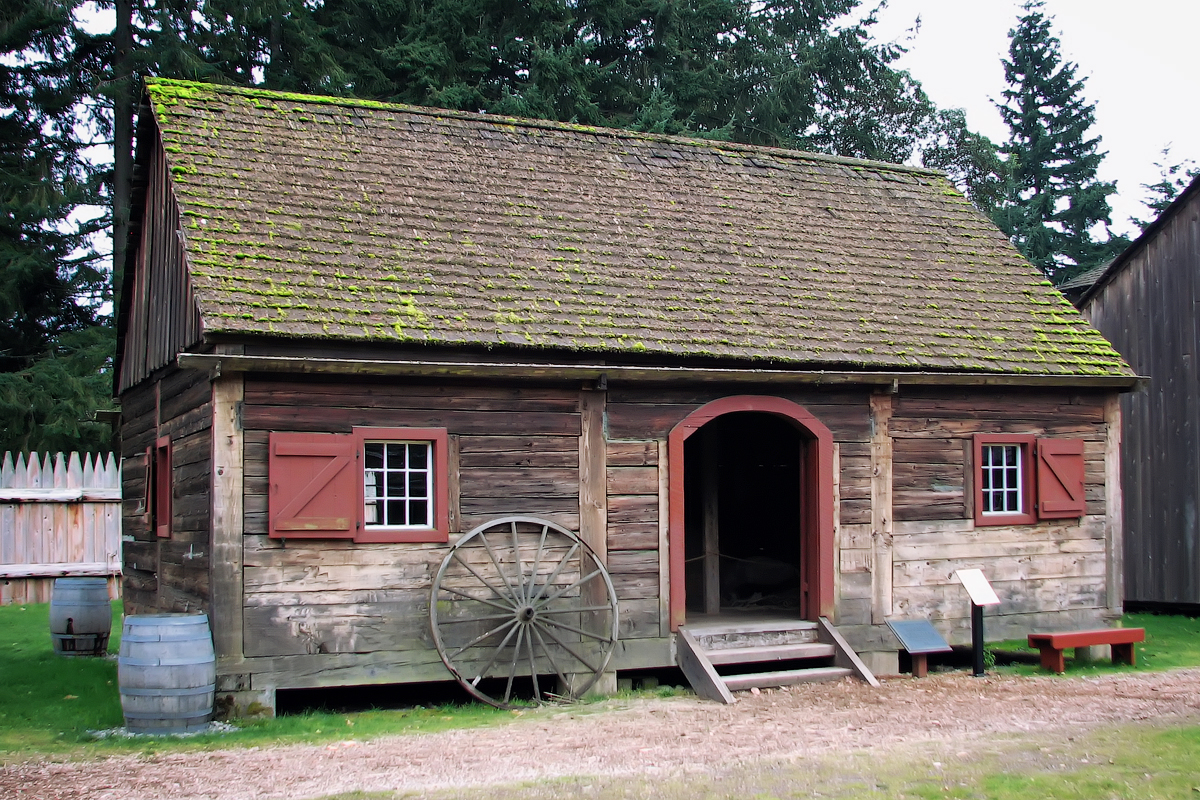
Fort Nisqually is a window into the earliest years of European settlement on Puget Sound. The original post was established in 1833 by the Hudson's Bay Company near the mouth of the Nisqually River, as a fur trading and agricultural station at the edge of a vast territory. The reconstruction inside Point Defiance Park re-creates the fort as it looked in the 1850s, with a stockade, a trade store, a blacksmith shop, bunkhouses and a factor's house, set among lawns and tall firs near the water. Two buildings, the Granary and the Factor's House, are original structures that were moved to the site and preserved, making them some of the oldest surviving buildings in Washington. Together with the reconstructed buildings they allow an unusually tangible look at the fur trade era, when Indigenous people, French Canadian voyageurs, Hawaiian workers, British officers and American settlers all shared a crowded, complicated world. The museum aims to tell that story with nuance rather than as a simple frontier tale. On many days, costumed interpreters work as blacksmiths, cooks and clerks, demonstrating skills such as forging iron, preparing food and handling trade goods. They answer questions in character or out of it, and children are encouraged to touch props and ask what life was like. Special events through the year, such as craft fairs and reenactments, add depth, but the fort is satisfying even on a quiet weekday.
Fort Nisqually keeps seasonal hours, with longer days in summer and a shorter or limited schedule in the colder months, so check ahead. Entry is a modest fee, and it sits inside a park that is itself free, which makes it easy to fold into a Point Defiance day. Allow about an hour for the buildings and demonstrations, longer if a special event or a talk is under way. Paths between buildings are gravel or grass, so strollers are manageable but wheelchair access can be uneven.
The fort pairs naturally with Camp Six, the logging museum nearby, which covers a different chapter of regional history. Many visitors begin at the fort, walk the nearby woodland trails, and finish with lunch and the zoo. The fort also hosts school groups on weekdays, so mornings in term time can be busy with children, whereas weekend afternoons are often quieter.
To get the most from the visit, read the interpretive panels or ask an interpreter about the Hudson's Bay Company, the Treaty of Medicine Creek and the local Nisqually people. The reconstructed bastion offers a lookout over the grounds, and the garden plots show what the fort grew to feed its workers. Dress for the weather since much of the experience is outdoors, and bring a camera for the timber buildings against the evergreen backdrop.
Visitors with a particular interest in craft will enjoy the blacksmith shop, where the sounds and smells of forging make the period feel immediate. The trade store, with its stacks of blankets, tools and furs, shows how goods moved across a huge network of posts, and the clerk's office explains how accounts were kept. Even a short conversation with an interpreter can turn a quiet corner of the fort into a lesson in economics, geography and the many languages that were once spoken here.
What to expect
The experience
A self-guided visit through a reconstructed fur trade fort, with costumed interpreters and demonstrations on many days.
Best time
Seasonal hours apply; late spring through early autumn has the fullest programming.
How long
One to two hours.
Tips
Check seasonal hours, wear shoes for gravel paths, and ask interpreters about the fort's original buildings.
Quick picks
- Best for
- History lovers and families with school-age children.
- Families
- Interactive and approachable, with demonstrations that children can follow.
- Couples
- A quiet historical stop between park walks and garden visits.
- Pair with
- Point Defiance Park, Camp Six and the zoo.
- Time needed
- Ninety minutes.
Good questions
Is Fort Nisqually open year round?+
It keeps seasonal hours, with fuller schedules in summer. Check before you visit.
Is it the original fort?+
No, it is a reconstruction of the 1850s fort, though two buildings are original structures moved to the site.
Do I need to pay for the park?+
Point Defiance Park is free. The fort charges a small admission fee.
Is it good for kids?+
Yes. Hands-on demonstrations and costumed staff help children connect to the past.
How long does it take?+
Most visitors need about an hour or two.