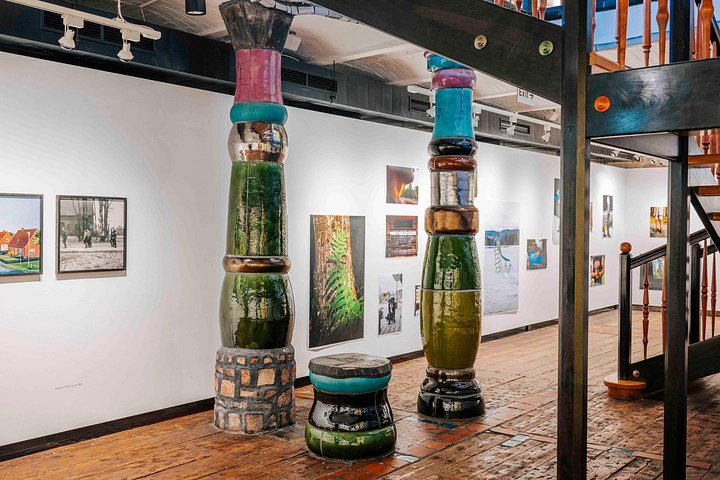
KunstHausWien is the museum that answers the question visitors ask after photographing the Hundertwasserhaus apartment block: what does the artist's work look like indoors? It is a gallery designed by Friedensreich Hundertwasser himself, converting a former furniture factory in the third district into a building that follows his convictions about nature, colour and the straight line. The floors undulate, the columns are tiled in mosaic, the walls refuse to be straight, and plants and trees grow inside the building. The permanent collection presents his paintings, graphics, tapestries and architectural models, with the spiral forms, bright patterns and organic outlines that made him the best-known Austrian artist of his generation after Klimt and Schiele. The museum also stages changing exhibitions of other artists, so the programme gives you a fresh reason to return. The building is as much the exhibit as the art, and you will notice that every detail, from the staircase to the cafe, carries the same hand. It is a different kind of Vienna experience, far from the Habsburg grandeur of the centre: playful, ecological and unashamedly decorative. Not everyone is a convert, and critics have long argued about whether Hundertwasser was a visionary or a decorator, but the visit makes the argument concrete. For visitors who have time for only one modern-art stop, the Albertina or the Leopold Museum offer a more conventional survey, whereas this museum offers a complete, singular world that exists nowhere else.
Planning the visit
The museum is at Untere Weissgerberstrasse 13 in the third district, a short walk from the Hundertwasserhaus apartment block and reachable by tram or by the U3 and U4 with a short walk. The tickets are for entry to the museum; check which exhibitions are running and whether the permanent collection and temporary shows are included when you book. Allow about an hour for the permanent collection, with extra time if a special exhibition interests you. Hours and any closing days are best checked on the day you plan to go.
Getting the most from it
Look down as well as around, because the uneven floors are an intentional experience of walking on a surface that is not machine-flat. Spend time in the architectural section, where models and drawings show how Hundertwasser wanted buildings to include green roofs, living trees and individual windows. The staircase and courtyard are good photographs. If you have already seen the exterior of the Hundertwasserhaus, you will understand the ideas immediately; if not, do both on the same afternoon, since the two are a short walk apart.
Who it suits
Art lovers who enjoy a distinctive personality, families with children who will respond to the colours and curves, and architecture fans interested in sustainable design. It is less suited to visitors who want old masters or Klimt. Pair it with the Hundertwasserhaus, the nearby Stadtpark or a coffee in the third district, and the Belvedere is a pleasant walk or short ride away for a day built around Austrian art.
What to expect
The experience
A self-guided visit to a museum designed by Hundertwasser, with his paintings, graphics and architectural models and changing exhibitions in a building of uneven floors and mosaic columns.
Best time
Weekday mornings; combine with the Hundertwasserhaus apartment block on the same afternoon.
How long
About an hour, longer if a special exhibition appeals.
Tips
Check which exhibitions are included when you book. Look at the floors, columns and staircase, which are part of the art. Walk to the Hundertwasserhaus afterwards.
Quick picks
- Best for
- Hundertwasser's art and architecture in a building he designed himself.
- Families
- Good: colourful, curvy and unusual, and children notice the uneven floors and indoor trees.
- Couples
- An offbeat and photogenic afternoon with the Hundertwasserhaus close by.
- Pair with
- The Hundertwasserhaus apartment block, the Stadtpark and the Belvedere.
- Time needed
- About an hour.
Good questions
What is KunstHausWien?+
It is a museum devoted to the work of Friedensreich Hundertwasser, housed in a former furniture factory that he converted himself. It shows his paintings, graphics and architectural ideas and also hosts changing exhibitions.
Is it the same as the Hundertwasserhaus?+
No. The Hundertwasserhaus is a nearby apartment block that you can admire from outside, while KunstHausWien is the museum with the collection. Many visitors see both on the same trip.
Where is it?+
At Untere Weissgerberstrasse 13 in the third district, a short walk from the Hundertwasserhaus. Tram and underground connections link it to the centre.
How long should I allow?+
About an hour for the permanent collection, with extra time if a special exhibition is running and interests you.
Is it good for children?+
Yes, the bright colours, the uneven floors and the plants growing indoors tend to appeal to children, although it is an art museum and not a hands-on attraction.