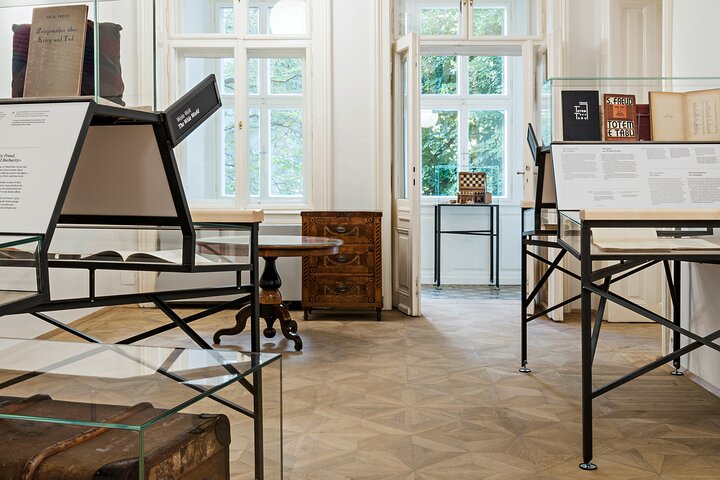
Berggasse 19 in the ninth district is the address where Sigmund Freud lived and practised for decades, and the museum that now occupies the building is the best way to understand the man behind the couch. The apartment and consulting rooms are the heart of the visit, and the displays include documents, photographs, rare first editions and presentation copies of his books, along with objects from his life and practice. What many visitors do not realise is that the famous couch is not here: it went to London with Freud when he fled Vienna in 1938, and it can be seen at the Freud Museum in Hampstead. That absence is part of the story, and the Vienna museum is honest about it, concentrating instead on the rooms, the history and the voices of the people who sat in them. The former office hosts an exhibition on his visual thinking, and there is a conceptual art collection with works by artists including John Baldessari, Joseph Kosuth, Susan Hiller, Franz West and Haim Steinbach, a modern layer that connects Freud's ideas to contemporary art. The museum is small and quiet, a long way from the crowds at Schonbrunn, and it rewards unhurried reading. It is open most days with a closure listed on Tuesdays, and the building is wheelchair accessible. If you have any curiosity about psychology, Viennese modernism or the city's intellectual life in the decades around 1900, this is one of the most rewarding hours you can spend outside the major museums.
Planning the visit
The museum is at Berggasse 19, a short walk from the Schottentor area and the university, or a ride on the D tram or the U4 to Rossauer Lande. The museum is generally closed on Tuesdays and open the other days from morning until early evening, with last entry shortly before closing; check the day when you book. Allow around an hour to ninety minutes. An audio guide is available separately from the ticket, so decide whether you want one when you arrive. The building is accessible to wheelchair users.
Getting the most from it
Begin with the biographical displays to give the rooms context, then look closely at the first editions and at the photographs of the waiting room and study as they were before 1938. Spend time with the art, which is not decoration but a deliberate conversation with Freud's ideas about dreams, memory and the unconscious.
The shop has a good selection of books if you want to carry on reading. If you are interested in the end of the story, the Freud Museum in London holds the couch and the study as he reassembled them after emigrating.
Who it suits
Readers, psychology students, anyone curious about Vienna around 1900, and visitors who have done the grand museums and want something personal. It is not designed for young children and will not suit anyone expecting a spectacle. Pair it with a walk to the nearby university and the Votivkirche, a coffee house on the Ring, and the Hundertwasser sights on the other side of the Danube Canal. A quiet morning here sits well beside an afternoon at the Leopold Museum.
What to expect
The experience
A self-guided visit to Freud's former home and consulting rooms, with documents, first editions, a contemporary art collection and an exhibition in his former office.
Best time
Weekday mornings, when the museum is at its quietest; check opening days, as Tuesday is usually a closing day.
How long
About an hour to ninety minutes.
Tips
Check opening days when you book. Decide in advance whether you want an audio guide, which is separate from entry. Read the biographical displays first for context.
Quick picks
- Best for
- The rooms where psychoanalysis was born, with rare first editions and a thoughtful art collection.
- Families
- Better for teenagers and adults than young children; it is quiet and reading-based.
- Couples
- A calm, intellectual couple of hours, ideal before a coffee house lunch.
- Pair with
- The Votivkirche, the university, a coffee house on the Ring or the Leopold Museum.
- Time needed
- One to one and a half hours.
Good questions
Is Freud's couch in the Vienna museum?+
No. Freud took the couch to London when he left Vienna in 1938, and it is displayed at the Freud Museum in Hampstead. The Vienna museum shows his rooms, documents, first editions and a contemporary art collection.
Where is the museum?+
At Berggasse 19 in the ninth district, in the building where Freud lived and practised. The D tram and the U4 to Rossauer Lande are the easiest ways to reach it.
When is it open?+
It is generally open most days from morning to early evening and closed on Tuesdays, with last entry shortly before closing. Check the day of your visit when you book.
Is there an audio guide?+
An audio guide is available but is not included in the standard ticket. Decide whether you would like one before you go.
Is the museum accessible?+
Yes, it is listed as wheelchair accessible. If you have specific needs, check the details when you book.