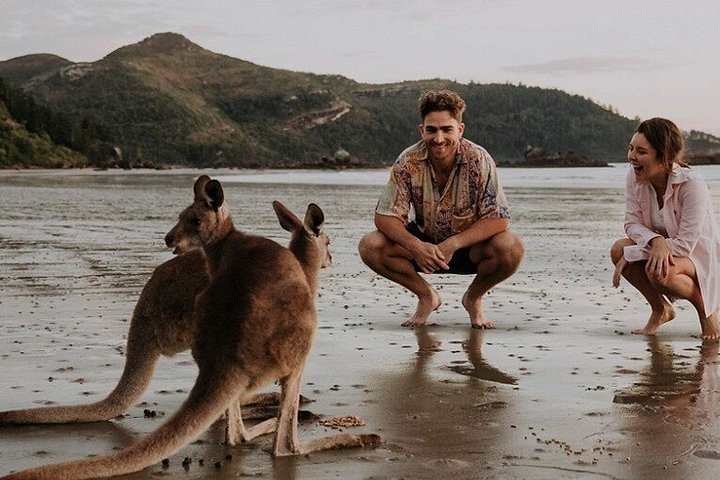
One of the most unusual sights in Queensland takes place at first light on a beach north of Airlie Beach. At Cape Hillsborough National Park, wallabies and eastern grey kangaroos come down from the bush to feed on the sand at dawn, picking over seed pods, mangrove fruits and washed-up vegetation as the sun rises over the water. The sky glows pink and orange, the sea is still and the animals move quietly across the beach, creating a scene that looks like a postcard from another world. The tour leaves Airlie Beach in the dark, with a drive of around an hour and a quarter to the national park. A guide explains the behaviour of the animals, shows you where to stand and how to keep a respectful distance, and points out birds, crabs and other wildlife. After the sunrise show, there is usually a morning walk through rainforest or mangrove boardwalks, with a chance to see the landscape of the cape, including its rocky headlands and volcanic geology. A simple breakfast or morning tea is often included.
Go in with the right expectations. The animals are wild, so numbers and positions vary from day to day, and sightings depend on tide, weather and season. The best displays often occur when the low tide exposes fruits and seeds on the beach at sunrise, and the guide will choose the day's strategy accordingly. If the animals are close, resist the urge to chase them or reach out; stay low, move slowly, keep your voice down and let the kangaroos come to you. Feeding is not allowed, and flash photography can disturb them.
The early start is part of the experience. You will probably be up well before dawn, so prepare the night before by packing a layer, a camera and water. Mornings on the coast can be cool and damp, and you will be standing still on sand for a while, so wear closed shoes or sandals you do not mind getting wet and long trousers if insects are active. Bring insect repellent for the bush walk, and a hat once the sun climbs. Sunrise times shift through the year, so the departure time moves with them.
The tour is a good complement to the marine-focused days. After snorkelling and sailing, an hour with kangaroos adds a distinctly Australian flavour and gives children and adults a different kind of wildlife encounter. It also provides a chance to see another side of the coast, with its tidal flats, mangroves and mountains rising behind the beach. Photographers should bring a telephoto lens if possible, though wide shots with the sunrise behind the animals are just as rewarding.
If you are driving yourself, remember that the road to Cape Hillsborough is long and kangaroos are active on rural roads at dusk and dawn, so take care. A guided tour removes the stress of early driving and the need to find the right spot, and the guide's knowledge of the animals adds value. Combine this experience with other mainland outings, such as the platypus trip at Eungella or the crocodile safari, and you can build a wildlife-themed few days between island and reef excursions.
What to expect
The experience
An early-morning eco tour to Cape Hillsborough National Park to watch wallabies and kangaroos on the beach at sunrise, with a short bush walk.
Best time
Year-round at sunrise, with the best displays often around low tide. Cooler months are more comfortable.
How long
About half a day, including a drive of roughly an hour and a quarter each way.
Tips
Wear closed shoes, bring a layer and insect repellent, keep your distance and never feed the animals.
Quick picks
- Best for
- Families, photographers and anyone who wants a classic Australian wildlife scene.
- Families
- Children love it; the early start is the main challenge.
- Couples
- Quiet, beautiful light and a different kind of romantic outing.
- Pair with
- The crocodile safari or the platypus tour on other days.
- Time needed
- Half a day.
Good questions
Where is Cape Hillsborough?+
It is a national park on the coast north of Airlie Beach, roughly an hour and a quarter by road, and the guided tour handles the drive.
Will I definitely see kangaroos?+
Sightings are common at sunrise but not guaranteed, since the animals are wild. Tide and weather influence what happens on the day.
Can I feed or touch them?+
No. Keep a respectful distance, stay quiet and do not use flash.
What should I bring?+
A warm layer, closed shoes, insect repellent, water, a hat and a camera.
Is it suitable for children?+
Yes, and many children enjoy it, although the pre-dawn start can be tiring.