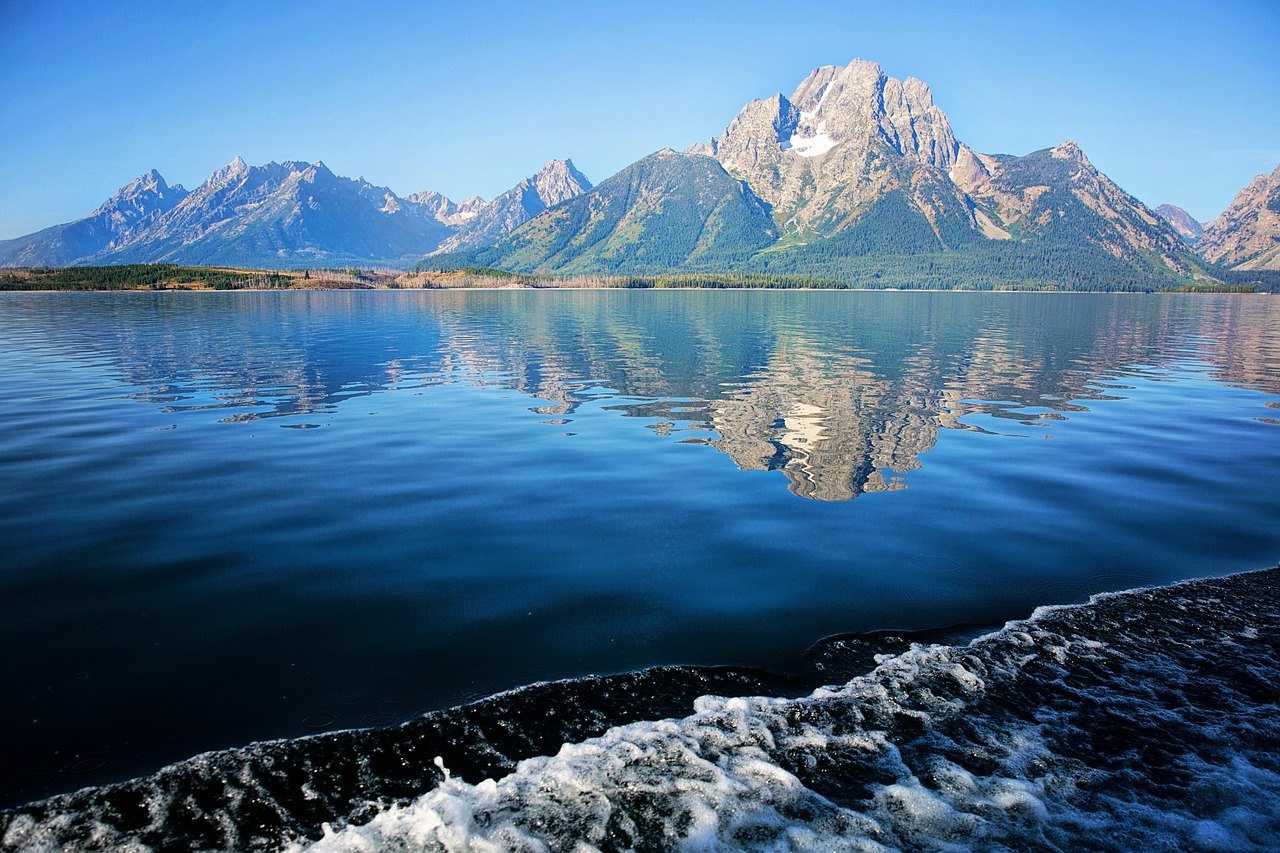
Mormon Row is where Grand Teton's human history and its most famous view meet. In the 1890s, Mormon settlers from Idaho founded a farming community called Grovont on the flats east of Blacktail Butte, drawn by fertile soil, shelter from wind and water from the Gros Ventre River; they clustered their homesteads along a single road, an unusual arrangement in the West that let families share labor, and over the following decades they dug irrigation ditches by hand, some of which still carry water. What remains is a scatter of barns, houses and outbuildings, and two of them have become icons: the barns of brothers John and Thomas Alma Moulton. John's two-story gambrel barn stands north of Antelope Flats Road next to his pink stucco house; T.A.'s barn, south of the road, took him about 30 years to finish. Photographed at sunrise with the Tetons glowing behind, the T.A. Moulton barn is one of the most reproduced images of the American West. The site also rewards wildlife watchers: bison and pronghorn often graze the sagebrush flats around the barns. Access is via Antelope Flats Road off US 191 north of Moose, with a small parking area by the pink house; there is no entrance station on this route. Seasonal and project notes: the park has been improving pedestrian and cyclist access here, with work zones through mid-November 2026, and Antelope Flats Road can close in winter depending on conditions. Fit: first-time visitors, photographers, families who like history with their scenery, and anyone wanting a gentle, flat walk.
The story behind the barns is one of persistence and, eventually, departure. Homesteading here was hard: one family did not have running water until 1927 and produced its own electricity with a windmill decades later. Rural electrification reached the row only in the 1950s, and by then many families had sold their land to become part of the expanding park. The National Park Service now preserves the buildings, and the site's interpretive signs and trail brochure explain who lived where and how the community worked.
To visit well, go at sunrise
The sun lights the Tetons from the east while the barns stay in shadow, giving the classic glowing-peaks image. Midday brings flat light but quieter conditions. Walk the dirt road between the buildings, read the signs, and give bison a wide berth; they can be unpredictable, and the park's rule is to stay at least 25 yards from bison. Do not climb on or enter the historic structures.
Practicals and fit
From Jackson, drive north on US 191 past Moose Junction and turn east on Antelope Flats Road, then follow it about 1.5 miles to the north-south dirt road by the pink stucco house. There is no fee to reach the site by this route. Pair with Schwabacher Landing and Oxbow Bend for a highway-side Teton loop. Fit: photographers, first-timers, families and history lovers.
What to expect
The experience
A preserved homestead district of barns and houses along a dirt road, with interpretive signs, a trail brochure and a flat walk between buildings, set against the Teton Range.
Best time
Sunrise for the glowing peaks; spring through fall when Antelope Flats Road is open. Winter access depends on road conditions.
How long
About an hour, longer for photographers.
Tips
Arrive before dawn for the famous light. Stay 25 yards from bison. Do not climb on the buildings. Check for project work zones in 2026.
Quick picks
- Best for
- The iconic barn-and-Tetons photograph and the homesteading story behind it.
- Families
- Easy, flat walking with history and frequent bison sightings.
- Couples
- Sunrise together at the Moulton barn.
- Pair with
- Schwabacher Landing and Oxbow Bend.
- Time needed
- An hour, 20 minutes north of Jackson.
Good questions
Which barn is the famous one?+
Both Moulton barns are photographed constantly, but the T.A. Moulton barn, south of Antelope Flats Road, is the one in most sunrise images with the Tetons behind it.
Is there an entrance fee?+
No station is on the route. Mormon Row is reached from US 191 via Antelope Flats Road without passing an entrance station.
Can I visit in winter?+
Antelope Flats Road can close in winter depending on conditions. Check the park's road status; on good days visitors walk or ski in.
Will I see bison?+
Often. Bison and pronghorn graze the surrounding flats. Stay at least 25 yards away.
When is the best light?+
Sunrise, when the Tetons are lit from the east and the barns stand in silhouette or soft light.