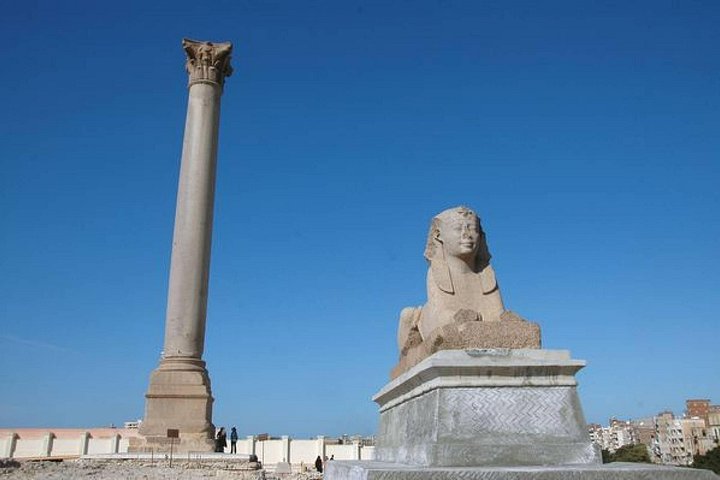
Pompey's Pillar is a single shaft of red granite standing about 25 metres high on a low hill in the Karmouz district. Despite the name it has nothing to do with the Roman general Pompey, because it was raised in 297 CE to honour the Emperor Diocletian, and early visitors misread the inscription. Around the base lie the remains of the Serapeum, the great temple of the god Serapis, whose underground galleries and sphinx statues still survive. In ancient times the temple was one of the city's holiest places and is thought to have held an overflow of scrolls from the Library. Today the site is a quiet archaeological garden with stone fragments, carved sphinxes and tunnels that are fun to explore.
What there is to see
The pillar itself dominates the site, with a Greek inscription on its base. Wander the paths among broken columns and look into the narrow galleries cut into the rock, where niches once held sacred texts and offerings. Sphinx statues near the galleries make good photo spots. Climbing the pillar is strictly forbidden.
A reality check
This is a small, rather bare site, so it works best as part of a wider day with the catacombs, the Roman Amphitheatre and the Library rather than as a destination of its own. Most visitors spend between half an hour and an hour here. Imagination helps, so read a little about the Serapeum beforehand to picture the temple as it once looked.
Practicalities
The site opens during the day and is usually cheap to enter, with a ticket paid at the gate and some extra charge for cameras. Shade is limited, so bring a hat and water in summer. It lies a few minutes' drive from the Catacombs of Kom el-Shoqafa, and a driver or ride-hailing app is the easiest way to link them. Guided tours often start here before heading to the rest of the city.
What to expect
The experience
A short wander around a hilltop archaeological site with a tall granite column, temple remains, sphinxes and rock-cut galleries.
Best time
Morning or late afternoon, when the light is soft and the site is cooler.
How long
Thirty to sixty minutes.
Tips
Bring a hat and water, keep cash for the ticket, and read a little about the Serapeum before you arrive.
Quick picks
- Best for
- History fans who want to stand beside one of the city's few remaining Roman monuments.
- Families
- Open space and sphinxes keep children interested, but there is little shade.
- Couples
- A short, scenic stop on a day of ancient Alexandria.
- Pair with
- The Catacombs of Kom el-Shoqafa, a few minutes away.
- Time needed
- Under an hour.
Good questions
Was Pompey's Pillar built for Pompey?+
No, it was erected in 297 CE for the Emperor Diocletian. The name came from a mistaken reading of the inscription by later visitors.
What is the Serapeum?+
It was the great temple of the god Serapis, a blend of Egyptian and Greek deities that Ptolemy promoted. Only foundations, galleries and a few statues survive around the pillar.
Can I climb the pillar?+
No, climbing is not allowed. You can walk around the base and the surrounding ruins.
How long does a visit take?+
Around thirty to sixty minutes is typical. It works best as one stop in a longer city tour.
Is it worth visiting on its own?+
It is a modest site, so most people pair it with the catacombs and other sights. If you only have a few hours, it is not the first priority.