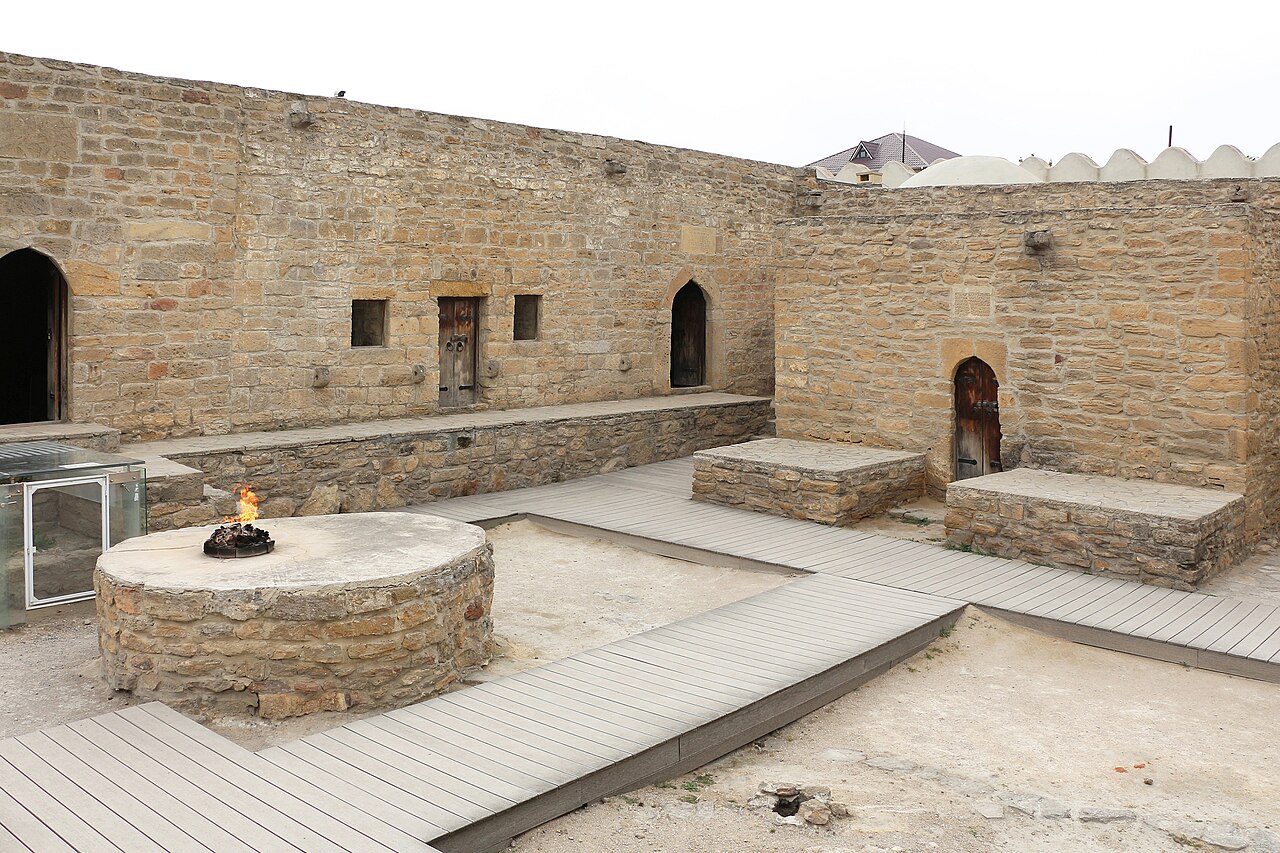
The Ateshgah of Baku sits in the Surakhani area of the Absheron Peninsula, a short ride from the city and the airport. It is a walled, pentagonal complex with a central altar-shrine and ring of monks' cells, built in the seventeenth and eighteenth centuries on a much older site where natural gas vents burned. Its name combines the Persian words for fire and place. It served as a place of worship for Indian visitors, Hindus, Sikhs and Zoroastrians in particular, who travelled the Silk Road trade routes, and the cells around the courtyard held their pilgrims. The natural gas that fed the flame ran out in the twentieth century, and today the fire in the altar is lit by gas supplied from the city. The complex was abandoned in the late nineteenth century, became a museum in 1975 and now operates as an open-air museum on the UNESCO Tentative List. Inscriptions left by pilgrims, displays in the cells and a small exhibition bring the pilgrims' lives to life, and the courtyard is a peaceful place to walk.
What you will see: the heart of the temple is the altar under a small open pavilion, where the flame burns, surrounded by cells whose doors open onto the arcade. Some cells have displays about the religions practised here, others have reconstructed scenes of pilgrims at prayer. The scale is small, and most people spend 30 to 45 minutes.
How to visit: the temple is at its best when paired with Yanar Dag, the burning mountain, in a half-day Absheron tour, with the two often sold as a single combined ticket. A private or small-group tour from Baku takes care of transport, and some tours add other Absheron stops, so check the inclusions and entry fees before you book. Ticket prices and hours change, and sources disagree on the current fee, so confirm the day before.
Good to know: it is mostly open-air, so dress for the weather and carry water in summer. Visiting is easy for most people because the grounds are flat, with a few steps into the cells. In winter there is less crowd and a hush that suits the place, and the nearby Absheron stops give you reasons to continue the trip.
What to expect
The experience
A guided half-day tour to the open-air fire temple museum, usually combined with a visit to the burning mountain of Yanar Dag.
Best time
Morning or late afternoon, outside the hottest hours, with a visit to Yanar Dag at dusk if the tour allows.
How long
Around 45 minutes at the temple and three to four hours for the full Absheron tour.
Tips
Check the tour inclusions for entry fees, carry water and wear sturdy shoes for the stone courtyard.
Quick picks
- Best for
- History and religion buffs who like atmospheric, offbeat sites.
- Families
- Children enjoy the cells and the flame, and the compact site is easy to cover.
- Couples
- A quiet half-day pairing with Yanar Dag at sunset.
- Pair with
- Yanar Dag, Gobustan and the mud volcanoes.
- Time needed
- Allow a half day including Yanar Dag.
Good questions
Is the flame real?+
Yes, there is a flame at the altar, but it is supplied by piped gas, because the natural gas vents that once fed it ran dry. The site still gives a vivid sense of the fire-worship tradition.
Who built the Ateshgah?+
The present structure dates to the seventeenth and eighteenth centuries and was used by Hindu, Sikh and Zoroastrian visitors from India. It stands on an older place of fire worship.
How long do I need?+
About 45 minutes is enough for the temple. Plan a half day if you add Yanar Dag.
How far is it from central Baku?+
It is in Surakhani on the Absheron Peninsula, roughly half an hour to an hour by car depending on traffic. A tour or taxi is the easy option.
Can I combine it with other sights?+
Yes, Yanar Dag is the usual pairing, and many tours add Gobustan and the mud volcanoes for a full-day trip. Check each tour's route.