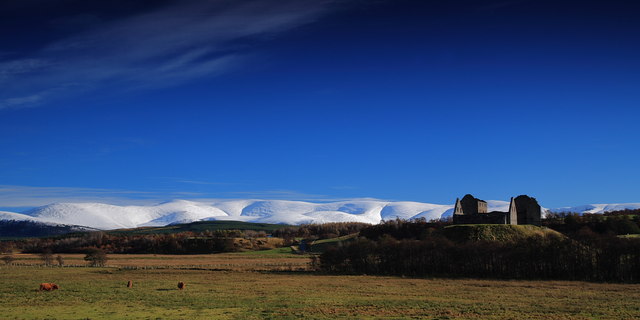
Ruthven Barracks stands on a steep green hill above the flat Insh Marshes, visible from the A9 and instantly memorable. It was built in 1719 by the British government after the 1715 Jacobite rising, to control the Highlands and guard the road network, and it is one of the best preserved examples of such military barracks in Scotland. The site also holds the remains of earlier fortresses, including a medieval castle associated with the Wolf of Badenoch. The barracks survived a Jacobite attack in 1745 but fell the following year, when it was captured and later blown up by retreating Jacobite forces after the defeat at Culloden. Their survivors gathered here for a last time, received the message that the cause was lost, and dispersed into the hills. Today the ruins are managed by Historic Environment Scotland and are free to visit all year. A short path climbs from the car park to the top of the mound, where the walls, stables and barrack blocks survive in dramatic form and the view over the flood plain and the Cairngorms is spectacular.
The story is as striking as the setting. The barracks were designed to house a garrison of soldiers and horses to patrol the Highland glens, and they included accommodation for officers, stables for dragoons, a bakehouse and a well. After 1745, when Prince Charles Edward Stuart's army briefly took the site, it changed hands again, and after Culloden the Jacobite remnants assembled here.
The message that every man should look to his own safety is remembered as a bleak end to the rising. Reading the interpretation panels and walking the walls makes it easy to picture the soldiers and the scattered clan survivors.
Visiting is easy. The site is open at all times, there is no ticket office and no fee, and the walk from the car park takes only a few minutes, though the final slope is steep. Take care with children and dogs, since the walls are uneven and there are drops, and stay off unstable stonework. Interpretation panels give the history, and a visit takes thirty to sixty minutes, longer if you linger for photographs or a picnic on the mound.
Light and season change the experience. In the early morning or evening the low sun turns the walls gold and throws long shadows over the marsh. In winter the ruin stands against snow-covered hills, and in spring the Insh Marshes below attract migratory birds, with a nature reserve and hides a short drive away. Floodlighting at night is sometimes provided, and the ruins are especially dramatic when lit. Midges can bother in still summer evenings, so carry repellent.
Ruthven fits easily into a Badenoch day. It lies just over a kilometre south of Kingussie, and the Highland Folk Museum at Newtonmore is a short drive away, making a rich afternoon of history. Combine it with lunch in Kingussie, a walk at the Insh Marshes, or the Dalwhinnie distillery for a southern Cairngorms circuit. It is also a convenient stop on the way between Perthshire and Aviemore.
Photographers will want a wide lens for the long barrack blocks and a longer lens for details of the stonework, and the best views of the whole mound are from the roadside lay-by approaching from the south. Pause for the interpretation panels, which tell the human story of the soldiers and Jacobites who lived and fought here, and imagine the scene on a stormy night in 1746.
What to expect
The experience
A free, self-guided visit to the ruins of an eighteenth-century barracks on a mound above the Spey valley, with a short uphill path and interpretation panels.
Best time
Early morning or evening for golden light; clear days for the views.
How long
Thirty to sixty minutes.
Tips
Take care on uneven ground, supervise children near drops, and bring midge repellent for summer evenings.
Quick picks
- Best for
- History fans, photographers and anyone passing on the A9.
- Families
- Children enjoy climbing the mound and exploring, with supervision.
- Couples
- A romantic sunset stop.
- Pair with
- The Highland Folk Museum and Dalwhinnie Distillery.
- Time needed
- About an hour.
Good questions
Is there an entry fee?+
No. The site is free and open at all times of year.
What is the history of Ruthven Barracks?+
Built in 1719 after the 1715 rising, they were captured and destroyed in 1746 by retreating Jacobites after Culloden.
How long does the visit take?+
About thirty to sixty minutes, including the short climb from the car park.
Is it suitable for children?+
Yes, with supervision. The ground is uneven and there are drops, so keep young children close.
Where is it?+
Just south of Kingussie in Badenoch, visible from the A9, about thirty minutes from Aviemore.