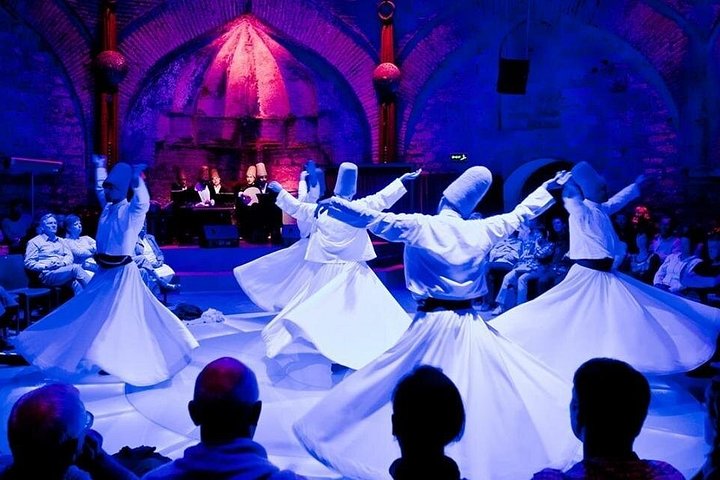
The whirling dervish ceremony, or sema, is a religious ritual of the Mevlevi Sufi order, founded in the 13th century by followers of the poet and mystic Rumi, whose tomb is in Konya. In Cappadocia, ceremonies are staged for visitors in a restored 13th-century caravanserai, a stone building of the kind that once sheltered Silk Road traders and gives the evening its atmosphere. The ritual lasts roughly fifty minutes. A singer and musicians play a slow, devotional piece on the ney, a reed flute, and drums, and the dervishes in long white skirts and tall felt hats enter, bow and begin to turn, with one palm raised to heaven and the other turned toward the earth. The turning symbolises a spiritual journey toward union with the divine. It is quieter and more solemn than the folk shows that fill dinner theatres, and past guests describe it as a spiritual ritual with a serious tone rather than a dance performance. This booking has a very large number of strongly positive reviews, which makes it one of the safest cultural picks in the area. Read the booking page for the pickup arrangements, the start time and the day of the week, because ceremonies do not run every evening.
What to expect
You take a seat in the hall, usually on benches, and the ceremony begins in a hush. Photography and filming are not allowed during the ritual, and guests are asked to stay seated and silent until the end, because this is a form of worship.
Afterwards, performers often pause for a brief photograph session. A short leaflet or a word of introduction may be provided, but the experience is richer if you read a little about the sema beforehand: the hat represents a tombstone, the white skirt a shroud, and the turning a return to the source.
Who it suits
The ceremony is atmospheric and slow, so it is best for adults and older children who can sit quietly for the better part of an hour. It is not a dinner show and does not include food, so it combines naturally with a meal afterwards. The venue is in a historic building, and access may involve steps, so ask the operator if mobility is a concern. Because it is a religious ritual, dress modestly, with covered shoulders and knees, and be respectful in manner.
Practical tips
Arrive on time, because the ritual begins in silence and latecomers may be asked to wait. Evenings in autumn and winter are cold, so bring a jacket. If you want something livelier, the Turkish night show is a better fit, while the dervish ceremony is for those who want something contemplative.
It pairs well with a sunset in the valleys and a late dinner in Göreme. Understanding what you see: the ceremony has several sections, beginning with a prayer for the Prophet, followed by a drum beat, a solo on the reed flute and then the turning itself, in four parts called selams.
The dervishes remove their black cloaks, symbolising the shedding of worldly attachments, before they whirl. Knowing the sequence makes the hour more meaningful, and a few minutes of reading beforehand helps. Treat the occasion as you would a service in any place of worship and applaud only if the performers or hosts indicate that it is appropriate.
What to expect
The experience
A seated, silent viewing of a Mevlevi sema ceremony with live music and whirling dervishes in a historic caravanserai setting.
Best time
Early evening, after the day's sightseeing and before dinner.
How long
The ritual lasts about fifty minutes; allow an hour or more with arrival.
Tips
Arrive on time, do not film during the ritual, dress modestly and bring a jacket for the cold evening.
Quick picks
- Best for
- Visitors who want a contemplative, authentic cultural experience.
- Families
- Best for older children who can sit quietly; younger ones may find it long.
- Couples
- A hushed, memorable evening before dinner.
- Pair with
- A sunset in the Rose Valley, then dinner in Göreme.
- Time needed
- One evening, about two hours with transport.
Good questions
What is a whirling dervish ceremony?+
It is the sema, a Mevlevi Sufi ritual in which dervishes turn to music as an act of devotion, founded by followers of the poet Rumi.
Can I take photographs?+
Not during the ceremony. Performers sometimes allow a short photo session afterwards.
How long is it?+
About fifty minutes for the ritual itself. Allow longer for arrival and pickup.
Is it a show or a religious ritual?+
It is a religious ritual presented to visitors. The tone is serious and quiet, unlike a dinner show.
Does it run every night?+
No. Check the booking page for the days and start time.