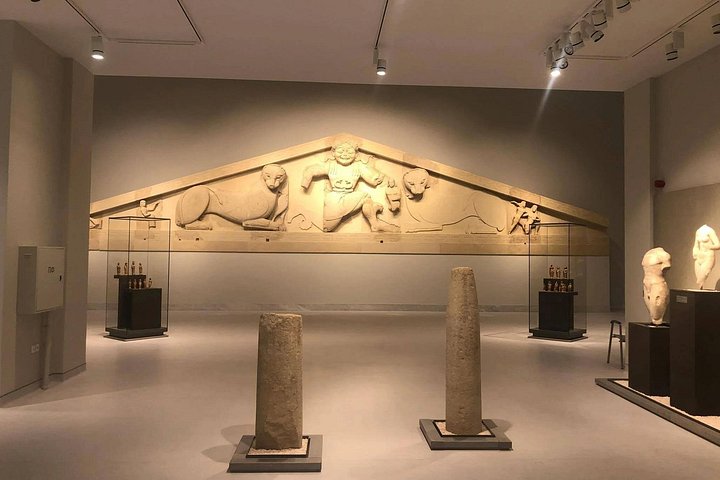
The Archaeological Museum of Corfu is the place to meet the ancient island, long before the Venetians. Its star piece is the Gorgon pediment from the Temple of Artemis, dating from about 580 BC, a large limestone sculpture of the Gorgon Medusa flanked by her children and by leopards, regarded as one of the most important Archaic works in Greece. Other displays cover the ancient city of Corcyra, which sat on the Palaiopolis peninsula near Mon Repos, with pottery, inscriptions, sculpture and grave goods that show the island as a trading power and a rival of Corinth. The collection also includes the Lion of Menecrates, a funerary monument of the Archaic period found near the city's cemetery. It is not a huge museum, so it suits a visit of one to two hours, and it is indoors, a useful option in November. The tour on offer is a private guided tour of the museum, which is the easiest way to understand why the Gorgon pediment matters and how the finds connect to the ruins you can see elsewhere on the island.
How it works
The museum is run by the Greek state, and opening hours and entry fees are set seasonally, with winter hours that are normally shorter than in summer. Check the day you plan to go, and note that state museums close on certain public holidays. The private tour on offer gives you a guide for the visit, which is useful if you want the story of ancient Corcyra rather than a list of objects. Independent visitors can also pay at the door.
What to expect
A calm museum with a handful of outstanding pieces and a clear story. The Gorgon pediment is displayed so that you can see its scale, the staring face of Medusa at the centre and the small figures around her, and a short time spent looking closely is worth more than rushing through the rest.
Pottery cases show how Corfu traded with the wider Greek world, and labels explain the cult of Artemis and the building that carried the pediment. The surroundings of the museum are quiet and green, and it is a short taxi ride or a longer walk from the old town.
Making the most of it
Pair the museum with the Mon Repos and Palaiopolis entry, since that peninsula is where ancient Corcyra stood and some of the museum's finds were made. It also works well with a quiet old-town day, perhaps after Casa Parlante and the Asian Art museum, if you want a cultural itinerary that does not depend on the weather.
Visitors who enjoy classical history will find it rewarding, while younger children may prefer the Gorgon's dramatic face and then move on. If you are short of time, give the pediment and the Lion of Menecrates your attention and skim the rest.
Visitors with a little time to spare may enjoy reading about the history of Corcyra before they go, including its role in the conflict with Corinth that helped trigger the Peloponnesian War. That background gives the finds a context that the labels alone cannot, and it connects the museum with the ruins on the Palaiopolis peninsula. Even if you are not a specialist, the scale and the confidence of the Gorgon sculpture make it a piece you will remember, and it is a good photograph if the rules allow it.
What to expect
The experience
A visit to the museum of ancient Corfu, centred on the Gorgon pediment from the Temple of Artemis, independently or on a private guided tour.
Best time
Any open day; weekday mornings are quietest and it is an easy wet-weather choice.
How long
One to two hours.
Tips
Winter hours are normally shorter than summer ones, so check on the day, and spend your time on the Gorgon pediment and the Lion of Menecrates.
Quick picks
- Best for
- History and classics lovers who want to meet ancient Corcyra.
- Families
- The Gorgon's face grabs older children; the museum is small enough for a short visit.
- Couples
- A quiet, rewarding hour or two on a rainy day.
- Pair with
- Mon Repos and Palaiopolis, the Museum of Asian Art and the old town.
- Time needed
- One to two hours.
Good questions
What is the highlight of the Archaeological Museum of Corfu?+
The Gorgon pediment from the Temple of Artemis, from about 580 BC, is the best-known piece and one of the great Archaic sculptures of Greece.
What else is on display?+
Finds from ancient Corcyra, including pottery, inscriptions and sculpture, and the Lion of Menecrates funerary monument.
Is it open in November?+
It is an indoor museum, but state museums use shorter winter hours and close on some holidays, so check on the day.
How long do I need?+
One to two hours is enough for the main pieces.
Is it worth a guided tour?+
A guide helps explain ancient Corcyra and why the pediment matters, which is useful if you are new to the period.