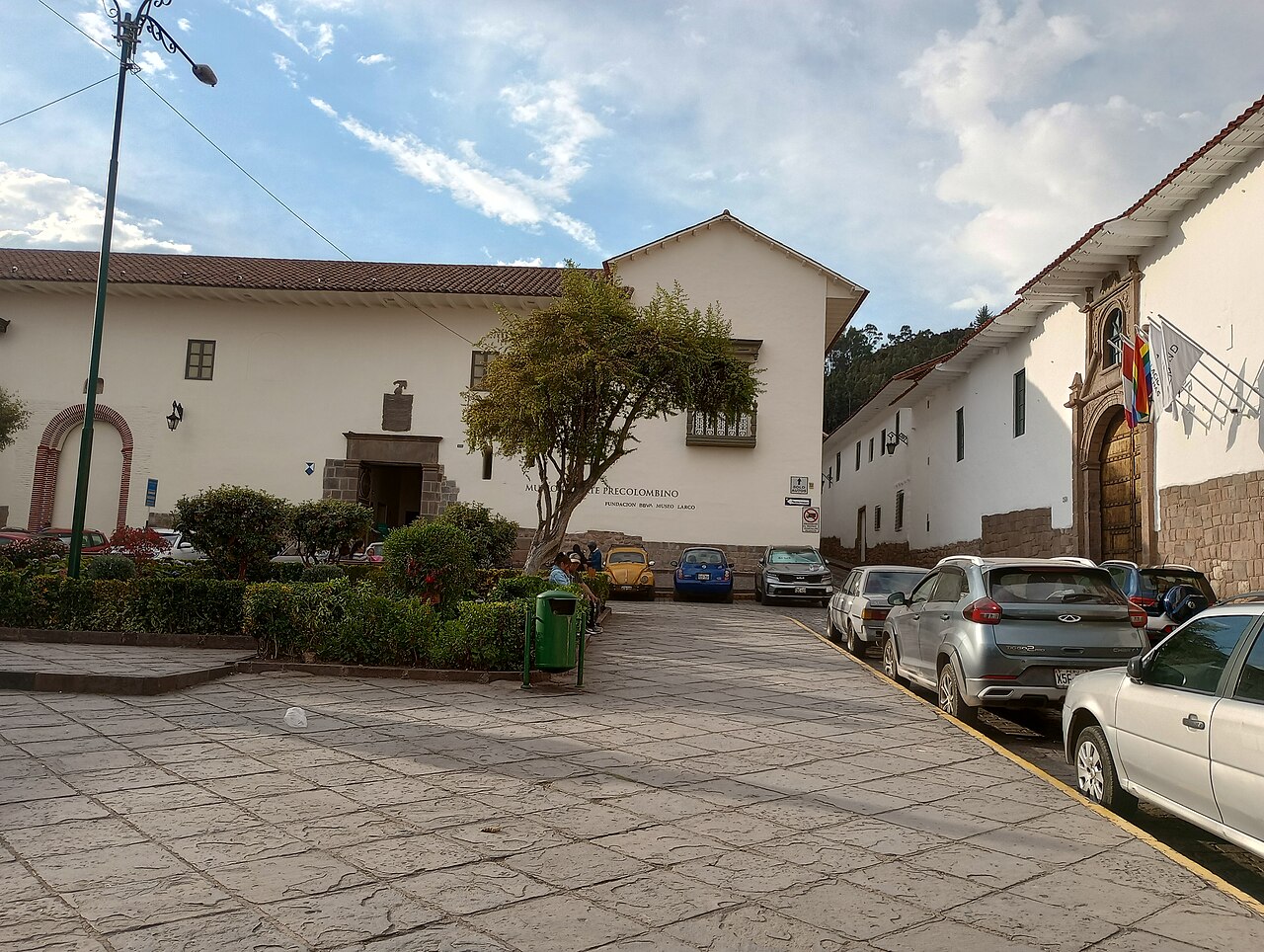
The Museo de Arte Precolombino, known as MAP, is the best museum in Cusco for understanding that the Inca were the last chapter of a very long story. Set in a colonial mansion on the quiet Plaza de las Nazarenas, a few minutes uphill from the Plaza de Armas, it presents a carefully chosen selection of objects drawn from the great collection of the Larco Museum in Lima, and it displays them as works of art: each piece is lit and spaced in elegant, dark galleries, with concise labels that explain the cultures and the meanings of the images. The galleries move through the major traditions of ancient Peru, organized by region and material, from the cultures of the north coast and the south to the Inca. Expect the portrait vessels and fine-line painted ceramics of the Moche, the vivid polychrome pottery of the Nazca, wooden sculpture and textiles, shell ornaments, and rooms of metalwork in gold and silver from cultures such as the Chimu and the Inca, including ear ornaments, crowns and ceremonial pieces of astonishing quality. The museum is small enough to see in about an hour and a half without fatigue, and it is a perfect counterweight to the stone ruins around Cusco, filling in the artistry, beliefs and craftsmanship that the walls cannot show. The courtyard also houses the MAP Cafe, a well-known contemporary restaurant set in a glass pavilion. The museum is run with the support of the BBVA Foundation and has its own admission ticket, not covered by the Boleto Turistico. Fit: history lovers, art lovers, families with curious children, and anyone who wants context before visiting Machu Picchu or the Sacred Valley.
How to visit: start at the beginning of the circuit and let the chronology build, rather than heading straight to the gold. The early rooms set the scene with the first ceramic traditions and the great north-coast cultures, whose realistic portrait vessels and scenes of rituals and daily life are some of the most expressive art of the ancient Americas. The Nazca rooms bring color and stylized mythical beings, while the metal rooms near the end show the extraordinary skill of Andean goldsmiths before the conquest melted most such work into bullion. The labels are bilingual and concise; an audio guide has been offered in recent years, and is worth asking about at the desk.
The setting: the mansion, known as the Casa Cabrera, faces the small Plaza de las Nazarenas alongside the former convent that now houses the Palacio Nazarenas hotel, one of the most beautiful corners of the old city. After the museum, walk downhill to San Blas or the Twelve-Angled Stone, both a few minutes away. If you plan to eat at MAP Cafe, book ahead for dinner, as it is a popular special-occasion restaurant.
Practical notes: the museum opens daily, generally from morning until the afternoon, at Plaza de las Nazarenas 231, with admission paid on site and reduced rates for students; residents of Cusco enter free. It is a good rainy-day or rest-day option, since it involves little walking and no stairs at altitude beyond the courtyard. Allow about ninety minutes.
What to expect
The experience
An elegant art museum of ancient Peruvian ceramics, textiles and metalwork drawn from the Larco collection, in a colonial mansion with a courtyard restaurant.
Best time
Any day, especially a rest day or a rainy afternoon; early in a trip it gives useful context for the ruins.
How long
About ninety minutes.
Tips
Follow the galleries in order and save the gold rooms for the end. Book MAP Cafe ahead if you want dinner there.
Quick picks
- Best for
- Context for everything else in Cusco, presented as world-class art.
- Families
- Compact, calm and full of animals, faces and gold that children enjoy.
- Couples
- The museum by day and dinner at MAP Cafe in the courtyard.
- Pair with
- San Blas and the Twelve-Angled Stone a few minutes downhill.
- Time needed
- About an hour and a half.
Good questions
Is MAP included in the Boleto Turistico?+
No. The museum has its own admission ticket, paid on site, with reduced prices for students and free entry for Cusco residents.
Where do the objects come from?+
They are selected from the collection of the Larco Museum in Lima, one of the great collections of ancient Peruvian art.
How long does a visit take?+
About ninety minutes for most people. The museum is small and well laid out.
Is there a restaurant?+
Yes, MAP Cafe occupies a glass pavilion in the courtyard and is a popular restaurant for dinner, so book ahead.
Where is it?+
On the Plaza de las Nazarenas, a few minutes uphill from the Plaza de Armas, near San Blas.