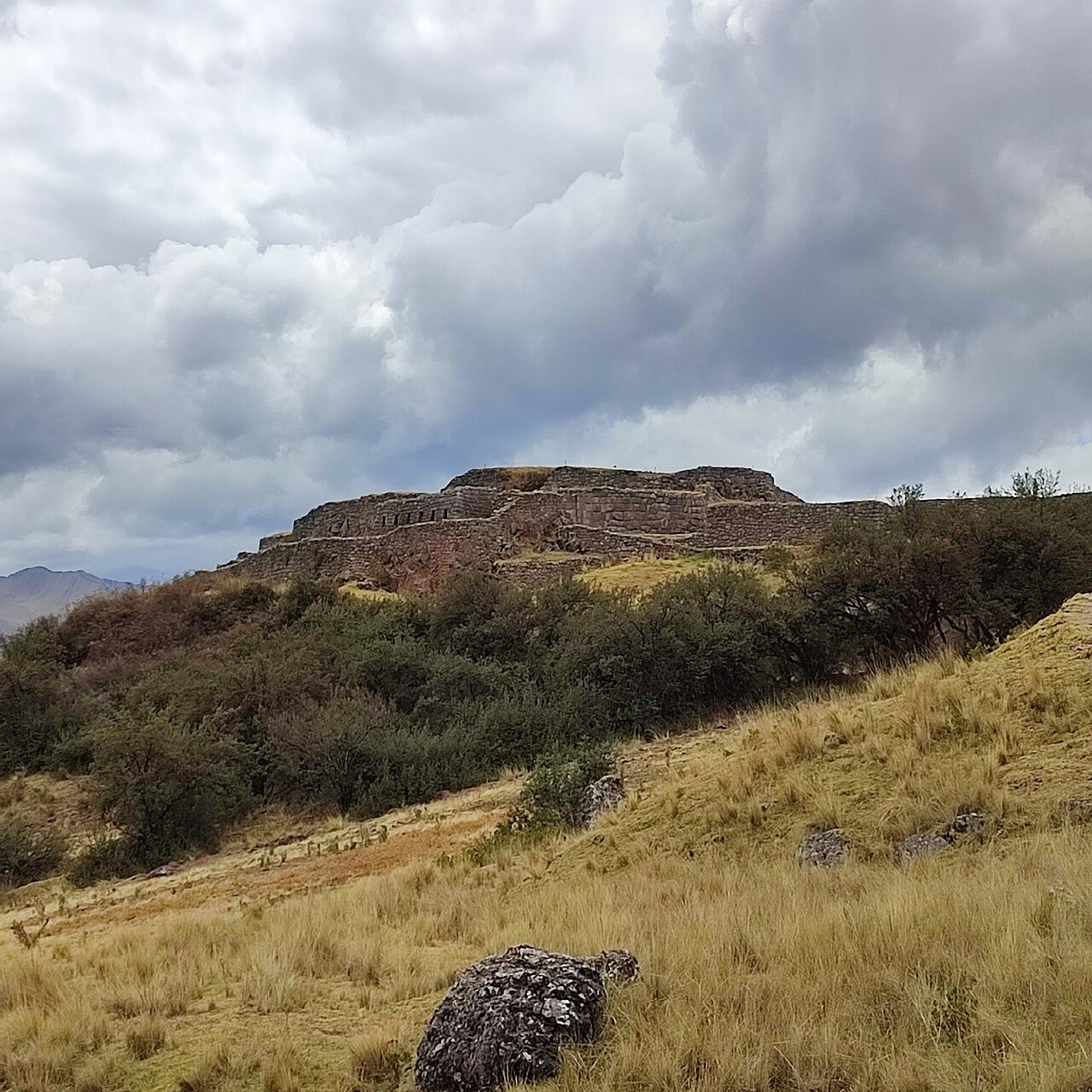
Above Cusco, along the road that climbs past Sacsayhuaman toward Pisac, lies a string of smaller Inca sites that together make one of the most enjoyable half days near the city. They are part of the same Boleto Turistico circuit as Sacsayhuaman, and they show sides of Inca culture that the great walls do not. Qenqo, the closest, is a huaca, or sacred place, carved into a huge limestone outcrop. Its surface is cut with steps, niches and a zigzag channel thought to have carried chicha or blood in rituals, and inside the rock is a cave with a carved altar-like table, believed to have been used for ceremonies connected with the dead; the name is usually translated as labyrinth or zigzag. Further up the road, Puka Pukara, whose name means red fortress for the color of its stone, is a compact complex of walls, rooms, plazas and terraces, probably a tambo or waystation and checkpoint on the road toward the Sacred Valley, with a fine view over the valley. Across the road, Tambomachay is a beautiful small site built around water: three tiers of finely fitted stone walls with niches, and channels that still feed a pair of fountains, often called the baths of the Inca. It is generally interpreted as a place of water worship and rest for the Inca nobility. Visited together, the sites take a few hours, and the classic way to do it is by taxi to the highest site, Tambomachay, then walking back down toward Cusco, visiting each site on the way and finishing at Sacsayhuaman or the Cristo Blanco viewpoint above the city. Fit: first-time visitors, history lovers, families and anyone acclimatizing who wants a gentle, mostly downhill walk.
How to do it: start at Tambomachay, at around 3,700 meters the highest point, and spend half an hour watching the water flow through the stone channels. Puka Pukara is just across the road. From there, walk or take a short taxi ride down to Qenqo, the most interesting of the three; go inside the cave, look for the carved puma figure and the channels on top of the rock, and ask a guide to explain the ritual interpretations. From Qenqo, it is a short walk to Sacsayhuaman, and then down through the San Cristobal or San Blas neighborhoods into the center. A local guide at the entrances can bring the sites to life, and a city tour often bundles them with Qorikancha and Sacsayhuaman in an afternoon.
Why it matters: these sites show the Inca relationship with sacred rock and sacred water, the infrastructure of roads and waystations that held the empire together, and the landscape around the capital that the Inca shaped into a ritual geography. They are also excellent acclimatization, as the walk back to Cusco is mostly downhill.
Practical notes: the sites are covered by the Boleto Turistico, either the full ticket or the partial circuit that includes Sacsayhuaman, and are generally open from morning until late afternoon. The national tourist ticket introduced by law in 2026 was still being regulated in late 2026, so confirm current terms. Bring sun protection and water, wear good shoes for the descent, and avoid walking the quieter stretches alone late in the day. Around the papal visit on 15 November 2026, when Pope Leo XIV is scheduled at Sacsayhuaman, expect closures and heavy traffic on the hill road.
What to expect
The experience
Three small Inca sites on the hill road above Cusco, visited on the Boleto Turistico, ideally by taxi to the top and a downhill walk back past Sacsayhuaman.
Best time
Morning or early afternoon, leaving time to walk back to Cusco in daylight.
How long
Two to four hours, depending on whether you walk back to the city.
Tips
Start at Tambomachay and work downhill. Go inside the cave at Qenqo, and finish at Sacsayhuaman or the Cristo Blanco viewpoint.
Quick picks
- Best for
- An easy, rewarding half day of Inca sites close to the city.
- Families
- Short visits, running water, a cave to explore and a mostly downhill walk.
- Couples
- A quiet walk back to Cusco with views over the city at the end.
- Pair with
- Sacsayhuaman on the same circuit, and San Blas on the way down.
- Time needed
- A morning or an afternoon.
Good questions
Are these sites on the Boleto Turistico?+
Yes. Qenqo, Puka Pukara and Tambomachay are covered by the full tourist ticket and the partial circuit that includes Sacsayhuaman.
What is Qenqo?+
A sacred rock shrine carved into a limestone outcrop, with a zigzag ritual channel on top and a cave with a carved altar inside.
Can I walk back to Cusco?+
Yes. From Tambomachay the route is mostly downhill past Puka Pukara, Qenqo and Sacsayhuaman into the city, a walk of a couple of hours with stops.
Why is Tambomachay called the baths of the Inca?+
Because of its finely built fountains fed by stone channels that still run today. It is generally interpreted as a place of water worship and rest.
Will the papal visit affect access?+
Pope Leo XIV is scheduled at Sacsayhuaman on 15 November 2026, so expect road closures and restricted access on the hill above Cusco around that date.