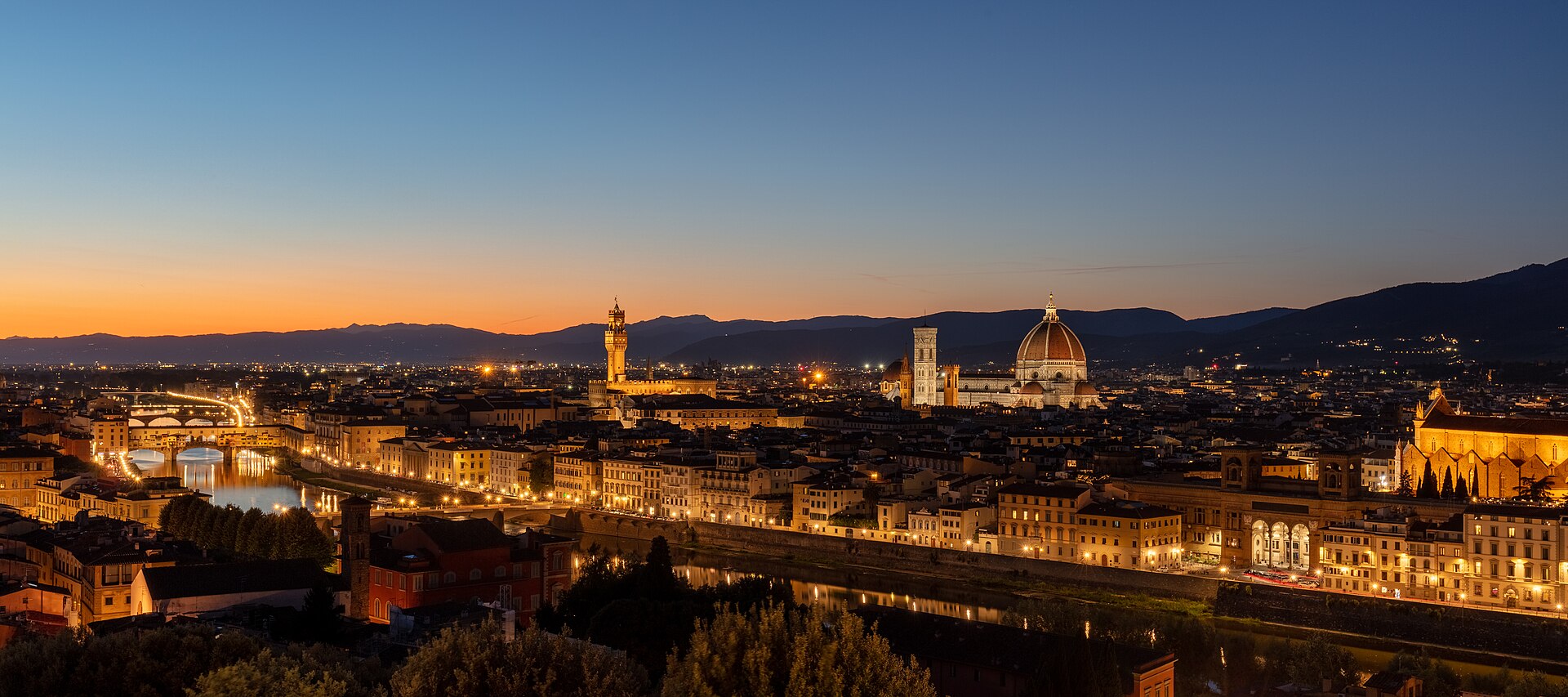
Fiesole is Florence's original and its easiest escape: the Etruscan hill town that predates the city below by centuries (Faesulae ruled these hills when Florence was a river camp; the medieval rivalry ended with Florence razing its mother-town in 1125 — the grudge built the view) — reached by city bus 7 from Piazza San Marco in 25 winding minutes: the cheapest great excursion in Italy, climbing through villa gardens and cypress avenues to a piazza 300 meters over the valley where the air changes, the crowds vanish and Tuscany begins. The town's circuit is a composed half day: the archaeological area — the 1st-century-BC Roman theater (3,000 seats of grey stone facing the Mugello hills, still staging the Estate Fiesolana's summer concerts and films: a performance here on a warm night is the area's most magical ticket), the baths' arches, the Etruscan-Roman temple terraces and the little museum's lombard-and-bucchero layers; the climb — via San Francesco's steep five minutes to the monastery crown: the Franciscan convent's tiny cloisters and missionary museum, the public terrace below it delivering THE view (all Florence arranged in the valley — Duomo, towers and Arno in one calm frame; sunset turns it devotional), and San Domenico's Fra Angelico altarpiece at the hill's lower church (the painter was a friar of this house before San Marco — the Madonna remains); the wandering — the cathedral's austere Romanesque (Mino da Fiesole's carvings), Bandini's little museum of della Robbias, the villa lanes (Fiesole's slopes hold the Medici villa — Renaissance landscape design's prototype, bookable visits — and the storied gardens of the Anglo-Florentine century), and the long lunch (the piazza's trattorie run honest; the view terraces price the panorama). The classic finish is the walk down: the old footpath via Vecchia Fiesolana descends through olive groves and villa walls to San Domenico (25 minutes of the most beautiful ordinary road in Tuscany — Leonardo tested flight theories from these slopes by the lore), catching the 7 home from there. Fit: couples (the terrace sunset and the walk), history travelers (Etruscan-to-Roman layers without museum fatigue), families (the theater's run-around stones and the bus-ride adventure), and every Florence stay of three-plus days — the half day that resets the city's intensity.
The town's past outranks its size
The Etruscan walls' cyclopean stretches still bound the north side (the 4th-century-BC masonry visible along via delle Mura Etrusche), the Roman municipium's theater-baths-temple ensemble survived the medieval centuries as quarry and garden until the 1800s excavations (the archaeological park's lombard tombs and the temple's Etruscan-Roman double foundations tell the layered-conquest story plainly), and the medieval chapter — cathedral, Badia Fiesolana's unfinished facade below, the bishop's seat that Florence could humble but not erase — set the town's permanent role: the contemplative balcony above the ambitious city. The Anglo-Florentine century added the villa lore (the Brownings', Bernard Berenson's circle, the gardens of the expatriate aesthetes — Villa Medici's terraces, bookable, are the Renaissance's first landscape-designed view), and the Estate Fiesolana (Italy's oldest summer festival, 1947) keeps the Roman theater working at its original job.
The half-day craft
Morning buses beat the heat on the climb (the 7 runs frequently from San Marco; validate and ride to the terminus), the archaeological park first (the theater's stones want the cool hours; the combined Fiesole ticket covers park, museum and Bandini), the San Francesco climb before lunch (the terrace's light is kindest before the haze builds — though sunset is the romance), the piazza lunch long, and the Vecchia Fiesolana descent as the digestif — pausing at San Domenico for the Fra Angelico (ring if closed; the sacristan tradition persists). Summer adds the theater's calendar (book the Estate Fiesolana nights ahead — opera, jazz and film under the stars in Roman stone), and the energetic extend the walking: Monte Ceceri's Leonardo-flight park trails and the quarry caves run an hour's loop above town.
Practicals and fit
Bus 7 from Piazza San Marco to Fiesole's Piazza Mino (25 minutes, standard city ticket), the combined archaeological ticket modest, terraces free, half day total (full day with villa bookings or trails). Fit: couples at the terrace sunset, history collectors (the Etruscan mother-town), families (theater stones and bus adventure), summer-festival travelers — and anyone whose Florence needs a balcony.
What to expect
The experience
The Etruscan mother-town 25 bus minutes above Florence — Roman theater and temple terraces, the Franciscan hill's definitive valley view, villa lanes, long lunch, and the olive-grove footpath home.
Best time
Mornings for the climb and clear light; sunset for the terrace romance; summer for the Estate Fiesolana's concerts in the Roman theater — book those nights ahead.
How long
A half day, full with villa bookings or Monte Ceceri trails.
Tips
Ride bus 7 from San Marco to the end — the cheapest great excursion in Italy. Walk down the via Vecchia Fiesolana through the olives and catch the bus at San Domenico, pausing for its Fra Angelico.
Quick picks
- Best for
- The half day that resets Florence's intensity — Tuscany beginning 25 minutes from the Duomo.
- Families
- The theater's 3,000 run-around stones, the bus-ride adventure and gelato on Piazza Mino.
- Couples
- The San Francesco terrace at sunset, then the footpath descent through villa walls.
- Pair with
- Nothing needed — though energetic days add Monte Ceceri's Leonardo-flight trails above town.
- Time needed
- One morning-to-afternoon escape.
Good questions
How do we get there?+
City bus 7 from Piazza San Marco climbs to Fiesole's main piazza in about 25 minutes on a standard ticket — the cheapest great excursion in Italy, villa gardens the whole way.
What is there to see?+
The Roman theater and archaeological park, the cathedral's Romanesque, the Franciscan monastery's crown — and the public terrace below it holding the definitive view of Florence in its valley.
Is the theater still used?+
Every summer — the Estate Fiesolana, Italy's oldest festival, stages opera, jazz and film in the 1st-century-BC stones; a warm night there is the hills' most magical ticket.
What is the walk down?+
The via Vecchia Fiesolana — 25 minutes of old footpath through olive groves and villa walls to San Domenico (pause for its Fra Angelico altarpiece), catching bus 7 home from there.
Why is it called the mother-town?+
Etruscan Faesulae ruled these hills centuries before Florence existed — the daughter city razed its parent in 1125, and the view from the grudge is now the region's gentlest half day.