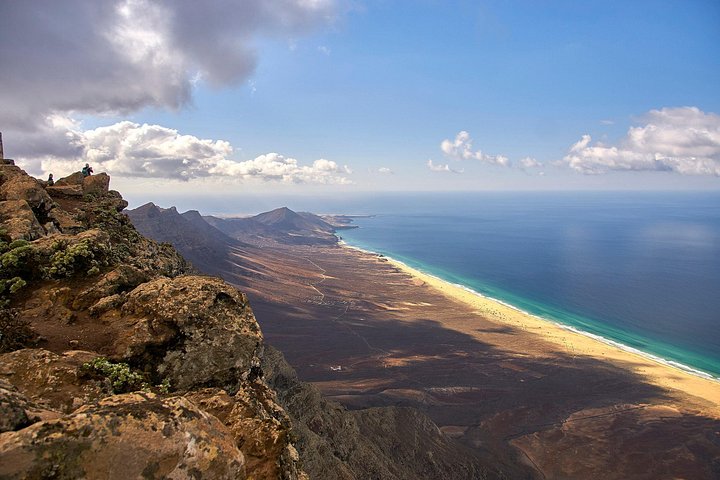
Calderón Hondo is the best-preserved volcanic crater on Fuerteventura, formed in an eruption about 135,000 years ago. It sits in the north of the island between Lajares and Corralejo, as part of a line of volcanic cones, and the summit viewpoint is about 278 metres above sea level. The crater is around seventy metres deep, with traces of yellow sulphur low down, and when the wind is calm you can walk round the rim. Most hikers start from the village of Lajares, about four kilometres away, and follow a cobbled path that climbs gently, then steepens just below the top. The recommended southern path is about two and a half kilometres uphill and takes roughly thirty-five minutes. From the viewpoint you see the crater, the lava fields, the Corralejo dunes, Lobos and, on a clear day, Lanzarote. It is one of the easiest volcano walks on the island, and is suitable for most families and casual walkers. It is free, there is no entrance gate, and no guide is needed, although the wind can make the rim unpleasant or unsafe.
The walk
The route is a clear, mostly cobbled path across a dry plain, with a steeper, stonier left-hand branch and an easier right-hand branch, which is the better choice. The climb is moderate and short, and the effort lies mostly in the final stretch. Wear closed shoes with grip, bring a hat and water, and take a windproof layer, because the wind is stronger at the top. There is no shade, so sun protection matters even in winter, and you should not set out in poor visibility or when the wind is strong.
The crater
Standing at the rim you look down into a huge bowl that shows the layers of the eruption and the colour of the rock. If the wind is calm, walking the rim gives a full circle of views. If it is not, stay back from the edge, since gusts can be strong and the slopes are loose. Do not climb into the crater or take stones, and keep to the paths, because the volcanic ground is fragile. Dogs and children need close supervision near the edge.
Making the most of it
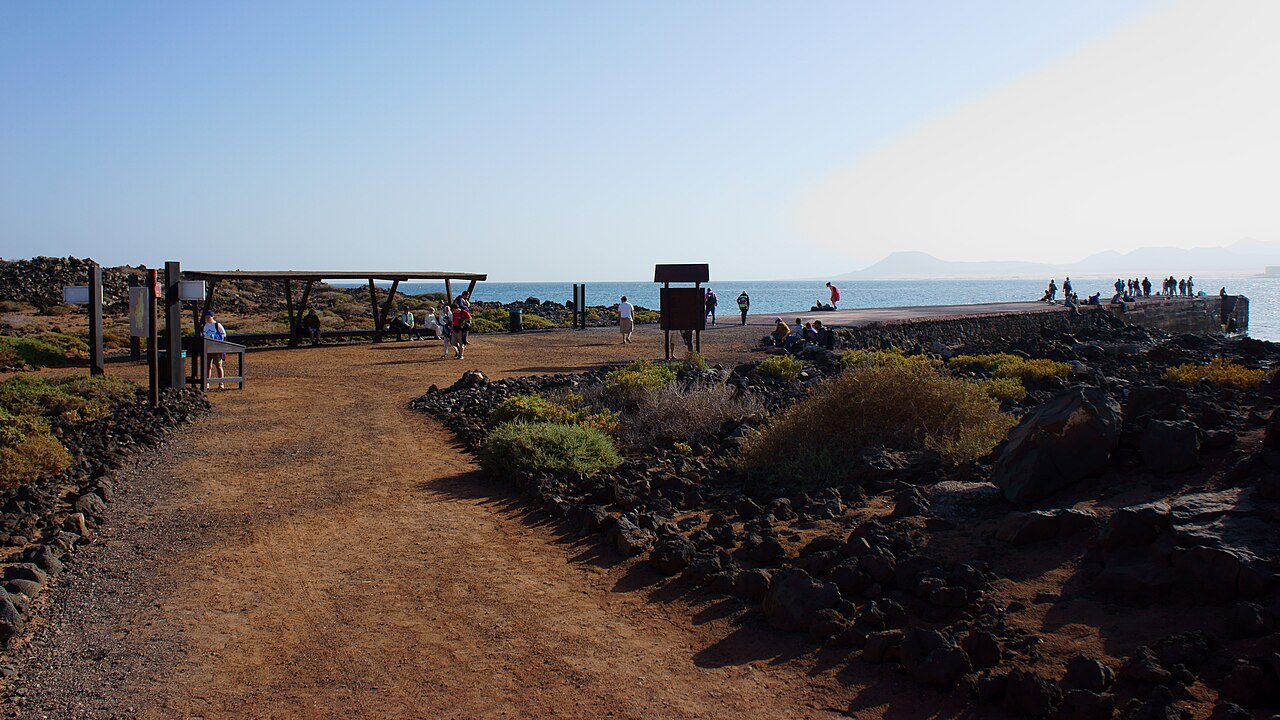
Late afternoon is the favourite time, because the light turns the lava fields gold and you can watch the sun go down over the plain, but allow time to descend before dark and bring a torch if you will be late. Pair the walk with a visit to nearby El Cotillo for dinner, or with the Corralejo dunes, to see the north’s contrasts of black rock and white sand.
If you prefer a guided experience, organised walks and moonlit hikes run from the north, but the hike is simple enough to do alone. Check the weather and the wind first.
What to expect
The experience
A self-guided hike on a cobbled path from Lajares to the viewpoint and rim of a deep volcanic crater.
Best time
Late afternoon, when the light is golden, as long as you can descend before dark.
How long
About thirty-five minutes uphill each way on the recommended path, plus time at the top.
Tips
Wear closed shoes with grip, take water, a hat and a windproof layer, and stay back from the rim in strong wind.
Quick picks
- Best for
- Casual walkers who want a volcano and a big view without a long hike.
- Families
- One of the easiest volcano walks on the island, but supervise children near the edge and avoid windy days.
- Couples
- A sunset climb with views over the dunes, Lobos and Lanzarote.
- Pair with
- Dinner in El Cotillo or a morning on the Corralejo dunes.
- Time needed
- Two hours including time at the top.
Good questions
How hard is the walk?+
It is one of the easiest on the island. The path is cobbled and the climb is moderate, with a steeper section just below the summit.
How long does it take?+
The recommended southern path is about two and a half kilometres uphill and takes roughly thirty-five minutes. Allow extra time for the rim and the descent.
Is there an entrance fee?+
No, the crater and the paths are free and there is no gate, although you should stay on the marked paths.
Can I walk around the rim?+
Yes if the wind is calm. In strong wind the rim is unpleasant and can be unsafe, so stay back from the edge.
What can I see from the top?+
The crater itself, the lava fields, Majanicho, the Corralejo dunes, Lobos and, on a clear day, Lanzarote.