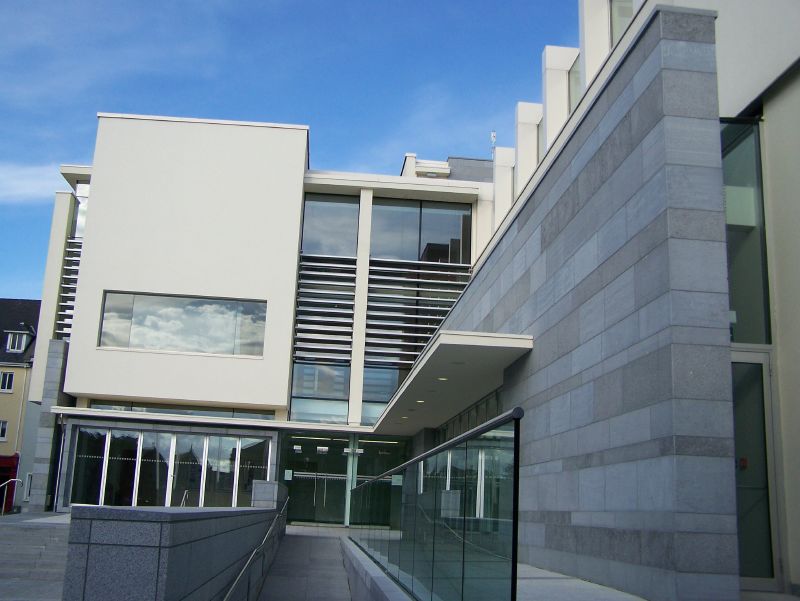
Galway City Museum stands on Spanish Parade, directly beside the Spanish Arch and the mouth of the River Corrib, and it is the best single place to understand why the city looks and sounds the way it does. Admission is free with no booking required, and the museum suggests a small donation of five euro if you would like to contribute. The collections follow Galway from its medieval walled-town beginnings and its trading Tribes through the shawls, boats and everyday objects of the nineteenth and twentieth centuries, and the museum has built teaching resources around single objects such as a Victorian post box, the shawls worn by Galway women and a short story by the Irish-language writer Pádraic Ó Conaire. It is a modern building with lifts, ramps and wide doors, so it works for wheelchair users and pushchairs, and there is a passenger drop-off area at the door. Opening is Tuesday to Saturday from ten to five, with the galleries closing at a quarter to five, and on Sundays from noon to five between Easter and mid-September.
Why go
The city's old walls are mostly gone, so the museum does the work that a ruined fortress would do elsewhere. It lets you read the street plan, the family names and the harbour trade before you walk out into the Latin Quarter, which is why it pairs so well with the Spanish Arch just outside and the walking tour in this guide. An hour is enough for a first pass, ninety minutes if you read the panels, and it is an easy fallback when Atlantic rain stops a coastal plan.
Winter practicalities
The museum is closed on Christmas Day, St Stephen's Day, St Patrick's Day and Good Friday, and it posts changes to its hours on its own website. Hours can change at short notice, so check before you set out. Accessible parking is in the Jurys Inn car park opposite and on Merchant's Road, and in the busy weeks of the Christmas Market you will be glad of a short walk rather than a car.
Making it work
Go early in the day when school groups are least likely, start with the oldest material and finish with the twentieth-century rooms, and then step outside to follow the river to the Claddagh. With children, ask at the desk for any trail sheets being used and keep the visit short; the museum is a place for looking rather than climbing. Because it is free, there is no pressure to see everything, and many visitors pop in twice, once at the start of a trip and once for a rainy afternoon.
If you are building a rainy-day itinerary, this is the anchor: pair it with a coffee on Quay Street, a browse through the shops of the Latin Quarter and a walk to the Claddagh when the showers clear.
What to expect
The experience
A self-guided walk through modern galleries on the history of Galway, with objects, boats, textiles and interpretive panels. Entry is free with a suggested donation.
Best time
Weekday mornings, or any wet afternoon. Galleries close at a quarter to five and the museum is closed on Mondays.
How long
About an hour, or ninety minutes if you read the panels.
Tips
Check the museum's website for one-off closures before you go, and pair the visit with a stroll through the Spanish Arch and along the river.
Quick picks
- Best for
- First-timers who want the background to the city before they explore it on foot.
- Families
- Short and free, so it suits children for an hour; it is fully accessible for buggies.
- Couples
- A calm hour before a long lunch in the Latin Quarter.
- Pair with
- The Spanish Arch and Latin Quarter, then the walking and tasting tour.
- Time needed
- One hour, plus a coffee stop.
Good questions
Is Galway City Museum free?+
Yes. Admission is free and no booking is needed, though the museum suggests a donation of five euro.
What are the opening hours?+
Tuesday to Saturday from 10am to 5pm, with galleries closing at 4:45pm, and Sundays from noon to 5pm between Easter and mid-September. It closes on Christmas Day, St Stephen's Day, St Patrick's Day and Good Friday.
Where is it?+
On Spanish Parade, right beside the Spanish Arch and the River Corrib, a short walk from Shop Street and the Latin Quarter.
Is it accessible?+
Yes. It has lifts, ramps, wide doors, accessible toilets and a drop-off area, and pushchairs are allowed.
Is it open this weekend?+
Closures are announced on the museum's website. Hours can change at short notice, so check before you travel.