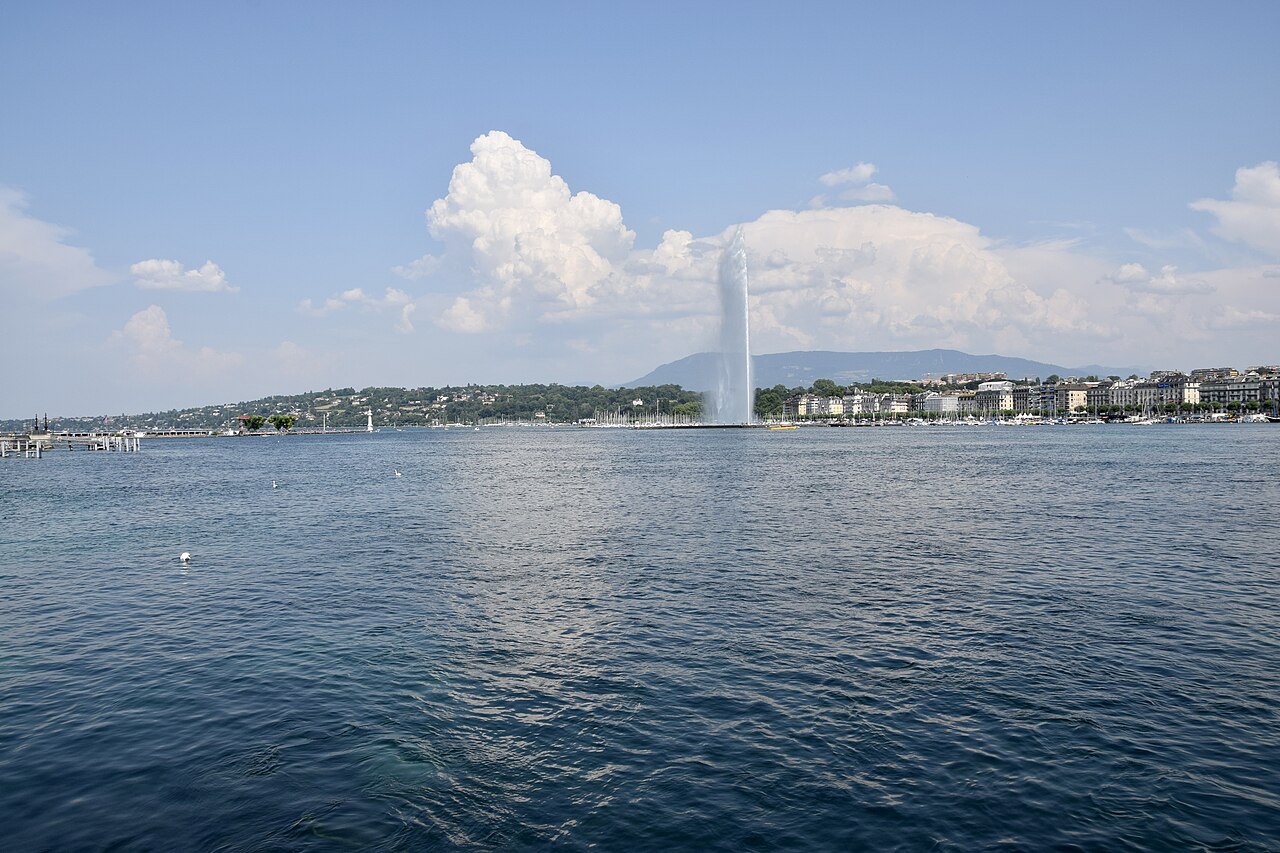
Every city has its symbol, and Geneva’s is made of water. The Jet d’Eau rises from the end of the Jetée des Eaux-Vives on the left bank of the harbour, shooting about half a cubic metre of water per second to a height of around 140 metres. The water leaves the nozzle at roughly 200 kilometres an hour, driven by two pumps that together weigh more than 16 tonnes, and on a sunny day the falling spray hangs a rainbow over the harbour. Its origins are surprisingly practical. In 1886 a jet was installed at a hydraulic pumping station on the Rhône to release excess pressure in the evening, when workshops stopped using water power; people liked it so much that in 1891 the City moved a jet to the harbour and lit it with electricity, and since 1930 it has been illuminated regularly. Today the fountain is free to see from anywhere on the shore, from the boats and from the Old Town above. You can also walk out along the stone jetty almost to its foot, where the wind decides how wet you get. The surrounding lakefront, with the English Garden and its Flower Clock and the long quays on both banks, is the city’s favourite promenade.
When it runs: the Jet d’Eau is subject to the weather and is stopped when the wind is strong or when it freezes, partly to protect passers-by on the bridges and quays. It also has an annual maintenance stop each autumn, typically for a few weeks around late October and November; in 2023 that ran from 30 October to 15 November. No dates for 2026 had been announced when we checked, so look at the City of Geneva or SIG websites before you make a special trip in late autumn. When it is running, the fountain is lit at night.
Making the most of it: for the classic photograph, stand on the right bank by the Pâquis or on the Mont-Blanc bridge with the Old Town behind the plume. For the experience, walk out along the jetty from the Quai Gustave-Ador and stand upwind; if the wind shifts, expect a soaking. Late afternoon light is lovely, and on clear days the Alps and Mont Blanc appear behind the jet.
Around the fountain: the English Garden, on the left bank near the Mont-Blanc bridge, holds the famous Flower Clock, a working clock made of plants that changes with the seasons. On the right bank, the Bains des Pâquis bathing pier has a café that stays open all year and a fine view of the jet. The Geneva Boat Tour passes close to the fountain.
What to expect
The experience
A free outdoor landmark you can see from the shore, the bridges and the boats, or approach on foot along the stone jetty.
Best time
A clear, calm afternoon for the rainbow and the Alps behind it, or after dark when it is lit.
How long
Half an hour for the jetty and photographs, longer with a lakeside walk.
Tips
Check that it is running before a special trip, especially in late autumn or on windy days, and stand upwind on the jetty unless you want a shower.
Quick picks
- Best for
- Everyone; it is the first thing to see in Geneva and it costs nothing.
- Families
- Children love walking out to the spray, but hold hands on the jetty when it is wet and windy.
- Couples
- Watch it lit up at dusk from the Bains des Pâquis pier with a drink in hand.
- Pair with
- The Geneva Boat Tour, the Flower Clock in the English Garden and a climb up to the Old Town.
- Time needed
- Half an hour to an hour.
Good questions
How high is the Jet d’Eau?+
The Jet d’Eau reaches about 140 metres. The water leaves the nozzle at around 200 kilometres an hour.
Is the Jet d’Eau running in November?+
It usually stops for a few weeks of annual maintenance in late autumn, and it is also switched off in strong wind or freezing weather. Check the City of Geneva or SIG websites before you go.
Can you walk to the Jet d’Eau?+
Yes, you can walk out along the stone jetty from the Quai Gustave-Ador on the left bank. Expect to get wet if the wind blows the spray your way.
Is the Jet d’Eau lit at night?+
Yes, the fountain has been illuminated regularly since 1930. It looks especially good from the right bank at dusk.
Why was the Jet d’Eau built?+
It began in 1886 as a safety valve to release excess pressure in the city’s hydraulic water network. It proved so popular that the City moved it to the harbour in 1891.