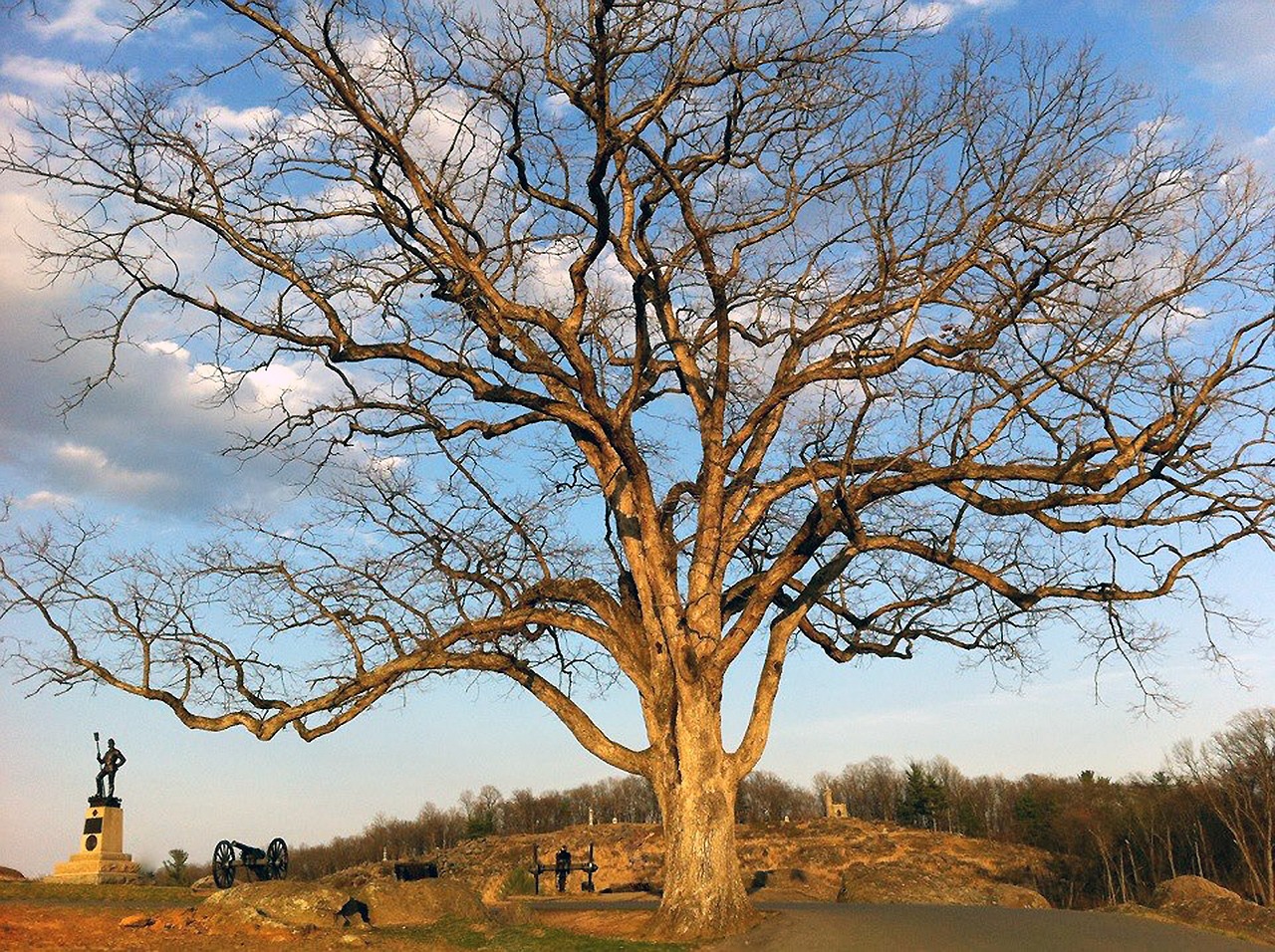
Gettysburg's ghost economy stands on ground that earns the solemnity: three days in July 1863 produced 51,000 casualties, the town's every church, barn, and parlor became a field hospital, and the dead were buried where they fell by the thousands before the national cemetery gathered them. The evening lantern tours that leave from the town's historic center nightly are the country's most history-saturated ghost walks — Farnsworth House (its garret sniper post and bullet-pocked brick walls the standard first stop), the Jennie Wade House where the town's one civilian death happened mid-bread-dough, Sachs Covered Bridge out in the fields where both armies crossed, and the battlefield's named horrors: Devil's Den's sharpshooter warren, the Wheatfield, Little Round Top at dusk. Operators range from costumed-storyteller walks to equipment-in-hand paranormal investigations inside the Farnsworth and other buildings; the best guides are battlefield historians first, and the material needs no embroidery. The battlefield itself closes at 10pm — dusk on the field, lantern tour in town after, is the right order.
What separates Gettysburg from every other haunted destination is that the darkness is documented: the Army of Northern Virginia and the Army of the Potomac left more casualties here in three days than any battle before or since on the continent, amputation piles stood at hospital windows, and the July heat forced burials so hasty that farmers turned up remains for decades. The ghost stories grew directly from that soil — the Farnsworth House's garret (Confederate sharpshooters worked its attic; the house claims the shot that killed Jennie Wade passed from this line), the Hoffman Mansion, the orphanage on Baltimore Street whose postwar cruelty story turned its basement into the tour circuit's grimmest stop, and the field itself: Devil's Den's boulders where Alexander Gardner photographed the dead (and infamously moved one for composition), Triangular Field where cameras allegedly fail, Sachs Bridge at moonrise.
Format and strategy
Town walking tours run 60-90 minutes by lantern or candle, nightly, March through November with October the crush — they stay on sidewalks, suit all ages, and live or die on the guide, so book operators whose guides are named and whose material leans historical. Paranormal investigations (Farnsworth House's basement and attic sessions the flagship) run two-plus hours with equipment and suit the committed. The battlefield after dark is its own discipline: the park closes at 10pm, rangers enforce it, and the move is legal dusk — Little Round Top or Devil's Den in the last hour of light, when the monuments go long-shadowed and the field empties — then the town tour after full dark.
Licensed battlefield guides (hired at the visitor center, by car) cover the daytime history that makes the night material land.
The visit architecture
Do the history first — the Gettysburg Museum and Cyclorama, a licensed-guide battlefield circuit or the self-driven auto tour, the national cemetery where Lincoln spoke — because the ghost tours assume the fluency and reward it. Town inns put the overnight inside the story (several claim hospital histories; the Farnsworth rents its haunted rooms), and the courthouse square's restaurant row handles the between.
October brings Halloween-scale crowds and sold-out weekend tours — book two weeks ahead — while late autumn and winter, with bare trees and long dusks, is the connoisseur window: thin crowds and the field at its most austere. Gettysburg is an easy drive from Washington, DC, Baltimore and Harrisburg, which makes it a natural overnight rather than a rushed day trip.
What to expect
The experience
Lantern-lit town walking tours nightly (60-90 minutes, all ages), equipment-in-hand investigations in the Farnsworth House and other buildings, and the battlefield itself at legal dusk — the park closes at 10pm.
Best time
Dusk on the field, town tour after dark. October is the crush; late autumn and winter are the austere, uncrowded ideal.
How long
An evening for the tour; a full day with battlefield history first makes the night material land.
Tips
Do the museum and a battlefield circuit by day — the tours assume the history. Book named-guide operators. Devil's Den or Little Round Top in the last legal hour of light is the field at its best. The Farnsworth garret is the town's signature stop.
Quick picks
- Best for
- History-first travelers — the one haunted destination where the dark material is fully documented.
- Families
- Lantern walks run PG and sidewalk-bound; school-age kids who met Gettysburg in class get the best version of the lesson.
- Couples
- Dusk at Little Round Top, lanterns on Baltimore Street, an inn with a hospital history — gravity makes its own romance.
- Pair with
- The museum and Cyclorama, a licensed battlefield guide by day, and the Jennie Wade House on Baltimore Street.
- Time needed
- A day and an evening done properly.
Good questions
Can we tour the battlefield at night?+
The park closes at 10pm and rangers enforce it — the move is legal dusk on the field (Devil's Den, Little Round Top), then the town's lantern tours after dark. Night access beyond hours is trespassing.
Are the ghost stories based on real events?+
The events are beyond dispute — 51,000 casualties, the town as one vast hospital, hasty field burials. The hauntings are the folklore that grew from documented ground, and good guides keep the history load-bearing.
Which tour should we choose?+
A named-guide lantern walk covering the Farnsworth and Baltimore Street for the first night; the Farnsworth basement-and-attic investigation for the committed return.
Is it appropriate for kids?+
The walking tours yes — sidewalks, storytelling, no gore theatrics from the good operators. The investigation formats and the orphanage material run heavier; judge by your kid.
When is it least crowded?+
Late autumn through early spring pairs thin crowds with the field at its most austere, which is the connoisseur season. Some walking tours run reduced schedules in winter, so check ahead.