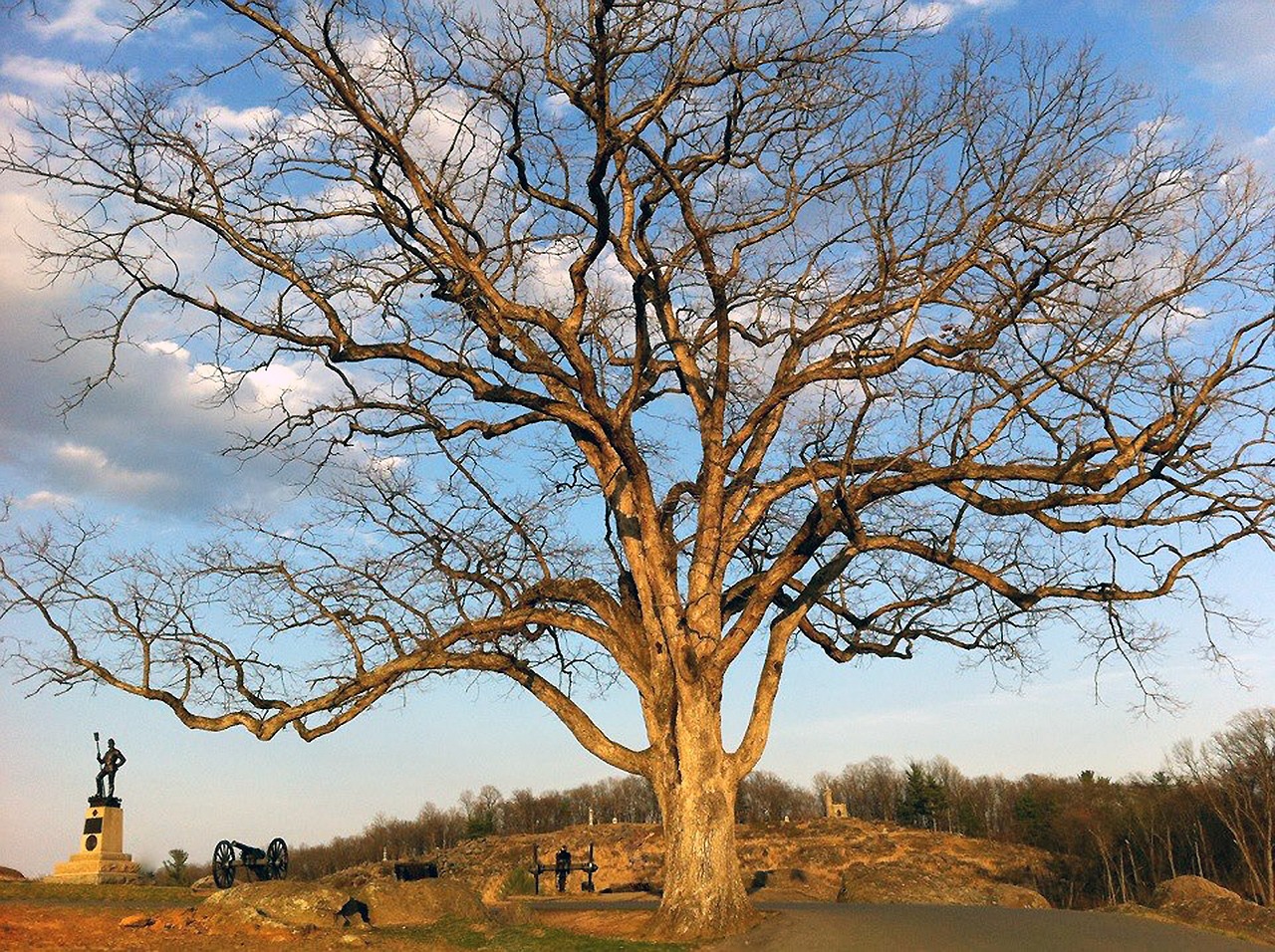
Few places in American military history are as closely tied to a single afternoon as Little Round Top. On July 2, 1863, the second day of the Battle of Gettysburg, Confederate troops attacked the southern end of the Union line, and this wooded, boulder-strewn hill became the anchor of the Union left flank. Union reinforcements reached the summit just before the Confederates did, and the 20th Maine, commanded by Colonel Joshua Lawrence Chamberlain, held the extreme left of the line against repeated assaults, finally counterattacking with a bayonet charge when its ammunition ran low. Brigade commander Strong Vincent was mortally wounded on the slope, and the hill's monuments, including the tall 44th New York memorial, mark the units and commanders who fought here. Today the summit is one of the most visited places in the park, a short drive or walk from the other battlefield highlights.
The reasons to go are both historical and scenic. The summit looks west across the Valley of Death and Plum Run toward the Wheatfield and the Peach Orchard, and north along Cemetery Ridge, so you can read much of the second day in one sweep. Signs, cannon and monuments at the top explain the action, and a short trail leads down the slope to the position of the 20th Maine, where a marker records the regiment's role.
The smaller hill next door, Big Round Top, is higher but less visited, and it can be a quiet place for a walk if the main summit is crowded. On clear evenings the western views are particularly beautiful, and many visitors time their visit for sunset.
Access is straightforward but demands planning. Parking on Sykes Avenue and near the summit is limited, so arrive early or in the evening, and be prepared to wait on summer weekends. Park rangers sometimes restrict vehicle access at busy times, so check the park's current guidance. Wear sturdy shoes, since the trails are rocky, and bring water because there is little shade near the monuments.
Children should be supervised, as the boulders are uneven and the drops are real. A guided bus tour or the audio driving tour will normally include Little Round Top as a main stop, but a return on foot is worth it for the views and the quiet.
Interpretation here rewards a little preparation. Read a short account of the second day before you arrive, or listen to your audio guide on the way, and you will find that the sight lines make sense: you can see why the Confederate approach from the west was so difficult, why the Union commanders feared losing the hill, and why the high ground was worth fighting for. Pair the visit with Devil's Den, a short walk or drive to the west, where the same attack struck the Union line among enormous boulders.
Visit both in one outing and you will have seen the core of the second day. Allow at least an hour, and if you have time, return at golden hour for the best light of the day. A short pause at the top, with the monuments around you and the valley below, is often the moment visitors say the battle finally made sense.
What to expect
The experience
A self-guided visit to the rocky summit, monuments and slopes, with a short trail to the 20th Maine position.
Best time
Early morning, or late afternoon for golden light and thinner crowds.
How long
Forty-five minutes to an hour and a half.
Tips
Arrive early for parking, wear sturdy shoes and bring water. Combine with Devil's Den.
Quick picks
- Best for
- Anyone who wants the iconic view and story in one stop.
- Families
- Fun for children who like to climb, but supervise them near the boulders.
- Couples
- A scenic sunset stop with real history.
- Pair with
- Devil's Den and a guided or audio tour.
- Time needed
- About an hour.
Good questions
Why is Little Round Top famous?+
The 20th Maine, led by Joshua Chamberlain, held the Union left here on July 2, 1863, a key moment in the battle.
Is it free?+
Yes, the summit and monuments are part of the national military park and free to visit.
Is parking difficult?+
Yes on summer weekends. Go early or late in the day.
Is it a hard walk?+
The summit can be reached by a short walk, and trails down the slope are rocky. Wear sturdy shoes.
Can I see Devil's Den from here?+
You can see the area below to the west, and it is a short walk or drive to the boulders themselves.