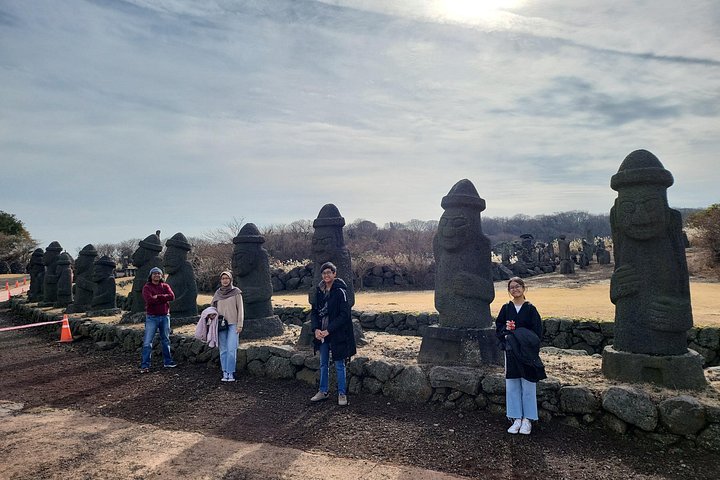
Jeju Stone Park is where the island's stone heritage is gathered in one place. The park is built around the creation myth of Seolmundae Halmang, a giantess said to have shaped Jeju and its hundreds of volcanic cones, and her five hundred sons, who are said to be commemorated by the rocky peaks of the island. Paths named for legends and a forest trail lead to a stone museum, and the grounds hold a great many objects, including rows of dol hareubang, the round-faced basalt statues that have become Jeju's mascot, stone pagodas, gateposts and gravestones. Other areas show prehistoric to modern stone tools in traditional thatched huts, and a recreated thatched village with horse mills demonstrates how island families lived with the black rock. A newer exhibition hall devoted to the Seolmundae story adds a modern indoor stop, plus a cafe, shop and a children's hall for little ones.
Why it is different
Most of Jeju's famous sights are dramatic landscapes, whereas this is about people and their relationship to stone. Walls, tombs, field boundaries, mills and statues all appear here with explanations, so by the end you understand why the island's fields are ringed with black walls and why the stone grandfather statues guard so many doorways. The scale is generous, with long walks between zones, and the setting among woodland makes it calm even on a busy day.
Tours and timings
Guided tours of about an hour to ninety minutes run in the morning and early afternoon with a break at lunchtime, and booking ahead through the park is recommended, especially for groups. The park closes on Mondays, or the next weekday if Monday is a public holiday, and on New Year's Day, Lunar New Year and Chuseok, so check the calendar before you drive out.
The exhibition hall keeps its own hours, opening Tuesday to Sunday and closing on Mondays. The children's hall is for toddlers up to the age of nine, needs socks, and weekend visits require advance reservation.
Getting there and combining it
The park is in Jocheon on the island's north-east side, not far from the east-coast highway. It pairs well with Manjanggul Lava Tube, which sits on the same side of the island, and with the Haenyeo Museum for a day about island life rather than scenery. A car or private driver is by far the easiest way to reach it. Wear comfortable shoes, bring a light waterproof layer and plan on two to three hours if you want the guided tour and time to wander.
What to expect
The experience
A large outdoor park and museum with guided tours, forest walks, statue gardens, a thatched village and an indoor exhibition hall.
Best time
Weekday mornings for a guided tour, in dry weather for the outdoor zones.
How long
Two to three hours, longer if you add the exhibition hall and a meal.
Tips
Book a guided tour ahead, avoid Mondays, bring socks if you plan to use the children's hall and wear comfortable walking shoes.
Quick picks
- Best for
- Travellers who want to understand Jeju's myths and stone culture, not only its scenery.
- Families
- A good fit, with open space, statues children enjoy and a dedicated hall for the very young.
- Couples
- A calm, shaded wander that makes a change from the busy coastal sights.
- Pair with
- Manjanggul Lava Tube, Jeju Haenyeo Museum and Seongsan Ilchulbong.
- Time needed
- Half a day.
Good questions
What is Jeju Stone Park about?+
It tells the story of Jeju's stone culture and the myth of the giantess Seolmundae Halmang through outdoor exhibits, a museum, a thatched village and an exhibition hall.
Which day is it closed?+
The park closes on Mondays, or the following weekday when Monday is a public holiday, and also on New Year's Day, Lunar New Year and Chuseok.
Do I need to book a guided tour?+
Tours run on a set daytime schedule with a lunch break, and advance booking through the park is recommended. You can also walk the grounds on your own.
Is it good for young children?+
Yes, there is a hall for ages thirteen months to nine years, which requires socks and advance reservation on weekends and holidays.
How do I get there?+
A rental car, taxi or private driver is the easiest way, since the park is in Jocheon on the north-east side and public buses are infrequent.