Muleeaage is one of the handsome old buildings that give central Malé its character, and it is on the standard walking route of anyone who wants to understand the capital's past. Visit Maldives describes it as the residence of the President of the Maldives and a must-see on any Malé tour. It was built between 1914 and 1919 for Prince Hassan Izzuddeen by Sultan Mohamed Shamsuddeen III, on the site of former royal ancestral homes. It was never a sultan's palace, which is a common misconception, but a prince's house that later took on a far larger role in national life. The prince lived there from 1920 to 1934. After his arrest the building fell into disuse until the Second World War, then housed government offices and hosted visiting heads of state and dignitaries. It became the presidential palace in the early 1950s and was declared the presidential palace again in 1968. Its centenary was marked in 2019. The result is a building with a layered story: aristocratic home, administrative office, guest house for statesmen and residence of the head of state.
What you will actually see
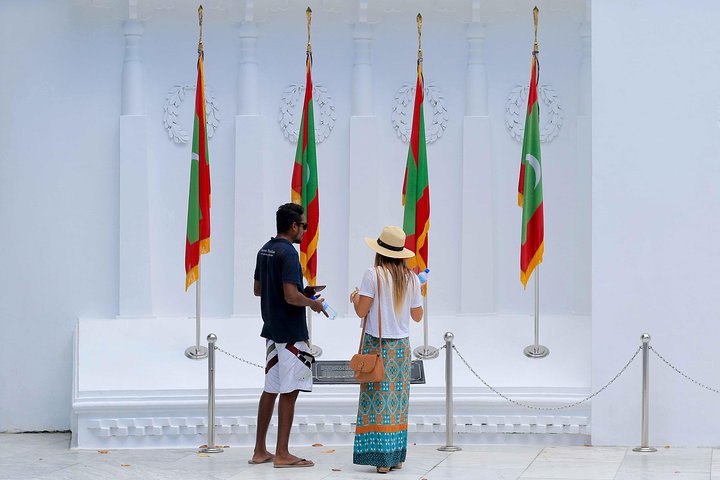
Muleeaage is a working residence, so it is a building to look at rather than to tour. Visit Maldives does not describe it as open to visitors, so plan on viewing it from the street, taking in the facade, the gates and the walls, and reading about its history before or after.
That is a sensible way to treat it. Keep your camera pointed at the architecture, follow any instructions you are given and do not linger at the gates. If you want a deeper look at the interior or the story behind it, a guide on the Malé walking tour can explain what is known.
Where it fits
Muleeaage sits in the compact grid of streets that holds most of Malé's sights. From it you can walk to Sultan Park and the National Museum in a few minutes, then to Hukuru Miskiy and the Islamic Centre, and to the harbour and Republic Square for the speedboat jetties.
Because the island is so small, the whole historic circuit is under an hour of walking, though the heat and the humidity make it feel longer. Streets are narrow and shared by scooters and delivery bikes, so keep to the side and watch for traffic as you stop to take photographs.
Making the most of it
Go early, when the light is soft, the streets are quieter and the air is cooler, or around sunset when the city begins to fill with residents. Dress modestly, with shoulders and knees covered, as you would anywhere in the city. A short stop here adds context to the rest of the walk, because it shows how the sultanate gave way to the republic in a single building.
Allow about fifteen minutes for the stop itself. If you are short of time, prioritise it after Hukuru Miskiy and before the museum, so the story runs from coral stone mosque to royal artefacts to the modern state, and finish the circuit with a drink or a snack in one of the small cafes nearby.
What to expect
The experience
A look at the exterior of an early 20th-century mansion that is now the residence of the head of state, as part of a Malé walk.
Best time
Early morning or around sunset, when the streets are quieter and cooler.
How long
Fifteen to twenty minutes as a stop on a longer walk.
Tips
View from the street, follow any instructions from staff, keep photographs to the architecture and dress modestly.
Quick picks
- Best for
- Visitors interested in the royal and republican history of Malé.
- Families
- A quick roadside stop; keep children close because the streets are narrow and busy.
- Couples
- A short, atmospheric stop on a morning walk.
- Pair with
- Sultan Park, the National Museum, Hukuru Miskiy and Republic Square.
- Time needed
- Under half an hour.
Good questions
When was Muleeaage built?+
It was built between 1914 and 1919 for Prince Hassan Izzuddeen by Sultan Mohamed Shamsuddeen III.
Was it a sultan's palace?+
No. Visit Maldives notes that it was never a sultan's palace but a prince's house on the site of former royal ancestral homes.
Can I go inside?+
It is a residence, and visitor access is not described by the tourism board. Plan to see it from the street and check locally.
Is there an entry fee?+
No ticketed attraction experience is offered. It is a landmark to view from outside.
What is nearby?+
Sultan Park, the National Museum, Hukuru Miskiy and the Islamic Centre are all within a short walk.