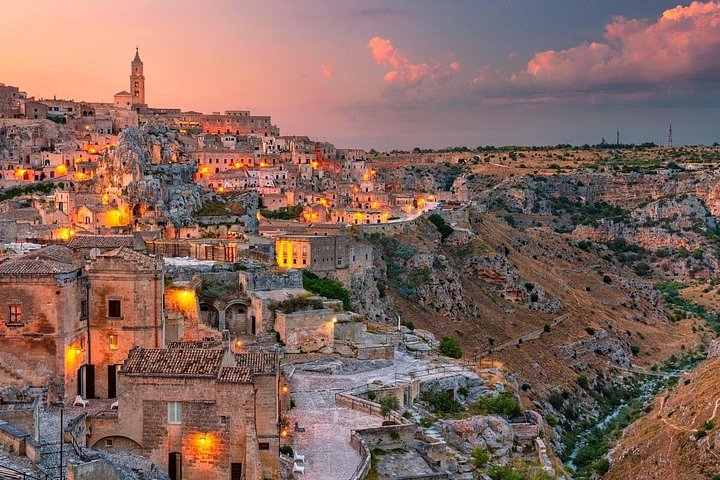
To understand Matera, you need a little history. The city looks like a stage set, but it is a real place with a long and sometimes painful story. Knowing the outline makes your walk through the Sassi richer and your visits to the churches more meaningful. This guide gives the essentials.
A ravine and a soft stone
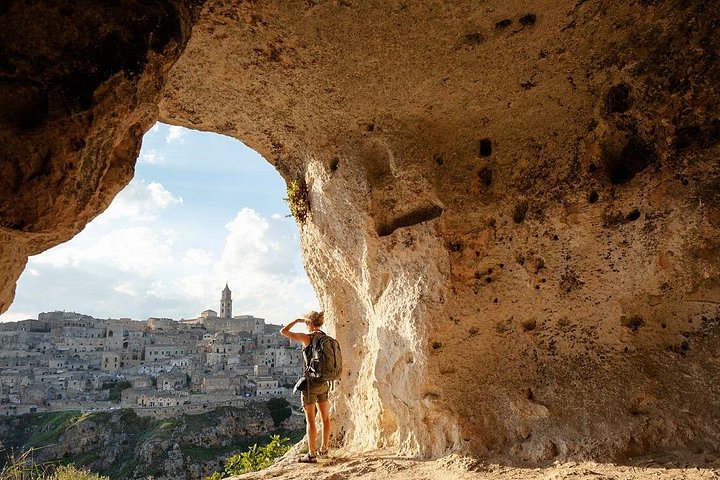
The old town sits beside a deep ravine, carved through a pale, soft limestone called calcarenite. The stone is easy to dig and hardens when exposed to air, which made it ideal for both caves and building blocks. People have lived in caves here for thousands of years, and the plateau opposite holds traces of prehistoric villages. Over time, residents dug deeper into the rock and built houses out of the stone they removed, creating the layered districts you see today.
The two Sassi
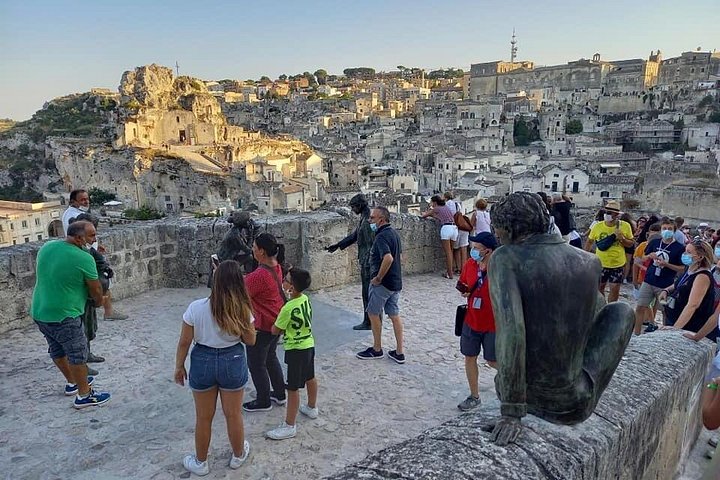
The word Sassi means stones. Sasso Barisano and Sasso Caveoso are the two districts, on either side of the Civita ridge. Houses are partly cave and partly built front, with stairs, terraces and courtyards connecting them. Rooftops of one level often form the street of another. This creates the maze that fascinates visitors and confuses navigation.
Water
In a dry landscape, water was life. Residents collected rainwater from roofs and streets, channelled it into cisterns and stored it underground. Some cisterns are enormous, and the largest in the old town lies beneath a main square. The system was ingenious, but it could not keep pace with overcrowding and sanitation problems in the twentieth century.
The monks and the churches
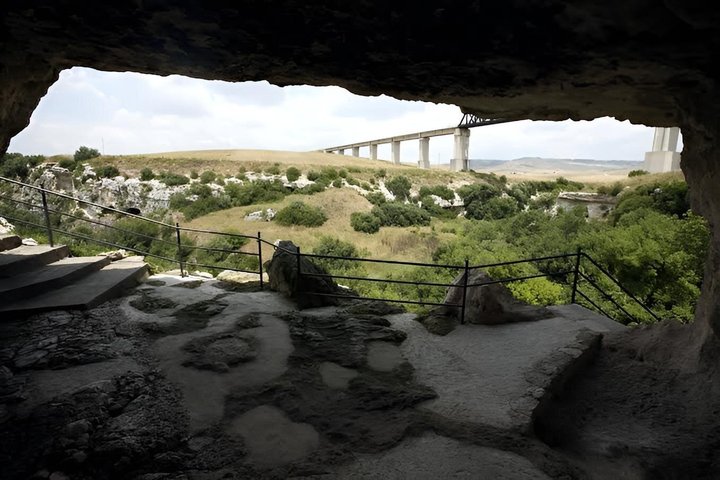
In the early Middle Ages, monks and hermits influenced by the Eastern Christian tradition settled in the ravine and across the plateau. They carved chapels, cells and monasteries into the cliffs and painted them with saints. Dozens of rock churches survive in the area, many of them fragmentary, some in surprising condition. In town, visit churches such as Santa Maria de Idris and San Giovanni in Monterrone, connected on a rock spur. In the countryside, trails lead to hidden chapels, and a painted cave known as the Crypt of the Original Sin holds a remarkable cycle of frescoes.
How to read a rock church
Look first at the shape of the space: apses carved from rock, altars left standing as part of the stone, and niches for lamps and saints. Then look at the plaster, where bands of colour, halos and Greek-style inscriptions may survive. Many images are faint, but a guide can point out details. Notice how chapels sit next to homes and cellars, showing how religion was part of daily life.
The Cathedral and the Civita
On the ridge between the two Sassi stands the cathedral, built in the Apulian Romanesque style in the thirteenth century. Its position makes it the visual anchor of the old town. The lanes around it are among the oldest in the city and are a good place to feel the medieval layer of history.
Poverty and exile
By the early twentieth century, many families lived in crowded cave homes with little sanitation, and animals often shared the same space. The writer Carlo Levi, exiled to southern Italy in the 1930s, described the region in his book Christ Stopped at Eboli, which brought national attention to the hardship. In the 1950s, the state moved thousands of residents to new housing outside the old town, and the Sassi emptied. For a time they were seen as a national shame.
Rebirth
From the 1980s, restoration began, and in 1993 the Sassi were listed as a UNESCO World Heritage site. Hotels, restaurants and workshops moved into the caves, and the city gained attention as a film location and a cultural destination. In 2019 it was European Capital of Culture. The transformation is remarkable, though it also raises questions about tourism and local life. A good guide will address both.
On the screen
Directors have used Matera to represent ancient Jerusalem and other biblical settings, and it has appeared in modern films, including a James Bond adventure. A film locations tour can add a lighter layer to your visit.
How to visit respectfully
Many churches are active places of worship or fragile monuments. Dress modestly, keep your voice low, follow photography rules and avoid touching walls. Residents still live in the old town, so be considerate with noise at night.
Where to start
A guided Sassi walk gives the overview, a cave house visit shows daily life, and a churches tour brings the frescoes to life. If you want to go further, visit the park across the ravine, where the monks lived and worked. Together, these experiences tell a story that is much bigger than a pretty view.