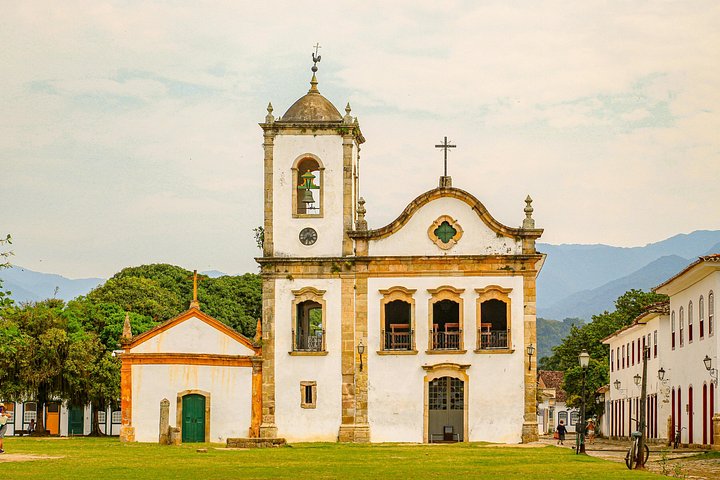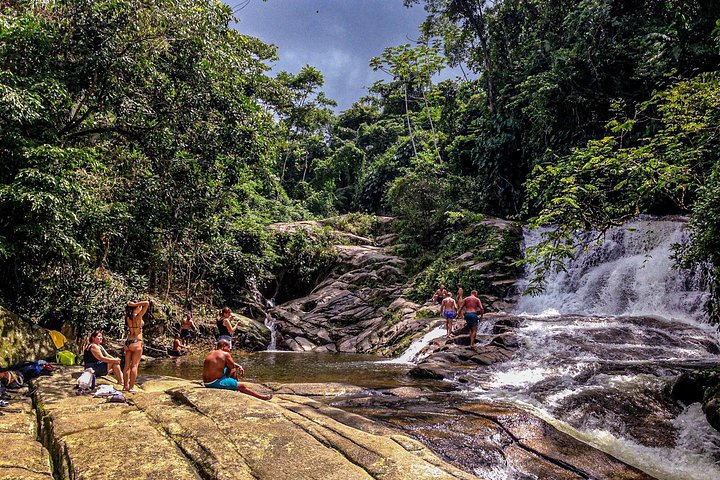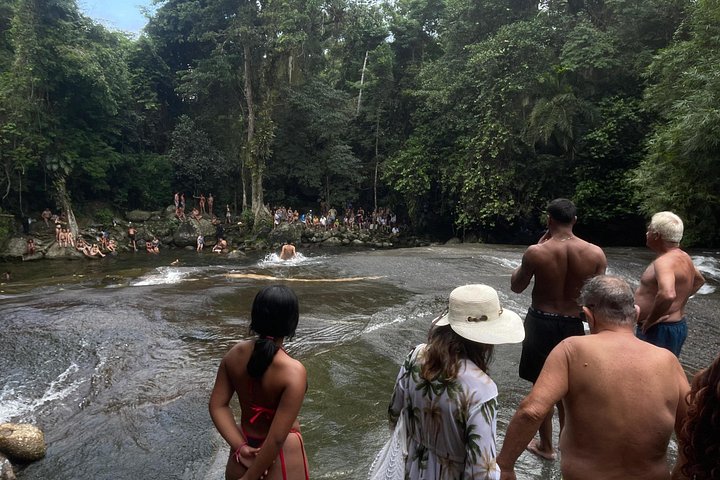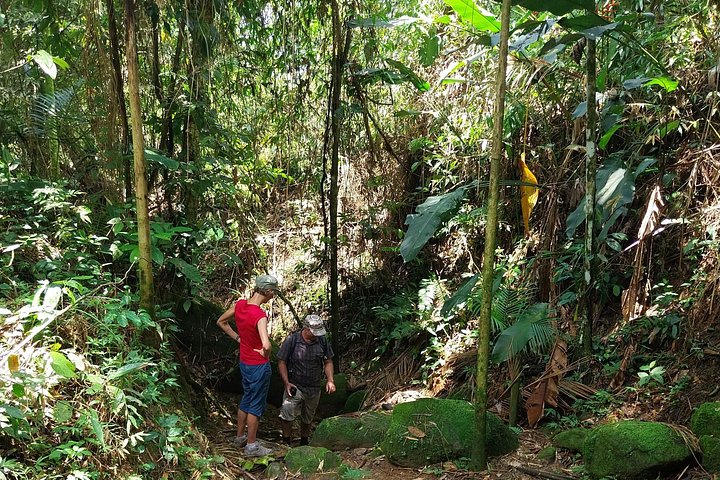
The reason Paraty exists is the Caminho do Ouro, the Gold Trail. In the early eighteenth century, when gold was found in the mountains of Minas Gerais, the Portuguese needed a way to bring it to the coast and ship it out. The route that emerged ran from the mining towns across the Serra do Mar down to Paraty, and by the 1720s it carried a steady stream of gold, mules and people. Paving it was a huge task, done largely by enslaved labour, and some sections still carry the original stones, rough, wide and still sturdy after three hundred years. This Gold Trail Atlantic Forest Walk takes you onto one of the preserved stretches. A guide leads you along the stone road through shady forest of ferns, bromeliads and tall trees, explaining how the trail worked, who used it and what it carried. The route usually includes a visit to a viewpoint or a small waterfall, and the setting makes it easy to imagine the line of mules coming down to the port. Ecologically the walk is also a lesson in the Atlantic forest, one of the most biodiverse and threatened habitats in the world, of which only a fraction remains. This is a walk of moderate effort, mostly on stone paths, with some uphill and downhill sections. The exact route, the length and any extras depend on the operator and the day, so check the product for details. The Gold Trail fits naturally with a historic center walk: one shows where the gold came from and how it travelled, the other shows the port town it built.
What the day is like
You are driven to a trailhead outside town, then walk for a couple of hours on the old stones, with stops to learn about the history and to look for wildlife. Birdsong, the smell of damp earth and the filtered light create a calm atmosphere. In places the stones are mossy, and in others they have been worn smooth. The return to town is by vehicle. The weather in the hills can change quickly, with showers common, so bring a light rain layer.
How to do it well
Wear sturdy shoes with good grip, because the old stones are uneven and slippery when wet. Bring water, insect repellent, sun protection and a snack. Walk at the guide's pace and keep your eyes on your feet; stop to look around rather than walking and gazing at the same time. If you want photographs, early morning gives the best light under the canopy. Ask the guide about the layers of history, from Indigenous paths that preceded the road to the gold period.
Who it suits
History lovers, walkers, nature enthusiasts and families with children who can manage a couple of hours on foot. It is less suitable for anyone with significant mobility problems. Combine the walk with a quiet afternoon on the bay, or follow it with a cachaca tasting, and you will have seen both the origins and the legacy of Paraty's wealth.
Good to know before you go
The Gold Trail is also a story about the people who built it. The paving was heavy work done mostly by enslaved labourers, and many travellers who came this way carried supplies on mules that returned loaded with goods from Europe. Ask your guide how the toll posts and resting places worked, and listen for the stories of the families who farmed beside the road. Stay on the marked path, do not collect plants or stones and carry water, because there are no shops along the route.
What to expect
The experience
A guided walk on a preserved stretch of the colonial Gold Trail, paved with the original stones, through Atlantic forest.
Best time
Morning for cool temperatures and good light; dry days are easier on the slippery stones.
How long
Around four hours, including transfers.
Tips
Wear grippy shoes, bring water, repellent and a light rain layer, and walk at the guide's pace.
Quick picks
- Best for
- History and nature in one outing, on the road that made Paraty rich.
- Families
- Suitable for children who enjoy walking; the stones are uneven.
- Couples
- A quiet, atmospheric walk away from the crowds.
- Pair with
- A historic center stroll to see the port the trail served.
- Time needed
- Half a day.
Good questions
What is the Gold Trail?+
The Caminho do Ouro was the colonial road that carried gold from Minas Gerais to the port of Paraty in the eighteenth century.
How hard is the walk?+
Moderate. The path is mostly stone with some uphill and downhill, and it can be slippery when wet.
Are the stones original?+
Sections of the road retain stones laid in the eighteenth century, mostly by enslaved labour. Guides can show which parts are original.
What should I bring?+
Sturdy shoes, water, insect repellent, sun protection, a snack and a light rain layer.
Is it suitable for children?+
Yes, for children who can walk a couple of hours on uneven ground, though young children may tire.