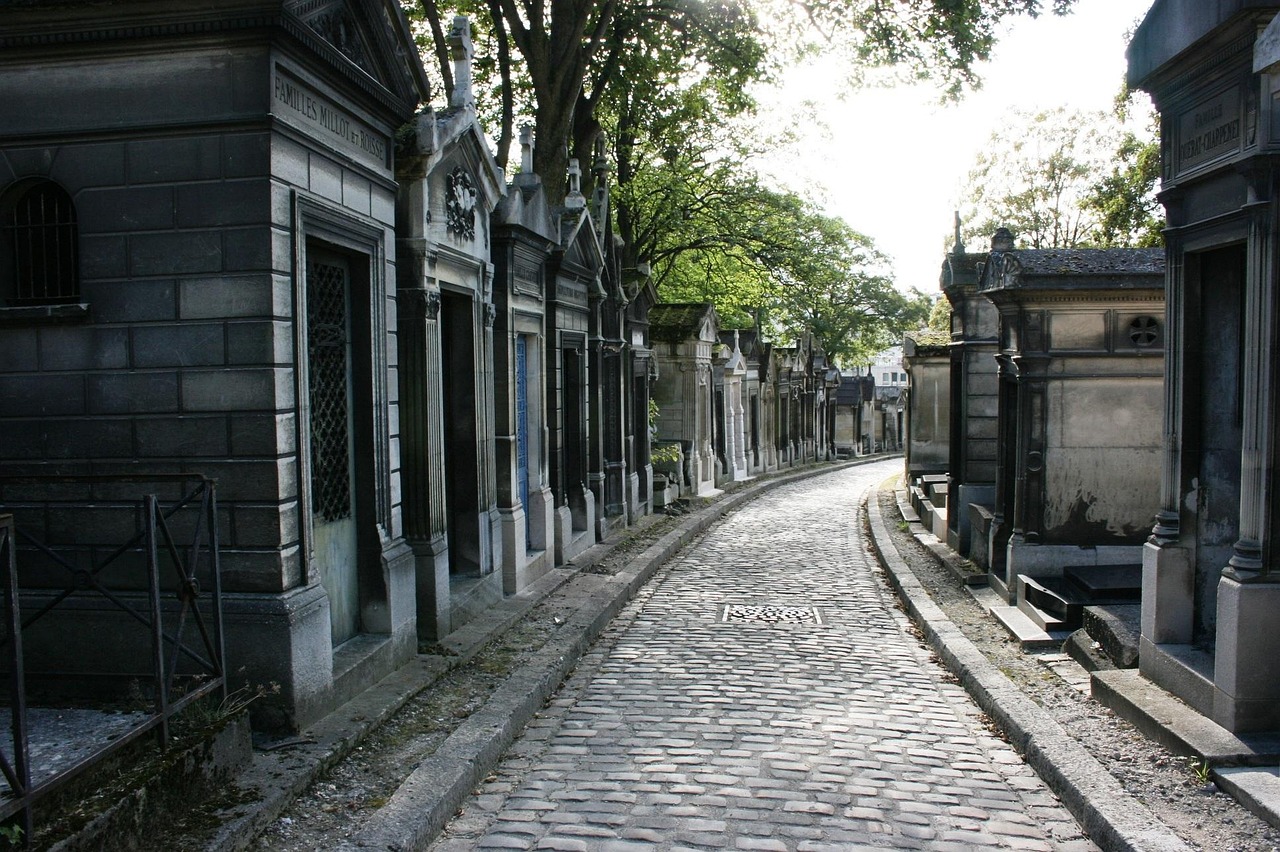
Père Lachaise is the world's great cemetery and one of Paris's great walks: 44 hectares of cobbled lanes climbing a chestnut-and-plane wooded hill in the 20th arrondissement — a million-plus burials since 1804, three-and-a-half million visitors a year, and an open-air museum where the sculpture, the trees and the lives compound into something no museum matches. The pilgrimage roster drives the visit: Oscar Wilde's angel-winged Epstein monument (the lipstick-kiss tradition now glassed over — the fine for kissing the glass is real, the affection undimmed), Jim Morrison's modest, barriered, eternally attended grave (the graffiti wars and the gum tree nearby are part of the lore), Édith Piaf resting with her roses in division 97, Chopin's muse with her real-heart-in-Warsaw story, Proust's plain black marble, Molière and La Fontaine (the 1817 transfers that marketed the new cemetery — it opened unfashionable and needed celebrities; it has never lacked them since), Balzac, Delacroix, Modigliani, Maria Callas's ashes' niche at the columbarium, and Abelard and Héloïse — the 12th-century lovers under their Gothic canopy, the cemetery's founding romance. The deeper walk earns more: the Mur des Fédérés in the southeast corner (the 1871 Commune's last fighters shot against this wall — the French left's hallowed ground, carnations always fresh), the Holocaust and deportation memorials' raw sculpture, the crematorium's Byzantine domes, and the ordinary tombs' chapel-row streets — a 19th-century city of the dead with its own architecture eras. The craft: get the map (apps or the gate kiosks — the hill defeats improvisers; Wilde and Morrison anchor opposite ends), enter at Gambetta and walk downhill to the main gate (the gradient argument), mornings for mist and birdsong, two-to-three hours for the honest circuit, and the etiquette plain: it is a working cemetery — funerals pass, photograph monuments not mourners. Free always.
The cemetery's history is Paris managing death into beauty: the 1804 Napoleonic reform moved burials outside the old city (the overflowing parish grounds had become a sanitation horror — the Catacombs took the bones), and Père Lachaise opened as the model garden cemetery — unfashionably far east until the administration transferred Molière, La Fontaine and then Abelard and Héloïse as anchor celebrities: the marketing worked so well it invented the modern celebrity grave. The 1871 history is the gravest: the Commune's last week ended here — fighters defending the tombs lane by lane, the captured shot against the southeast wall at dawn — and the Mur des Fédérés became the pilgrimage of the French left (the Communards' wall ceremonies continue each May).
The connoisseur's divisions
Wilde (89) and the glass argument, Morrison (6) found by following the visitors, Piaf (97) near the wall's memorials, the romantic quarter's early-19th-century tombs (divisions 11-12's Gothic revival), Chopin (11) always flowered, the artists' cluster (Delacroix, Géricault, Ingres), the columbarium's Callas and the crematorium domes, and the pure-atmosphere lanes — chemin du Dragon, the Carette rond-point's chestnut circle — where the cemetery is simply the most beautiful neglected garden in Paris. Wildlife notes are real: tawny owls, kestrels and the cats; autumn runs the full golden canopy and is the photographers' season.
Practicals and fit
Gambetta or Père Lachaise Métro (enter high at Gambetta, exit at the main Boulevard de Ménilmontant gate), free, gates close at dusk with the whistle sweep, maps essential, 2-3 hours honest. Fit: the history chip at full depth, music-and-literature pilgrims, photographers (autumn especially), couples on the contemplative walk — and pair it with the Atelier des Lumières ten minutes west for the 11th-arrondissement day.
What to expect
The experience
Forty-four wooded hectares of cobbled lanes — the celebrity pilgrimage from Wilde to Morrison to Piaf, the Communards' wall, and a 19th-century city of tomb architecture — free, map required.
Best time
Mornings for mist and birdsong; autumn for the golden canopy; enter high at Gambetta and walk downhill.
How long
Two to three hours for the honest circuit.
Tips
Get the map at the gate or an app — the hill defeats improvisers. Abelard and Héloïse's Gothic canopy is the founding romance. It is a working cemetery: funerals pass, photograph monuments, not mourners.
Quick picks
- Best for
- The history chip at full depth — lives, sculpture and 1871 in one hillside walk.
- Families
- Older kids engage with the find-the-famous map game; the lanes are stroller-hostile cobbles.
- Couples
- The contemplative two hours Paris does best — Abelard and Héloïse to the chestnut rond-points.
- Pair with
- Atelier des Lumières ten minutes west; the 20th's Ménilmontant cafés for the after.
- Time needed
- One unhurried morning.
Good questions
Who are the must-finds?+
Wilde's winged monument, Morrison's attended corner, Piaf, Chopin, Proust, Molière, and Abelard and Héloïse under their Gothic canopy — the map at the gate anchors the circuit; Wilde and Morrison sit at opposite ends.
Why is Wilde's tomb behind glass?+
Decades of lipstick kisses were eroding Epstein's stone angel — the glass barrier protects it now, the kisses land on the glass, and the posted fine is real.
What is the Communards' wall?+
The southeast wall where the Paris Commune's last fighters were shot at dawn in May 1871 — the French left's hallowed ground, with fresh carnations always and ceremonies each May.
Is it free to visit?+
Entirely — it is a working municipal cemetery, open daily until dusk with the whistle sweep at close; only guided tours charge.
How should we route it?+
Enter high at Gambetta Métro, walk downhill through the divisions to the main gate — two to three hours with the map, mornings for the mist, autumn for the gold.