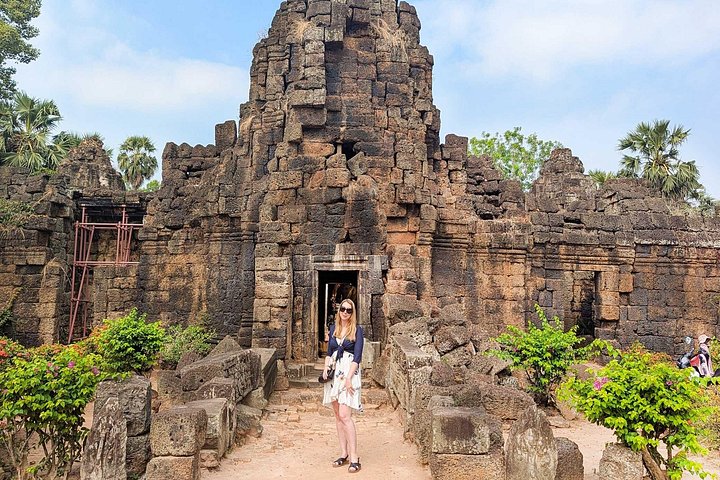
South of Phnom Penh, the flat countryside of Takeo province holds two temple sites that make an easy, quiet day trip. Phnom Chisor is a hilltop sanctuary built in the Angkorian period, reached by a long stone staircase that climbs through trees to a brick temple and a broad view across rice fields toward the horizon. Tonle Bati lies closer to the city and is a lakeside area with Ta Prohm, a small temple of the late twelfth century whose carved doorways and weathered towers are a taste of Angkor without the crowds. Together they give you a very different side of Cambodia from the capital: village roads, palms and paddy, small shrines, picnic huts on the lake and the pace of rural life. The experience here is a guided day trip from Phnom Penh that combines the two, so you do not need to arrange a driver or work out how to get between them. It is a good choice for travellers who are short of time for Siem Reap but still want to see an ancient Khmer temple, and for anyone who likes to spend a day in the countryside.
Getting there
Both sites lie south of the capital along the road toward Takeo, and the drive takes a little over an hour to the nearer sites and somewhat longer to the farther. A guided trip handles transport, timing and the order of the stops, which usually works best with the hill climb in the cooler hours and the lakeside temple later in the day. Start early, because the stairs up Phnom Chisor are exposed and the heat builds quickly.
What you will see
At Phnom Chisor the climb is the main effort, a few hundred steps, and the reward is the old brick temple at the top, the views and the sense of space. Tonle Bati is gentler. The temple of Ta Prohm there is compact and quiet, with carved lintels worth looking at closely, and the lake is ringed with simple wooden huts where Cambodian families gather for a meal at weekends. Weekdays are much quieter than weekends and holidays, so choose a weekday if you can.
Who it suits
Travellers who enjoy temples, countryside and slow travel, and who are happy with a long day in a vehicle. Wear comfortable shoes and cover your shoulders and knees at the temple sites. Carry water, sun protection and a little cash for drinks and small donations.
If you are heading to Siem Reap later in the trip, this is a quiet warm-up, and if you are not, it is a good substitute that sits comfortably on a day between the memorial sites and the river. Check the product details for the pickup arrangements and group size before you reserve.
What to expect
The experience
A guided full-day trip by road from Phnom Penh to a hilltop temple and a lakeside temple, with countryside stops on the way.
Best time
Start early to climb Phnom Chisor before the heat, and choose a weekday to avoid the weekend crowds at the lake.
How long
A full day, including the drive each way.
Tips
Wear comfortable shoes for the stairs, cover shoulders and knees at the temples, and carry water, sun protection and small notes.
Quick picks
- Best for
- Temple lovers and countryside fans who want an Angkorian taste without a trip to Siem Reap.
- Families
- Fine for older children who can manage the stairs and a long day. Younger ones may find the heat and the drive tiring.
- Couples
- A quiet, scenic day away from the city, with a view from the hilltop at the heart of it.
- Pair with
- A relaxed evening on the river or a Khmer cooking class the following day.
- Time needed
- A full day, with a morning start.
Good questions
What is Phnom Chisor?+
Phnom Chisor is a hilltop temple sanctuary from the Angkorian period south of Phnom Penh, reached by a long stone staircase and known for its views over the surrounding rice fields.
What is at Tonle Bati?+
Tonle Bati is a lakeside area with Ta Prohm, a small late twelfth-century temple, and wooden picnic huts by the water where local families gather, especially at weekends.
How long does the day trip take?+
Plan on a full day. The drive south takes a little over an hour each way, plus time at both sites.
How hard is the climb at Phnom Chisor?+
It is a few hundred steps up a stone staircase, steady rather than technical, but exposed to the sun. Go early and carry water.
What should I wear?+
Comfortable walking shoes and light clothes that cover shoulders and knees, since both sites are active places of worship.