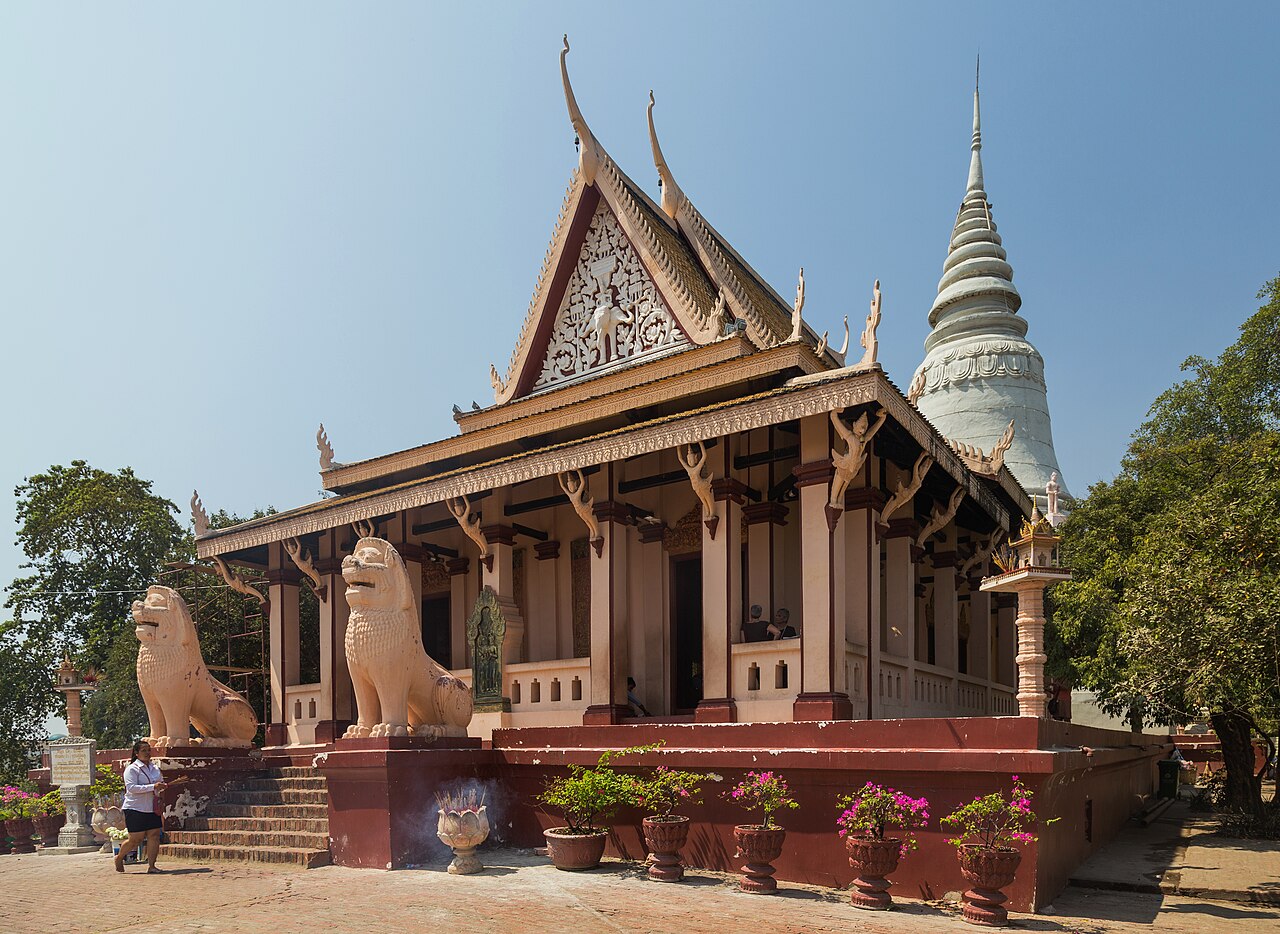
Wat Phnom is the spiritual heart of the capital and the origin of its name. According to legend, a wealthy widow named Daun Penh found Buddha statues in a koki tree that had floated down the river, and she had a hill raised to house them. The city takes its name from that hill, and the traditional founding date given for the temple is 1372. The hilltop is crowned with a vihara, the main hall of the temple, which has been rebuilt several times, most recently in the early twentieth century. Beside it stands a large stupa that holds the remains of King Ponhea Yat, who moved the Khmer capital from Angkor in the fifteenth century. Local people come here to pray for luck, exams and love, leaving offerings of flowers and incense, and the grounds around the hill are shaded by tall trees and full of the sights and sounds of everyday Phnom Penh. It is a gentle, atmospheric stop, usually combined with a walk through the nearby French quarter.
How to visit
The temple stands on the hill in a park at the northern end of the old town, close to the riverfront boulevards and the Raffles Hotel Le Royal. Foreign visitors pay a small entrance fee at the base of the steps, and the climb up the main staircase is short. The Ministry of Tourism recommends early morning or late afternoon visits, when the light is soft and the heat is bearable, and these are also the times when local worshippers are most active.
What to see
The vihara, with its painted interior and gilded Buddha images; the stupa of King Ponhea Yat on the hill; and the shrines around the grounds. Look for the offerings of jasmine and lotus buds, the incense smoke and the small stalls selling garlands and caged birds that some worshippers release for merit. Dress respectfully with shoulders and knees covered, and remove your shoes before entering the vihara.
Making the most of it
Wat Phnom is a short stop, and an hour is enough. Combine it with a walk through the colonial buildings nearby, a coffee in one of the cafes along the avenue, and a short tuk-tuk ride to the Royal Palace and the riverfront. It is a calmer, more local counterpoint to the palace, and a good first stop on a morning walking tour.
What to expect
The experience
A short climb up the steps to a hilltop temple and stupa surrounded by gardens, with local worshippers making offerings.
Best time
Early morning or late afternoon, when the light is soft, the heat is lower and local worshippers are most active.
How long
About 45 minutes to an hour.
Tips
Cover shoulders and knees, remove shoes before the vihara, carry small notes for the entrance fee and expect a few touts near the base of the steps.
Quick picks
- Best for
- First-time visitors, anyone curious about the origin of the city’s name and travellers who like a short, atmospheric stop.
- Families
- The short climb and the park setting are easy for children, who often enjoy the flower garlands and the busy atmosphere.
- Couples
- A pleasant late-afternoon stop before a stroll through the French quarter.
- Pair with
- The Royal Palace and National Museum, plus a walk past the colonial buildings nearby.
- Time needed
- An hour, or two with a coffee break in the surrounding streets.
Good questions
How did Wat Phnom get its name?+
According to legend, a wealthy widow named Daun Penh found Buddha statues in a koki tree and had a hill raised to house them. The city is named after that hill, and the temple is traditionally dated to 1372.
Do I have to pay to visit Wat Phnom?+
Foreign visitors pay a small entrance fee at the base of the hill. The amount can change, so carry small notes in US dollars or riel.
What is inside the large stupa at Wat Phnom?+
The stupa holds the remains of King Ponhea Yat, who moved the Khmer capital from Angkor in the fifteenth century. It stands beside the main vihara on the hilltop.
What is the best time to visit Wat Phnom?+
Early morning or late afternoon is best, with cooler air and softer light. These are also the hours when local worshippers arrive with offerings.
What should I wear at Wat Phnom?+
Cover your shoulders and knees and take off your shoes before entering the vihara. Light, breathable clothing works well in the heat.