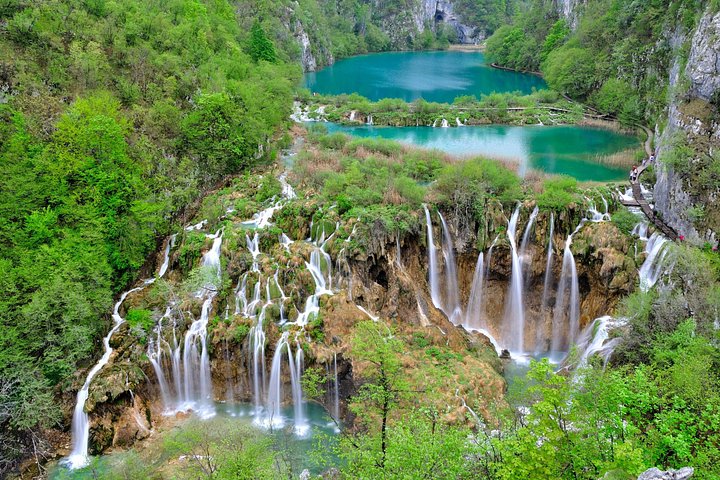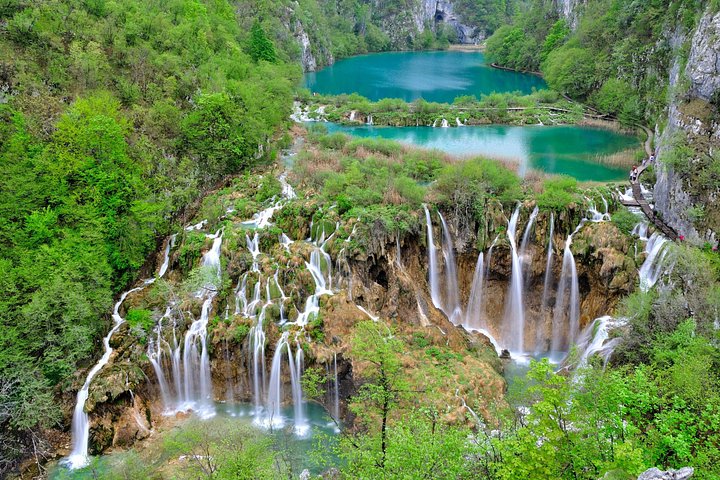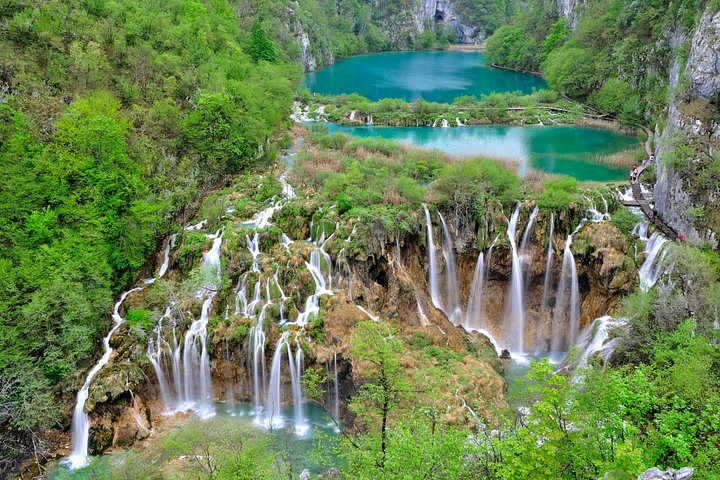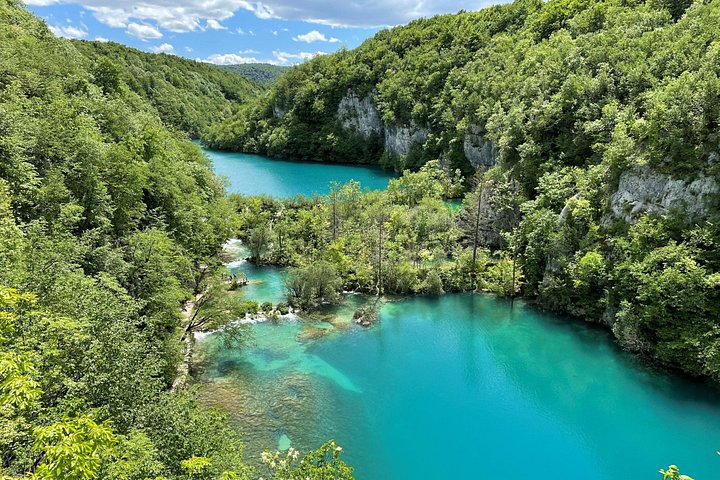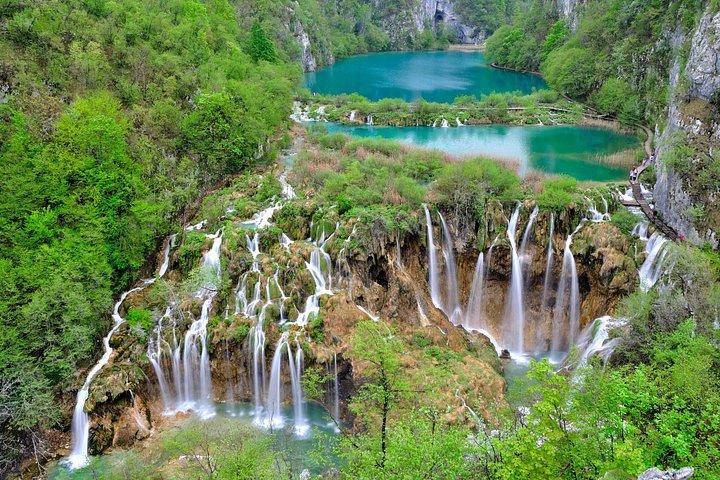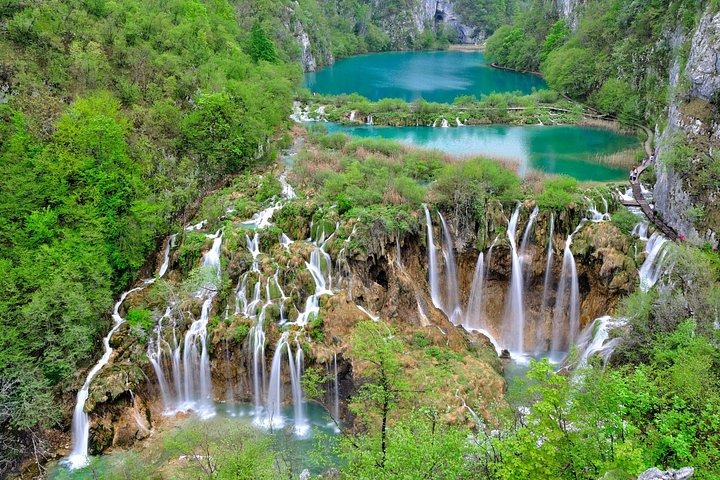
Plitvice Lakes National Park was established in 1949 and is a UNESCO World Heritage Site. Its sixteen named lakes sit in a narrow valley of beech and fir forest, each one held back by a natural dam of travertine, the soft limestone that the water itself builds as it flows. The lakes are divided into the Upper Lakes, in a dolomite valley with gentler, greener shores, and the Lower Lakes, in a limestone canyon with steeper walls, and the whole chain ends in Veliki Slap, the tallest waterfall in the park. Visitors follow a network of marked routes on wooden boardwalks and forest paths, with an electric boat across Lake Kozjak and a panoramic train between the main visitor areas. Two main entrances serve the park, Entrance 1 near the big waterfall and Entrance 2 near the hotels and Kozjak, and the same ticket works at both. The park is open in every season. This page covers the park as a whole; the pages that follow cover its lakes, transport and winter conditions in detail.
Why it looks the way it does: the water here is rich in dissolved calcium carbonate, and moss, algae and bacteria help it settle out as travertine. Over thousands of years that growth has built living dams across the Korana headwaters, and each dam is a waterfall with a lake behind it.
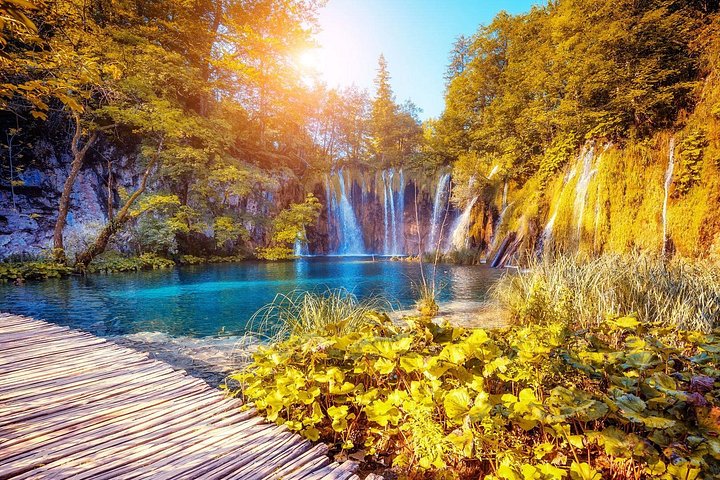
The effect is that the colour of the water changes with the minerals, the light and the season, from deep green to bright turquoise to grey-blue. The same process means the barriers are always slowly changing, which is why walking on them is not allowed and why the paths stay on boardwalks.
Planning the visit
Most people arrive by car or coach and enter at Entrance 1 or Entrance 2. Entrance 1 puts you closest to the Lower Lakes and the big waterfall; Entrance 2 is closest to the hotels, the Kozjak boat landing and the start of the Upper Lakes routes. The park publishes a set of numbered walking programmes, from a short loop of a couple of hours to a full day on foot, so you can choose by energy and daylight rather than trying to see everything.
Tickets are cheapest in the winter season and rise steeply in spring and summer, and high season is crowded, so winter and the shoulder months are far calmer.
What to know in November
This is the start of the quiet season. Days are short, paths can be wet or icy, and the park runs a reduced winter programme. Its last published winter timetable had ticket sales at Entrance 1 and the auxiliary entrance near Entrance 2 in the morning and early afternoon, with electric boats and the panoramic train running every thirty minutes until mid or late afternoon.
Some years the Upper Lakes paths close in deep winter and only the Lower Lakes stay open. Treat any timetable as indicative, check the park's current winter notice or call before you travel, and plan to be back at the exit by mid-afternoon.
What to expect
The experience
A self-guided walk on marked boardwalk and forest routes, with an optional electric boat and panoramic train included in the park ticket.
Best time
Weekday mornings outside summer, when the light is soft, the crowds are thin and the water is clearest.
How long
Two to three hours for a short loop, five to six hours for a longer route that adds the Upper Lakes.
Tips
Choose your route before you enter, wear shoes with real grip, bring a waterproof layer, and in winter finish before the early dusk. Food is limited inside the park, so carry water and a snack.
Quick picks
- Best for
- Anyone who wants Croatia's signature natural landscape in one outing.
- Families
- Yes, on the shorter loops: the boardwalks are safe and the boat and train give young legs a break, though prams are awkward on stairs.
- Couples
- A weekday in the shoulder season or winter, with a quiet boardwalk and a warm meal afterwards.
- Pair with
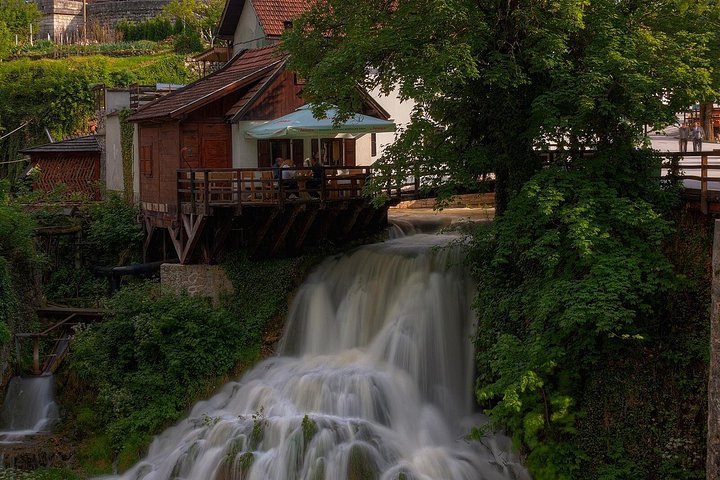
- Rastoke village on the way in or out, or a night at a lodge beside the park to avoid a long day trip.
- Time needed
- Four to six hours is the sweet spot; allow a full day for the longest routes.
Good questions
How many entrances does Plitvice Lakes have?+
There are two main entrances, Entrance 1 near the Lower Lakes and the big waterfall, and Entrance 2 near the hotels, Lake Kozjak and the Upper Lakes. An auxiliary entrance near Entrance 2 also sells tickets in winter.
Is the park open in winter?+
Yes, it is open all year with a reduced winter programme. Some paths, usually in the Upper Lakes, can close for ice or snow, so check the park's current notice before you go.
How much are tickets?+
Winter is the cheapest season, with an adult day ticket costing a fraction of the summer price. Prices step up in spring, autumn and summer, so confirm the current tariff on or the park's site.
Can I swim in the lakes?+
No. Swimming is not allowed anywhere in the park, and you must stay on the marked paths and boardwalks to protect the travertine.
Do I need to book ahead?+
In summer and on peak weekends, yes, because the park gets very busy and tickets can sell out. In winter you can usually buy on the day, but a ticket bought ahead saves queuing at the ticket office, which closes early in the afternoon.