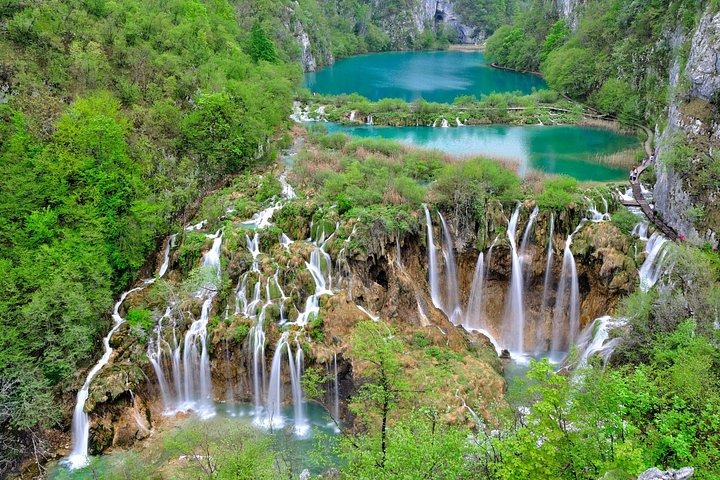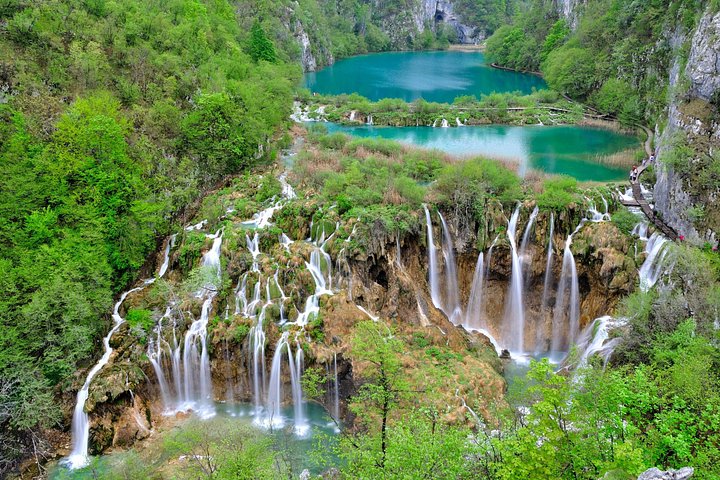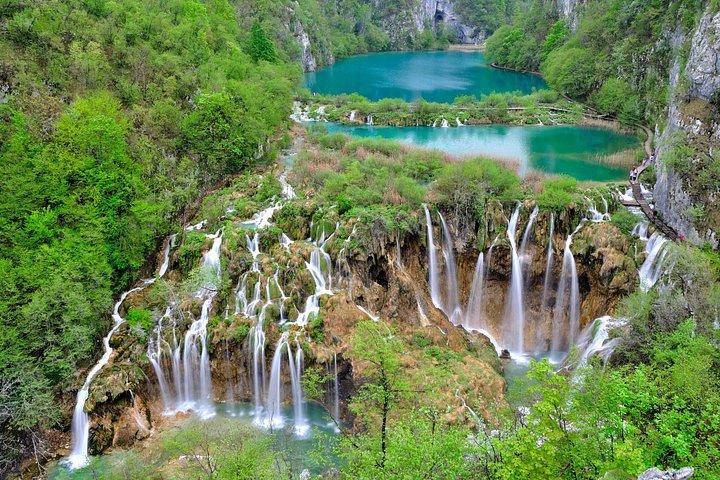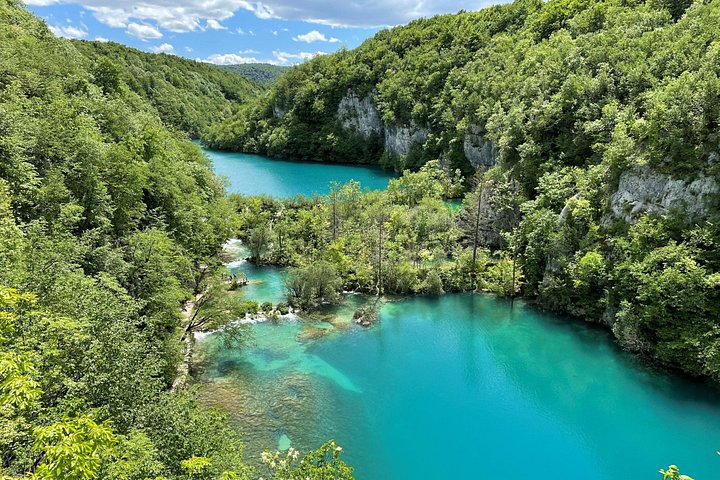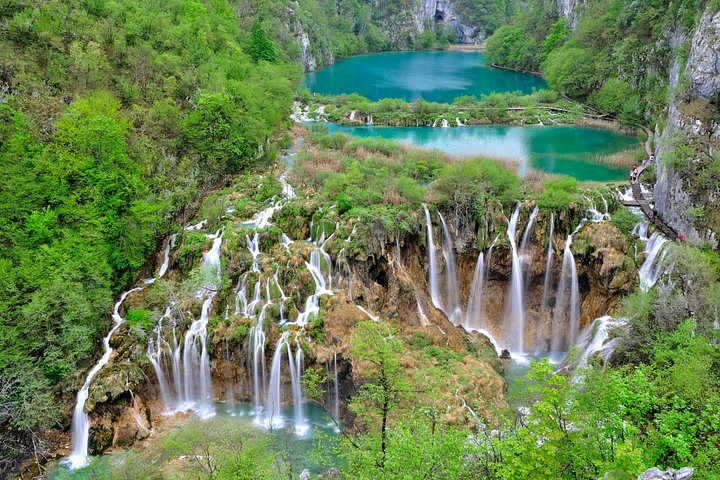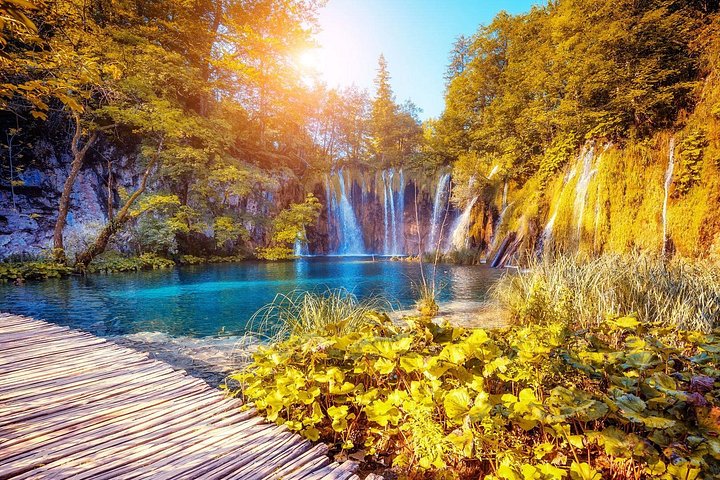
The Upper Lakes are the twelve lakes upstream of Lake Kozjak, the largest lake in the park. Where the Lower Lakes are a canyon, the Upper Lakes are a broad valley, so the boardwalks run across the water itself and the lakes spill into each other through low, wide cascades in a deep green forest. This is where the park feels most like a painting, and where the colour of the water is most varied. Reaching the Upper Lakes normally means starting at Entrance 2, crossing Kozjak by boat or walking around it, and then following either a short loop or a longer route that climbs through the valley to the top. The same area has the longer walking routes, which suit hikers who want to spend most of a day inside the park. In winter this is the section most likely to shut, because snow and ice make the wooden walkways unsafe.
Route choices
Shorter programmes cover Kozjak and part of the valley, taking a few hours. The longest route, around eight kilometres, takes in the Lower and Upper Lakes together with the smaller waterfalls of Veliki Prštavac and Mali Prštavac, and takes four to six hours at an easy pace. If you are choosing one route for a first visit, the longer one gives the most complete picture, but a shorter one with the boat is perfectly enough if the weather is poor.
What changes by season
In spring the water is high and loud; in summer the walkways are crowded and tickets are most expensive; in autumn the forest colour is superb and the crowds thin; in deep winter the park may close the Upper Lakes paths entirely, running only the Lower Lakes and a reduced boat and train service. In earlier winters the park announced this in mid-November, so a visit in early November is a good moment to ask at the park what is open. Frozen edges and light snow can make the lakes especially photogenic, but only if the paths are open.
On the day
Check the current route status with the park, start early in daylight, and dress in layers, because the valley holds cold air. Stay on the boardwalks, and do not stop on bridges where the path is narrow. If a route is closed, the park will usually point you to the open section, and your ticket still lets you use the boat and train between the parts that remain.
What to expect
The experience
Boardwalk and forest paths through twelve connected lakes above Lake Kozjak, joined to the Lower Lakes by boat or by a longer walking route.
Best time
Late spring and early autumn for colour and flow; in winter only when the park confirms the paths are open.
How long
Three hours for a short loop; four to six for the longest route with both lake systems.
Tips
Confirm open routes at the ticket office, start early, and carry water and a snack, because food is limited along the path.
Quick picks
- Best for
- Walkers who want the most scenic and varied part of the park.
- Families
- Fine for older children on the shorter loops; very small children will tire on the longer routes.
- Couples
- Early autumn, with the forest colours and a boat crossing of Kozjak.
- Pair with
- The Lower Lakes in the same day if you have the energy, and a stay beside Entrance 2.
- Time needed
- Three to six hours depending on the route.
Good questions
Which entrance should I use for the Upper Lakes?+
Entrance 2 is the usual starting point, as it is closest to the Kozjak boat landing and the Upper Lakes paths. The panoramic train also links the upper area with Entrance 1.
Are the Upper Lakes open in winter?+
Sometimes. In some winters the park closes the Upper Lakes paths for ice and snow and keeps only the Lower Lakes open, so ask before you plan a route.
How long is the longest route?+
The longest of the standard routes is about eight kilometres and takes four to six hours, including the Lower and Upper Lakes and the waterfalls of Veliki Prštavac and Mali Prštavac.
Is Lake Kozjak the biggest lake?+
Yes, Kozjak is the largest lake in the park and sits between the Upper and Lower Lakes. The electric boat crosses it and saves a long walk.
Are there places to eat inside?+
There are restaurants and snack points at the visitor areas, with reduced hours in winter. Carry food and water for any long route.