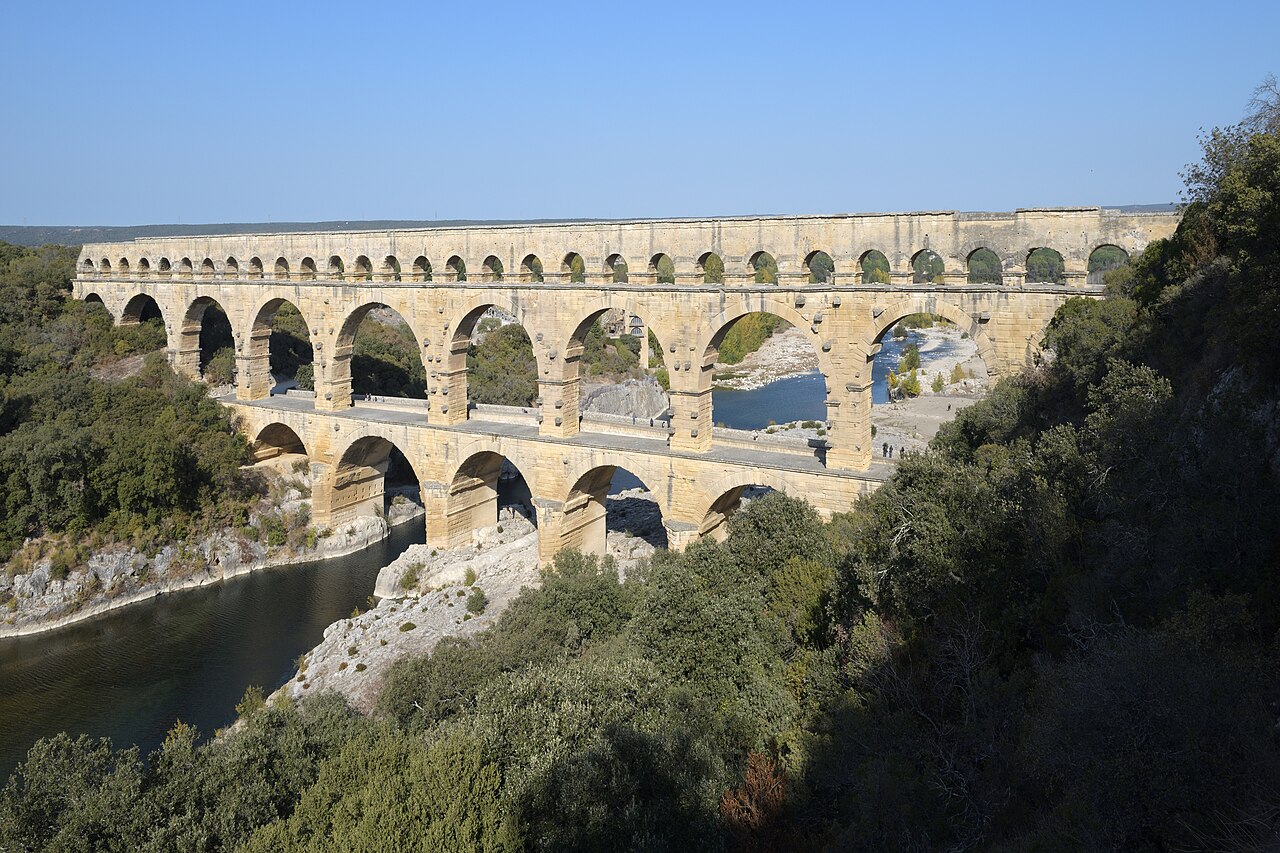
The Pont du Gard is the highest Roman aqueduct bridge in the world, a three-tier stone span about forty-nine metres tall that carried water across the Gardon valley as part of a fifty-kilometre aqueduct feeding the Roman city of Nîmes. It was built in the first century AD without mortar, using huge cut stones, and it is a UNESCO World Heritage Site. The setting is as striking as the engineering: pale stone arches framed by garrigue-covered hills and the green river below. Access to the site is free, and you pay only for parking, which makes it one of the easiest great monuments in France. In November the site itself is open every day, with paths on both banks and a view from beside the water, but the museum and cultural spaces are closed for the winter, so you come for the bridge and the walk.
Walk the left-bank and right-bank paths to see the bridge from several angles. The classic view is from the riverside gravel below the arches, while a short climb on a woodland path gives a higher view over the top tier. You can cross the river on the eighteenth-century road bridge built against the aqueduct's lower tier, and the setting is peaceful off-season. In summer, swimming in the Gardon is popular, but in November the river is cold and the focus is on the stone and the landscape. Wear shoes for uneven paths.
Practical facts matter in winter. The site is open daily from early morning until midnight, parking costs a daily fee per car regardless of how many people are inside, and the ticket office keeps shorter winter hours. The Museum of Romanity and the cinema, games and exhibition spaces are closed from November through February, and guided tours may be suspended on some days, so check the site's notice before you travel. A ticket that includes the museum is not useful in these months, which is why this page points to the venue's own site.
The Pont du Gard is about twenty kilometres from Avignon and is a straightforward drive of half an hour. Shuttle buses run from Avignon and Nîmes, though their schedules thin out in winter. Combine it with Uzès or with a wine tour on the same day, and allow about two hours at the bridge, longer if you walk the paths.
What to expect
The experience
A self-guided walk around a free-access Roman aqueduct bridge, with riverbank paths on both sides; you pay only for parking.
Best time
Morning or late afternoon for soft light on the stone; November is quiet.
How long
About two hours, longer if you walk the woodland paths.
Tips
The museum and cultural spaces are closed from November to February, parking is charged per car per day, and stout shoes help on the paths.
Quick picks
- Best for
- Anyone who wants to see the most impressive Roman monument in southern France without a ticket.
- Families
- Easy paths and plenty of space to explore; keep children away from the river edge.
- Couples
- A walk along the Gardon at golden hour, then dinner in Uzès or Avignon.
- Pair with
- A wine tour or the Roman monuments of Arles.
- Time needed
- Two hours.
Good questions
Is the Pont du Gard open in November?+
Yes. The site is open daily and access is free, with parking charged per car per day. The museum and cultural spaces are closed from November to February.
How much does it cost?+
Walking around the site is free and you pay for parking, which is charged per car for the day. The museum has a separate entry fee when it is open.
How do I get there from Avignon?+
It is about twenty kilometres and roughly a half-hour drive, with shuttle buses from Avignon and Nîmes. Winter bus times are reduced, so check ahead.
Can I walk across the bridge?+
The aqueduct itself is a protected monument, but a road bridge beside it lets you walk across the river, and paths on both banks give the best views.
How long should I allow?+
Two hours covers the main views. Allow longer for the woodland paths or if you combine it with a nearby town.