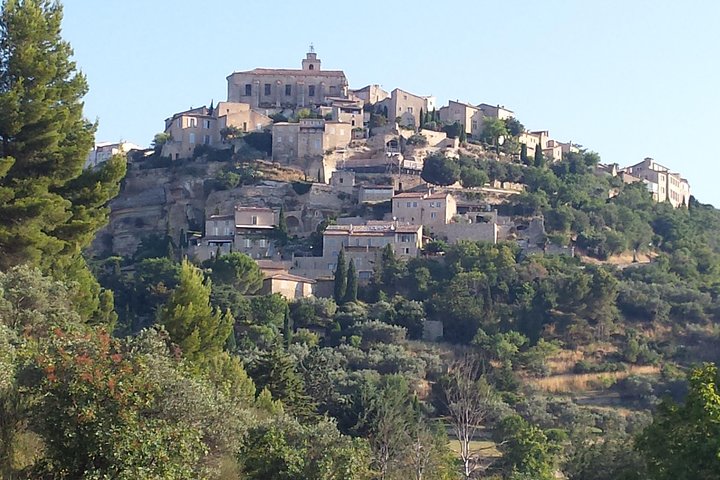
Notre-Dame de Sénanque stands at the bottom of a narrow valley a few kilometres from Gordes, a Cistercian abbey founded in the twelfth century and still lived in by a small community of monks. In summer the fields around it are famous for lavender, and photographs of the abbey with purple rows in front of it appear on every Provence postcard. In November the lavender is cut to stubble, but the abbey itself is unchanged: honey-coloured stone, a bare Romanesque church, a cloister with simple arches, a dormitory and a chapter house, all built with the plainness that Cistercian rules demanded. The silence is part of the visit, and the monks' daily prayer continues within the enclosure while visitors pass through.
Visits are organised rather than free-roaming. A guided tour of about an hour, led in French by a trained guide, is the abbey's recommended way to see the church, cloister and dormitory. For non-French speakers there is a self-guided option using a tablet app called the HistoPad, available in around eleven languages, which explains each space and shows how the buildings looked. Tours and entry windows run at set times, and Sundays start later in the day, so check the schedule, and book a place online ahead of your visit if your dates are fixed.
The abbey asks visitors to dress modestly and keep silence, since the monks pray in parts of the complex during the visit. Pets are not allowed other than assistance dogs. There are many steps and uneven floors, so access is difficult for people with limited mobility and not possible by wheelchair. Outside, a small shop sells products made by the community, including honey and lavender items, and a path leads up the valley for a short walk with views back down to the roofs.
The abbey is a short drive from Gordes and Roussillon, so it fits neatly into a Luberon day that includes both villages. In November the valley is quiet and the light is low and golden in the late afternoon, which suits the stone. Parking is at the entrance of the valley, and the road can be slow in summer but is easy in winter.
Take a warm layer, because the church and cloister are unheated, and wear shoes you can walk in. If your trip is in lavender season, the abbey is one of the busiest sights in Provence and tickets must be booked well ahead. In winter you will have space and silence, which are what the place is for.
Before or after your visit, take time to look at the building from outside. The church has no grand tower, and the plain stone roofs follow the slope of the valley, which was chosen for its isolation and a stream for the monks' needs. The Cistercians favoured this simplicity as a form of devotion, so there is almost no carved decoration, which is why the proportions and the light matter so much.
If you have time, the short walk up the valley road gives the classic view of the roofs from above. Staying quiet inside is part of the experience, so leave phone calls for the car park.
What to expect
The experience
A timed visit of the church, cloister and dormitory, either a one-hour guided tour in French or a self-guided visit with a tablet app in many languages.
Best time
Late afternoon, when the low sun warms the stone, or the first slot of the morning.
How long
About an hour, a little more with the shop and the valley path.
Tips
Dress modestly and keep silence, no pets, many steps, and book online if your dates are fixed because slots are timed.
Quick picks
- Best for
- Travellers who want a calm, beautiful place and an introduction to Cistercian architecture.
- Families
- Older children can enjoy the app, but silence is expected and there are many steps, so it suits quiet visitors.
- Couples
- A late-afternoon visit, then dinner in Gordes or Roussillon.
- Pair with
- Gordes, Roussillon and the ochre trails, and the Fontaine-de-Vaucluse.
- Time needed
- One hour to ninety minutes.
Good questions
Is the lavender in bloom in November?+
No. The lavender flowers from late June to early August and the fields are cut to stubble by autumn, but the abbey itself is unchanged and far quieter.
Can I visit without a guide?+
Yes. A self-guided visit with a tablet app is available in around eleven languages, while the guided tour is led in French.
Is the abbey suitable for wheelchair users?+
Not at present. The abbey has many stairs and uneven floors, and access is difficult for people with limited mobility.
Are pets allowed?+
No, only assistance dogs are admitted, because the monks live and pray within the enclosure.
How do I get there from Avignon?+
It is about an hour by car, near Gordes. Public transport is limited, so a rental car or a small-group Luberon excursion is the best option.