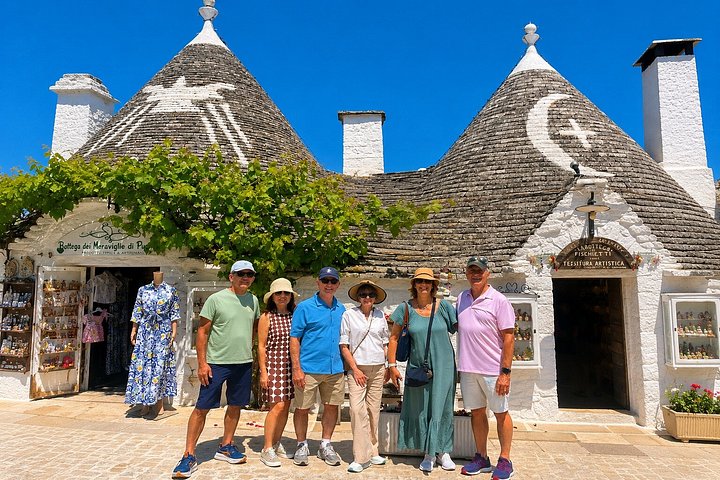
Alberobello is the one place in Puglia that looks like nowhere else. Its two old districts, Rione Monti and Aia Piccola, are packed with trulli, round dry-stone houses with grey conical roofs, many marked with painted symbols and now housing shops, cafes and guest rooms. The trulli were built without mortar, and local tradition says they could be dismantled quickly when tax inspectors came, though historians debate the story. The town was inscribed on the UNESCO World Heritage list in 1996, and it draws large crowds in summer. A local-guided walk is the best way to understand what you are seeing, from the construction method and the meaning of the roof symbols to the story of the Trullo Sovrano and the church in the shape of a trullo. Allow a short guided session and then free time to wander the lanes and shops.
A trullo is built of limestone slabs stacked into a thick wall and a corbelled cone, with no binding material. The thick stone keeps interiors cool in summer and warm in winter, and the conical roof sheds rain into cisterns. Walking through Rione Monti, you will see rows of trulli lining the slope, each with a small door and a symbol painted on the roof, some religious, some simply decorative. A guide explains how the pattern of stones, the pinnacle and the arrangements inside differ from house to house.
Crowds are the main drawback. In summer and on weekends, Rione Monti can be packed, and the souvenir shops are intense. Go early or late in the day, and consider Aia Piccola, the smaller and quieter district, for a more residential feel. Wear shoes with grip, as the paving is old and uneven, and bring water in warm weather. This guided walk lasts about an hour and a half, and most visitors then enjoy a coffee or a taste of local products before leaving.
Alberobello is easy to reach from Bari by regional train in roughly an hour and a half, or by car in a little over an hour. Many visitors combine it with Locorotondo, Ostuni or Polignano a Mare in a day, and overnight stays in a restored trullo are a highlight in themselves. If you can spare a night, the town is magical in the evening when the day-trippers leave and the stone glows in the lamplight.
What to expect
The experience
A guided walk of about an hour and a half through the trulli districts of Alberobello with a local guide.
Best time
Early morning or late afternoon, when crowds thin and the light is soft on the stone roofs.
How long
About 90 minutes guided, plus time for shops, coffee and the Aia Piccola district.
Tips
Wear sturdy shoes for old paving, bring water in summer, and visit Aia Piccola for a quieter, more residential look.
Quick picks
- Best for
- Anyone who wants to understand the trulli rather than just photograph them.
- Families
- Children enjoy the fairytale look; the lanes are uneven, so carry little ones rather than use a stroller.
- Couples
- Stay overnight in a trullo and see the town in the quiet of the evening.
- Pair with
- Locorotondo, Ostuni and Polignano a Mare, all within easy reach for a day.
- Time needed
- A half day, or an overnight stay to see the town without day-trip crowds.
Good questions
Why do the trulli have symbols on the roofs?+
The painted symbols are religious, protective or decorative, and each house differs. A local guide can read many of them for you.
Are the trulli UNESCO-listed?+
Yes, the trulli of Alberobello were inscribed on the UNESCO World Heritage list in 1996. The two old districts are the protected core.
Can I go inside a trullo?+
Yes, several trulli are open as shops, small museums or guest rooms, and the Trullo Sovrano is a well-known visit. Opening times vary, so ask locally.
How do I get from Bari to Alberobello?+
Regional trains run from Bari in roughly an hour and a half, and by car it takes a little over an hour. Check the timetable for the return so you do not get stranded.
Is it worth staying overnight?+
Yes, if you can. The town is calm in the evening, and sleeping in a restored trullo is a highlight of a Puglia trip.