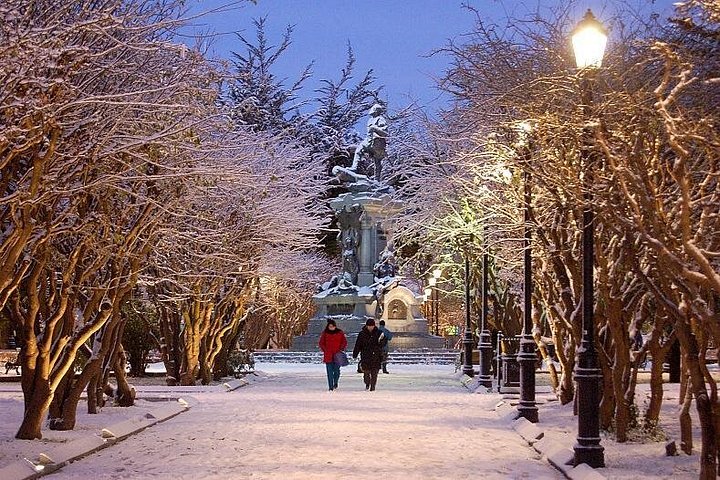
The municipal cemetery of Punta Arenas is regularly counted among the most beautiful in South America, and it is easily one of the city's most interesting sights. Entering through a grand gateway, you walk down avenues of tall, neatly clipped cypress trees that frame family mausoleums of marble and granite, built for the wool barons, shipping magnates and immigrant families who made their fortunes here. The cemetery was a gift to the city associated with Sara Braun, one of the region's wealthiest women, and her name remains attached. Walking the paths is like turning the pages of a history book, with surnames from Croatia, Britain, Spain, Germany, Italy and elsewhere recording the waves of immigration that built the city. There are monuments to sailors, firefighters and community associations, a memorial to the Selk'nam and other indigenous peoples of Tierra del Fuego, and a much-loved statue that visitors touch for luck. Despite its subject, the atmosphere is peaceful rather than gloomy, and the combination of ornate stone and manicured greenery makes for superb photographs. Entry is free, and visitors are asked to behave respectfully.
The grave monuments are the story. Marble angels, weeping women and carved ships stand beside small niches decorated with flowers, and the sheer variety of styles reflects the cultural diversity of the immigrants. Guides often point out the stories behind particular tombs, such as those of shipwreck victims, explorers and local politicians. The Selk'nam memorial is a thoughtful stop, recalling a people who lived in the far south for thousands of years before settlers arrived.For practical visiting, go in daylight and stay on the paths.
The cemetery is a short walk or a taxi ride from the plaza, and it is a standard stop on most city tours. If you go on your own, allow about an hour, wear comfortable shoes and bring a jacket, since the cypress hedges funnel the wind. Be respectful when other visitors are paying their respects, avoid noisy behaviour and ask before photographing people. The caretakers sometimes keep short hours, so check the opening times locally.Pair the cemetery with other history stops.
The Regional Museum shows how the families buried here lived, and the plaza displays the mansions they built. Together they form a coherent picture of the golden age of the wool trade and the fragile world that followed. Visitors who like quiet places and architecture will find the cemetery one of the highlights of the city, and those travelling with children can turn it into a gentle history lesson on a cloudy afternoon.A few details are worth watching for as you walk.
Notice how the cypress hedges are sculpted into tall green walls, creating a sense of corridors and rooms, and how different communities cluster their monuments, with Croatian, British and Spanish societies each leaving distinct marks. Some tombs bear carved ships, anchors and tools that hint at the trades of those buried there. In winter, a dusting of snow turns the avenues almost silent, and on a bright summer afternoon the contrast of dark hedges and white marble is striking. Respect, quiet and a slow pace make the visit most rewarding.
What to expect
The experience
A free, self-guided walk through cypress-lined avenues, past mausoleums and monuments, or a stop on a guided city tour.
Best time
Daylight on a dry day. Late afternoon light is lovely.
How long
About an hour.
Tips
Be respectful, stay on the paths and bring a windproof jacket.
Quick picks
- Best for
- History and architecture lovers, and photographers.
- Families
- Calm and interesting for older children; remind young ones to be quiet.
- Couples
- A quiet, atmospheric walk.
- Pair with
- The Regional Museum and Plaza Munoz Gamero.
- Time needed
- One hour.
Good questions
Is there an entrance fee?+
No. The cemetery is free to enter.
Why is it famous?+
For its cypress-lined avenues, elaborate mausoleums and monuments that tell the story of the city's immigrants.
How long should I allow?+
About an hour for a relaxed visit.
Is photography allowed?+
Generally yes, but be respectful of mourners and avoid intrusive behaviour.
Can I visit on a city tour?+
Yes. It is a standard stop on most guided city tours.