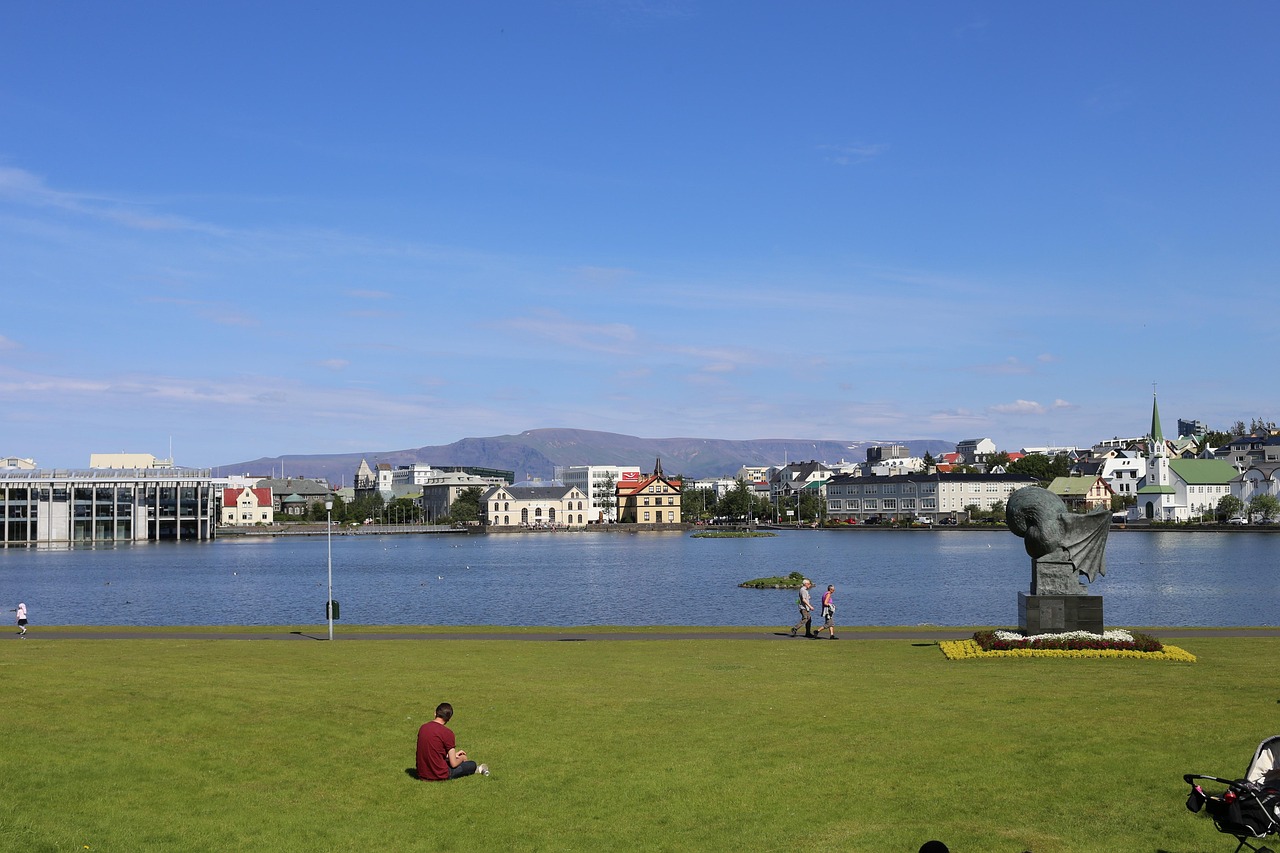
Tjörnin is Reykjavík at its most domestic and the city walk's gentle heart: the pond — the small lake at the city center's foot, ringed by the postcard row of painted gable houses, the white national-romantic churches and the turf-roofed Nordic House beyond — functioning as the capital's living room: the bird parliament (the pond is a serious waterfowl site wearing a tame disguise — whooper swans, greylags, eiders and dozens of duck species raft by the hundreds, the arctic terns commute, and the bread-bag ritual at the north corner is generational — the city even warms a corner of the water in winter, keeping the no-ice patch open for the birds: the steaming duck-spa against the frozen lake is the season's charming sight), the architecture ring (City Hall stands IN the water on its pillars — the free-entry foyer holds the giant 3D relief map of Iceland, the five-minute geography lesson every trip should take — with the National Gallery's lakeside run, Fríkirkjan's white steeple and the parliament quarter a block north), Hljómskálagarðurinn (the park at the south end — the bandstand the name remembers, the sculpture collection including the Einar Jónsson and womens-sculptors gardens, and the lawns where the city picnics on sunny days), and the seasonal registers: summer's midnight-light strolls and lawn culture, autumn's reflection photography, and winter's headline act — when the ice holds, Tjörnin becomes the city's skating pond (the of-course-they-skate-on-it civic ritual, kids and commuters cutting lines below the church steeples). The honest frame: this is a one-hour pleasure, not a day — the pond loop walks in 30-40 minutes, the duck theater and relief map pad it — and its role is connective: the walking day (Hallgrímskirkja, the center, the harbor) routes naturally around it, and the bench-and-coffee pause by the water is the itinerary's exhale. Fit: families definitionally (the duck parliament), couples (the painted-house reflections), first trips (City Hall's map and the postcard ring), and every walking day's gentle middle.
The pond's nature runs deeper than its tameness: Tjörnin is a lagoon remnant (the old bay's barrier-beach leftover — the name just means the pond), its 40-plus recorded bird species make it one of the world's best urban waterfowl sites (the eider colonies, the whooper swans' bugling, the odd rarity drawing the city's birders), and the warmed winter corner (geothermal runoff keeps the northeast patch open) concentrates the whole parliament into the steaming no-ice zone — the photograph of the season. The ring's buildings earn their minutes: City Hall (the 1992 modernist pile on pillars in the water — the free foyer's relief map of Iceland, hand-built over years, turns the trip's geography three-dimensional: find your route, grasp the highlands' emptiness), the National Gallery's lakeside galleries, Fríkirkjan's white timber steeple (the reflection shot), the Idnó theater's 1897 hall, and the south end's Nordic House (Alvar Aalto's only Iceland building — the design pilgrimage and café).
Hljómskálagarðurinn's layer: the park grew around the 1923 bandstand (the Hljómskáli — the music house of the name), the sculpture collection runs serious (the garden of works by Iceland's pioneering women sculptors is a quiet national statement), and the lawns host the city's sunny-day life (the picnic-and-frisbee register under the church view). The seasonal craft: summer's late light runs the lawns to midnight, autumn's still mornings give the painted-row reflections, winter's skating depends on a proper freeze (the city's of-course register when it comes — join carefully with the locals), and the duck corner works every day of the year. The walking geometry: the pond sits two minutes from Austurvöllur square and parliament, five from Laugavegur's west end, ten from the harbor — the loop is the city day's natural middle, and the National Museum (the roster's entry) anchors its southwest corner.
Practicals and fit
City center (every walk crosses it), free always, City Hall foyer free in opening hours, skating only on proper freezes. Fit: families' duck hour, couples' reflection stroll, first trips' geography lesson — the capital's exhale.
What to expect
The experience
The city-center lake and its park — hundreds of swans and ducks (a warmed winter corner keeps them), the painted-house postcard ring, City Hall's giant relief map of Iceland, sculpture lawns and winter skating when the ice holds.
Best time
Any day for the ducks; still mornings for reflections; proper freezes for the skating ritual; summer's midnight light runs the lawns late.
How long
An hour's loop with duck theater and the map; the walking day routes through regardless.
Tips
Take City Hall's free foyer for the 3D relief map — five minutes that explain the whole country's geography. The warmed winter corner concentrates the bird parliament into one steaming photo. The south park's sculpture gardens reward the extra ten minutes.
Quick picks
- Best for
- The city day's exhale — ducks, reflections and a bench by the water.
- Families
- The duck parliament at bread-bag range and skating when the freeze comes — generational rituals both.
- Couples
- The painted row doubled in still water, Fríkirkjan's steeple in the frame.
- Pair with
- The National Museum anchors its corner; parliament square and Laugavegur sit minutes away.
- Time needed
- One gentle hour, mid-walk.
Good questions
What birds will we see?+
A serious waterfowl site in tame disguise — whooper swans, greylags, eiders and dozens of duck species, 40-plus recorded: the city even warms a winter corner to keep the parliament in session when the lake freezes.
What is in City Hall?+
The free foyer holds the giant hand-built 3D relief map of Iceland — five minutes that turn the trip's geography three-dimensional: find your route, grasp the highlands, respect the distances.
Can you skate on it?+
When a proper freeze holds — Tjörnin becomes the city's skating pond in the old civic ritual: join carefully where the locals skate, and admire the steaming duck corner that never freezes.
What is the park at the south end?+
Hljómskálagarðurinn — the 1923 bandstand's park, with sculpture gardens (including the pioneering women sculptors' collection), picnic lawns and the Nordic House (Alvar Aalto's only Iceland building) beyond.
How long does it take?+
The loop walks in 30-40 minutes; the ducks, the relief map and a bench coffee stretch it to the hour it deserves — every walking day crosses it anyway.