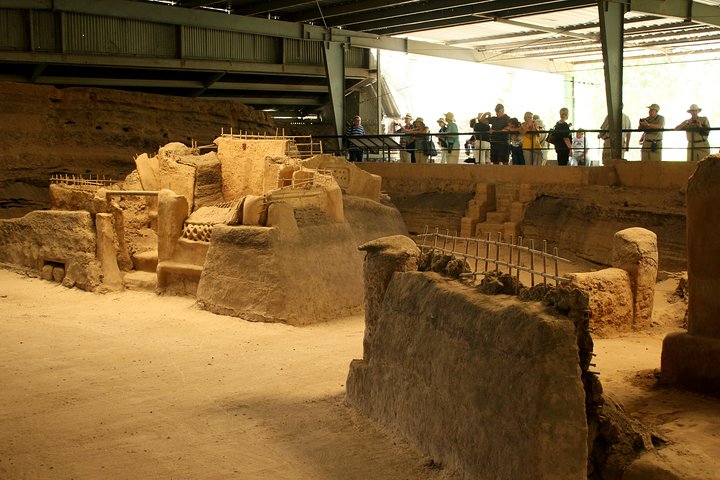
The Museo Nacional de Antropología Dr. David J. Guzmán, known as MUNA, is the best single place to understand the cultures behind the ruins you will see on day trips. Its permanent halls cover themes such as migration and belonging, agriculture, craft production and exchange, religion and the burial customs of pre-Hispanic El Salvador, and the collection ranges from ancient ceramics and stone sculpture to colonial and later pieces and contemporary art. The museum also stages temporary exhibitions, some of them large and immersive, which have been announced by the Ministry of Culture from time to time and may carry an extra charge. It sits in the San Benito district, close to the Museum of Art and the hotels of the Zona Rosa, which makes it an easy morning on foot for guests staying there. Seeing it before Joya de Cerén or Tazumal gives those sites much more context.
What to see
Allow time for the pre-Hispanic burials and ceramics, which give a close view of the beliefs and daily life of the people who lived here. The halls on agriculture and craft show how maize, cacao and weaving shaped the region. Labels are mainly in Spanish, so a translation app or a guide helps, and the museum has at times offered guided tours and a family-friendly play room.
Practical points
Tickets are sold through the Ministry of Culture’s online shop, with lower rates for Salvadorans and Central Americans and a higher rate for visitors from elsewhere, plus free entry for some groups such as young children and older adults. Prices and opening days have changed over the years, so check the booking page before you go. Temporary exhibitions can have a separate ticket. Museums in the capital often close one day each week, so confirm which day.
Getting there and combining it
The museum is in San Benito, about a short walk from the Museum of Art of El Salvador and the Sheraton area, and a taxi or ride-hail from the historic centre or Escalón is quick. A visit takes between one and two hours, and it pairs naturally with lunch in Zona Rosa. If you plan to visit Joya de Cerén, Tazumal or Cihuatán, this is the best preparation.
What to expect
The experience
A self-guided museum visit through permanent halls on pre-Hispanic and later Salvadoran culture, with changing temporary exhibitions.
Best time
Weekday mornings, when galleries are quietest, and any day if it is raining.
How long
One to two hours.
Tips
Check opening days and ticket rates on the booking page, and visit before the Maya sites for context.
Quick picks
- Best for
- Travellers who want background before the archaeological day trips.
- Families
- Children can enjoy the objects and the interactive spaces, especially in a temporary exhibition.
- Couples
- A cool, quiet indoor stop that pairs with lunch in Zona Rosa.
- Pair with
- The historic centre or a Joya de Cerén day trip.
- Time needed
- One to two hours.
Good questions
What does MUNA cover?+
The museum covers migration, agriculture, craft and exchange, religion and pre-Hispanic burials, along with later pieces and contemporary art. Its collection helps explain the Maya and earlier cultures of El Salvador.
How much does MUNA cost?+
Entry is modest, with different rates for Salvadorans, Central Americans and other visitors. Rates change, so confirm the current price on the booking page.
Are the labels in English?+
Most labels are in Spanish, so bring a translation app or join a guided tour if one is running. The objects speak for themselves.
Where is the museum?+
It is in the San Benito district, near the Museum of Art of El Salvador and the Zona Rosa hotels. A taxi from the historic centre is short.
Is it worth visiting before the day trips?+
Yes, the burial and ceramic halls give useful context for Joya de Cerén and Tazumal. It takes only an hour or two.