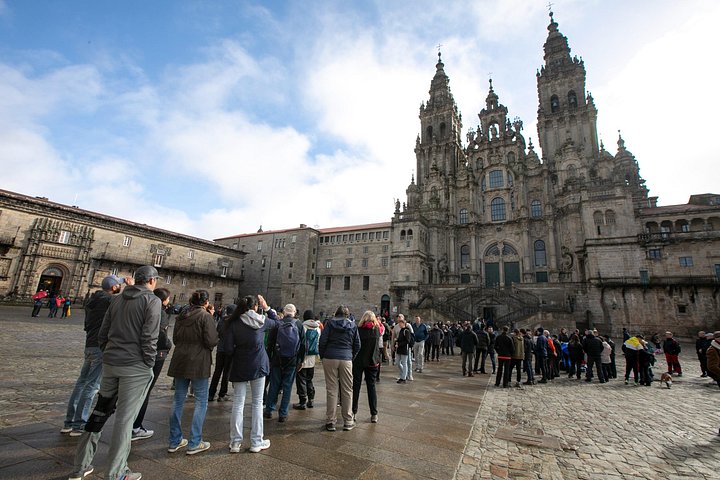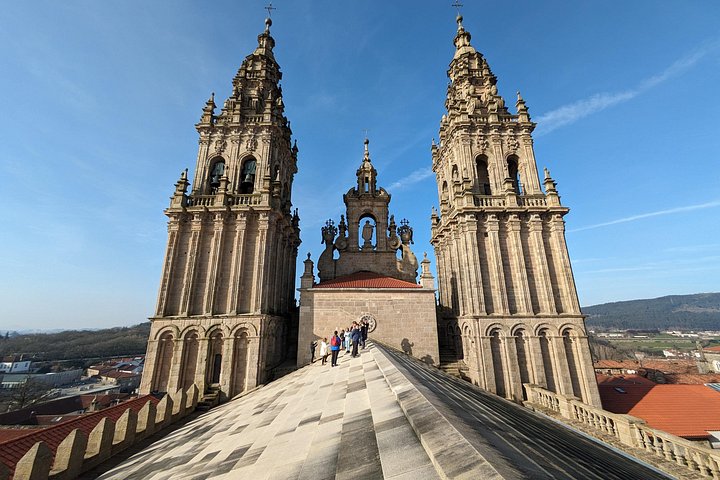
Santiago's old town is a labyrinth of granite arcades, stepped lanes and sunlit squares that was added to the UNESCO World Heritage list in the 1980s. It is compact enough to walk in an hour, but the details are easy to miss without a guide: the carved shells that mark pilgrim paths, the doorways of former hospitals, the university buildings that have trained students for five centuries and the stories of the families that built the palaces. A small-group walking tour pulls these threads into a clear narrative, and it is a very good first-day activity. A typical route starts near the Praza do Obradoiro and loops through the Praza das Praterías, with its horse fountain, the Praza da Quintana and the pedestrian streets of Rúa do Vilar and Rúa do Franco. The guide explains how the city grew around the shrine, how it handled floods of pilgrims and what changed in the nineteenth and twentieth centuries.
Walking tours differ in focus, so read the description to see whether yours is history, legends, architecture or a general introduction. Most last between one and two hours and finish within sight of the cathedral. Groups are kept small so you can hear the guide in the narrow lanes. Pace is unhurried, but there are cobbles, slopes and steps, so wear comfortable shoes. Rain is common in Galicia, and the arcades provide cover for much of the route, though a light waterproof is a sensible addition even in summer.
What you will learn depends on the guide, but expect a mix of faith, art and daily life. Santiago is a university city, and the student presence gives the old town a youthful rhythm after term starts. The guide may point out the Pazo de Xelmírez, the Praza de Cervantes with its old market feel, and corners where Romanesque, Gothic and Baroque styles meet. Questions are welcome, and a good guide will adjust the route to the weather and the group's interests.
Book a morning slot if you can. Mornings are cooler in summer, the light on the stone is good and the shops and cafes are waking up. Many guides recommend walking the same route again later on your own, now with context, to stop in the places that caught your eye.
A walking tour also helps you plan the rest of your stay, because you will see which museums, churches and tapas bars are worth returning to. Tips are customary for some guides, so carry a little cash, and ask about languages and group size when you reserve.
To get the most from the walk, bring a bottle of water, a hat or umbrella depending on the season, and a small notebook for names of places you want to revisit. Ask the guide about local bakeries, the best views of the cathedral and where students go to eat cheaply.
If you are interested in the Camino, ask about the symbols on the pavement and the shell markers set into the stone. Some guides also add short stories about local legends and festivals, which makes the history more vivid and gives you things to look for on your own later.
What to expect
The experience
A guided walk through the old town in a small group, usually in English or Spanish.
Best time
Morning or late afternoon, when the light is soft and crowds are thinner.
How long
About one and a half to two hours.
Tips
Wear comfortable shoes, bring a light waterproof and arrive a few minutes early at the meeting point.
Quick picks
- Best for
- First-time visitors who want orientation and stories.
- Families
- Kid-friendly for older children; younger ones may tire on cobbles.
- Couples
- A relaxed way to see the city together.
- Pair with
- The cathedral, the Rúa do Franco and the Mercado de Abastos.
- Time needed
- Two hours.
Good questions
Does the walking tour go inside the cathedral?+
Not always. Some tours include a cathedral ticket, while others finish outside, so check the description.
Is the old town hilly?+
There are slopes and steps, but the area is compact. Most visitors manage easily with good shoes.
What if it rains?+
Tours usually run in rain. The arcades give cover, but bring a waterproof.
Which languages are offered?+
Many tours run in English and Spanish, with other languages available on request. Confirm when you book.
Is it worth doing on your first day?+
Yes. It gives context for everything else you see, and the guide can suggest restaurants and day trips.