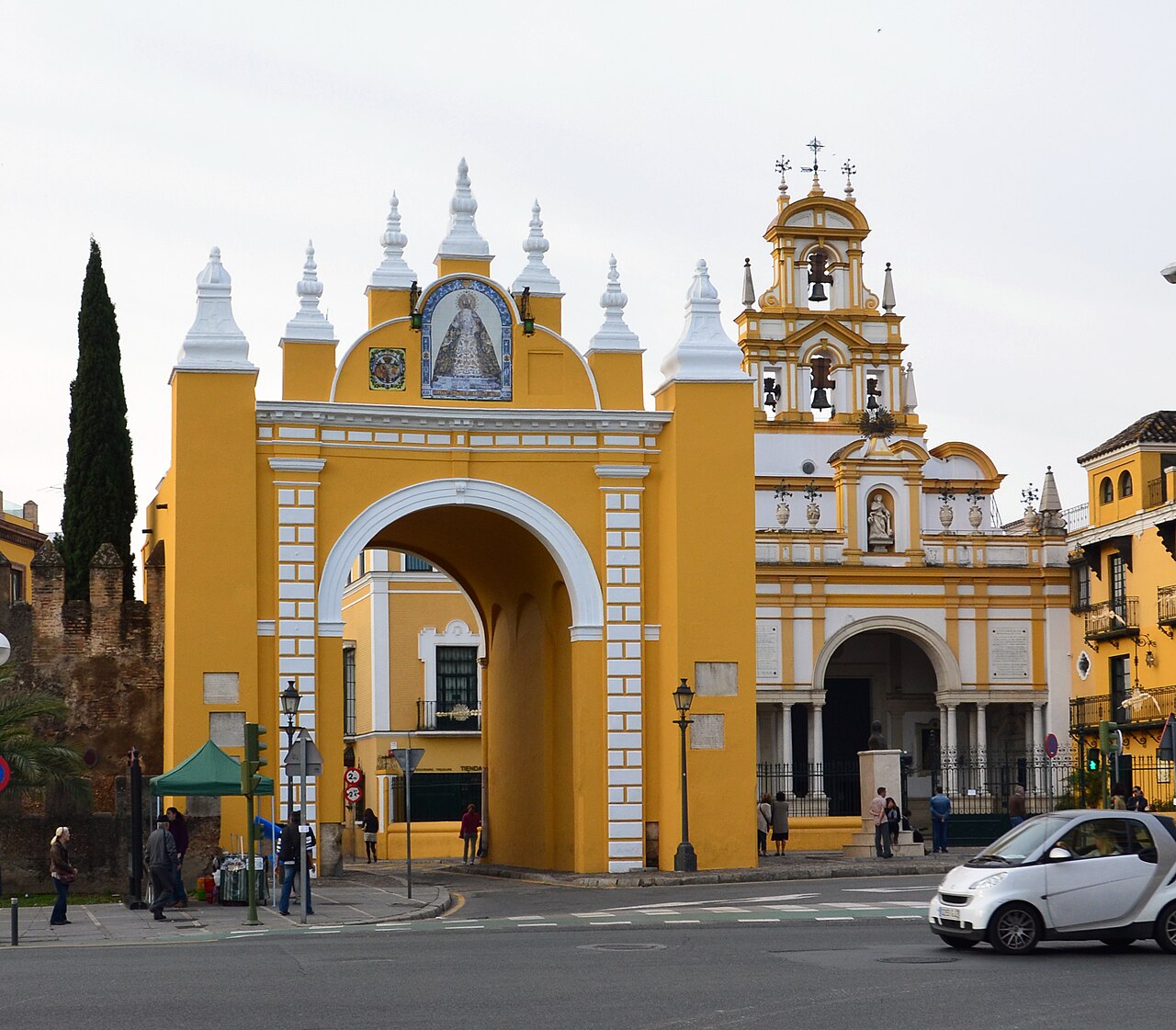
To understand Seville you have to understand Holy Week, the Semana Santa, when dozens of brotherhoods carry their images through the streets in procession, and to understand Holy Week you have to visit La Macarena. The basilica, inaugurated in 1949 and built largely with donations from the faithful, stands just inside the old city gate of the same name in the north of the old town, and it is the home of the Esperanza Macarena, the image of the Virgin of Hope carved by an anonymous sculptor in the seventeenth century. Few images anywhere inspire such devotion. She stands above the high altar, her face streaked with crystal tears, dressed in rich embroidered robes and wearing on her breast five emerald-green brooches, the mariquillas, a gift from the great bullfighter Joselito el Gallo, who was devoted to her. In the small hours of Good Friday, during the night known as the Madrugá, her brotherhood carries her out of the basilica on a silver float, preceded by the image of Christ of the Sentence and by the armaos, the brotherhood's Roman soldiers, and thousands of people wait through the night to see her pass. The rest of the year, the basilica is a place of constant visits, with Sevillanos dropping in to pray and visitors coming to see the image. The brotherhood's museum shows the treasures of the procession: the floats, the processional robes with their dazzling gold embroidery, the crowns, candlesticks and liturgical objects, and the uniforms of the armaos, and it explains how a brotherhood works and what the procession means. Outside, beside the basilica, runs the best-preserved stretch of Seville's Almohad walls, more than a hundred metres of twelfth-century rammed earth with square towers and battlements, alongside the Arco de la Macarena, one of the ancient gates into the walled city.
Visiting: the basilica is open daily, morning and evening, with a closure in the middle of the day; entry to the church is free, and the museum charges a modest fee. Dress respectfully, keep voices low, and avoid visiting during Mass if you want to walk around. The image is visible from the nave throughout the day. Allow half an hour for the basilica and another half-hour for the museum. The walls can be seen from the street at any time; walk along the outside of them on the Ronda for the best view of the towers and battlements.
Holy Week and beyond: if you are in Seville during Holy Week, the Madrugá procession of the Macarena is one of the great experiences of the year, but it is also extremely crowded, so plan carefully and expect to stand for hours. Outside Holy Week, the basilica gives you a sense of that devotion in calm, and the museum's floats and robes help you imagine the procession. Many visitors find the experience surprisingly moving, whatever their own beliefs.
The neighbourhood: the Macarena district is one of the most authentic in the old town, a residential quarter of narrow streets, convents, local markets and neighbourhood bars where tourists are few. From the basilica, walk south along the Calle San Luis, with its fine churches, including the Baroque San Luis de los Franceses, to the Alameda de Hércules for lunch or a drink, or explore the Feria market for a taste of local life. The basilica is about twenty-five minutes on foot from the Cathedral, or a short bus ride. Combine it with the Alameda and the Setas de Sevilla for a day in the north of the old town, far from the crowds of Santa Cruz. In the weeks before Holy Week, the basilica is especially busy with brotherhood preparations and visitors, which adds to the atmosphere.
What to expect
The experience
A free visit to a basilica of intense devotion, with an optional low-fee museum of Holy Week floats and robes, and the Almohad walls outside.
Best time
Morning or early evening, avoiding Mass times; the basilica closes in the middle of the day.
How long
Forty-five minutes to an hour with the museum.
Tips
Dress respectfully and keep voices low. See the walls from the Ronda outside. Walk on to the Alameda de Hércules for lunch.
Quick picks
- Best for
- Travellers who want to understand Seville's Holy Week and its living devotion.
- Families
- Short and free; children enjoy the floats and the armaos uniforms in the museum.
- Couples
- A moving stop on a walk through the authentic north of the old town.
- Pair with
- The Alameda de Hércules, the Setas de Sevilla and the Palacio de las Dueñas.
- Time needed
- About an hour including the museum and walls.
Good questions
Is the Basílica de la Macarena free?+
Yes, entry to the basilica is free. The brotherhood's museum of Holy Week treasures charges a modest fee.
Who is the Esperanza Macarena?+
A seventeenth-century image of the Virgin of Hope, by an anonymous sculptor, and the most beloved religious image in Seville. She processes in the early hours of Good Friday.
What are the mariquillas?+
Five emerald-green brooches on the Virgin's breast, a gift from the bullfighter Joselito el Gallo.
Can I see the city walls?+
Yes. The best-preserved stretch of the twelfth-century Almohad walls runs beside the basilica and can be seen from the street at any time.
How far is it from the Cathedral?+
About twenty-five minutes on foot, through the north of the old town, or a short bus ride.