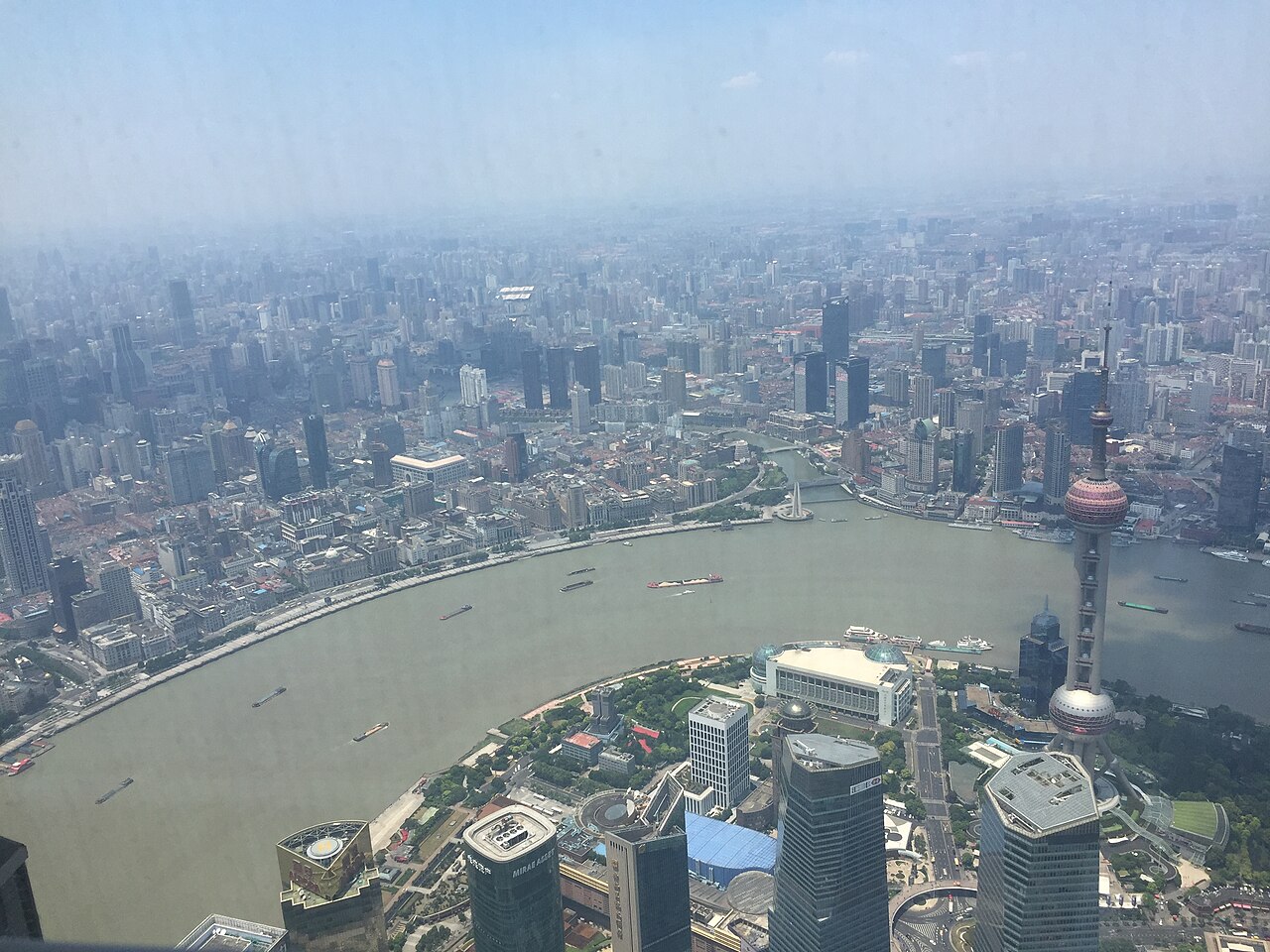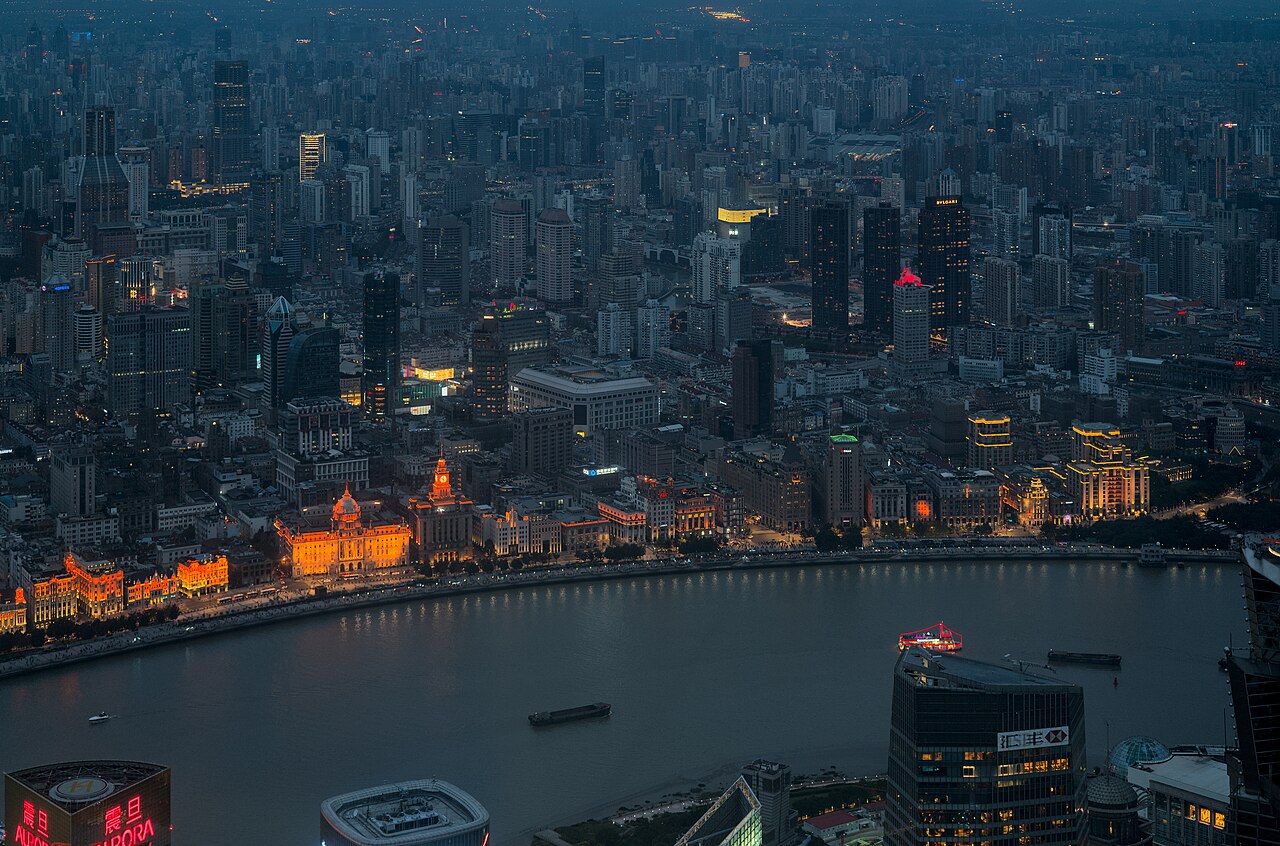
The Bund, or Waitan, is the waterfront that made Shanghai famous. For roughly 1.5 kilometres along the western bank of the Huangpu River, a long row of early twentieth-century buildings in neoclassical, Art Deco and Gothic styles faces the water: former banks, trading houses, customs offices and clubs built when Shanghai was the richest port in Asia. Facing them, across the river, rises Pudong, where the Oriental Pearl Tower, the Shanghai Tower and a forest of glass skyscrapers appear almost unreal at night. The contrast between the two banks, one a century old and the other barely three decades, is the whole point of the place. Walk the elevated riverside promenade for the skyline views and the people-watching, then cross to the building side of Zhongshan East 1st Road to look up at the details: the domed former HSBC building, the clock tower of the Customs House, the green pyramid roof of the Peace Hotel. Many of the old buildings now hold restaurants, bars, galleries and luxury shops, so you can step inside for a drink with a view. It costs nothing, it never closes, and it works in any weather. Even first-timers who plan to skip the headline attractions usually end up here twice, once by day for the architecture and once after dark when both banks are lit.
The history explains the look. After the First Opium War, Shanghai opened as a treaty port in the 1840s and the British settled this muddy riverbank, which became the International Settlement's showcase. By the 1920s and 1930s the Bund was the financial centre of the Far East, and its banks competed to build the grandest facade. After 1949 the buildings passed to state use, and from the 1990s they were restored and reopened, while the opposite bank of rice fields and warehouses was transformed into Pudong. The riverfront itself has been rebuilt several times, most recently into a wider, calmer promenade with more room for pedestrians.
Working the visit: begin at the northern end near the Waibaidu Bridge and walk south, reading the buildings as you go, then return along the water for the skyline. Go in the late afternoon so you can see the facades in daylight, watch the light change, and stay for the evening illumination when the Pudong towers switch on. The promenade is busiest at dusk on weekends and during public holidays, when crowds can be dense and slow. For a calmer experience come early in the morning, when locals practise tai chi and the light is soft and the air is clearer.
Practical notes: the nearest metro stations are East Nanjing Road and Yuyuan Garden on either side, and the walk between the Bund and Nanjing Road pedestrian street is short. Keep an eye on bags in the densest crowds, and ignore touts offering sightseeing trips or art students asking you to follow them to a gallery. The best views of Pudong are from the water side, and a river cruise gives you the reverse view back at the Bund itself, so many visitors pair a walk with a cruise.
What to expect
The experience
A self-guided stroll along the elevated riverfront promenade, with the historic buildings on one side and the Pudong skyline on the other.
Best time
Late afternoon into the evening, so you see the buildings in daylight and the skyline lit; early morning is the quietest.
How long
One to two hours for the full length with stops; most visitors return a second time after dark.
Tips
Walk north to south, then back along the water. Avoid the busiest holiday evenings, ignore touts, and step inside a historic building for a drink with a view.
Quick picks
- Best for
- Every first-timer, as this is the postcard view and the story of the city in one walk.
- Families
- Easy and stroller-friendly, with plenty of space to roam; hold hands in the dense holiday crowds.
- Couples
- Sunset on the promenade, then a drink in one of the old buildings as the Pudong towers light up.
- Pair with
- A Huangpu River cruise, Yu Garden and the Old City, and Nanjing Road a few minutes inland.
- Time needed
- About ninety minutes, plus a second visit after dark.
Good questions
Is the Bund free to visit?+
Yes. The riverfront promenade is open to the public at all hours and costs nothing. You only pay if you go into a restaurant, bar or observation deck.
When is the best time to see the Bund?+
Late afternoon into early evening is ideal, because you can see the facades in daylight and then watch the skyline lights come on. Early morning is calmer and clearer for photographs.
How long is the Bund?+
The classic stretch runs roughly 1.5 kilometres along the Huangpu River. You can walk it in about half an hour without stopping, but most people take one to two hours.
Which side has the best view?+
The promenade on the Puxi side looks across to the Pudong skyline, while the Pudong waterfront looks back at the old Bund buildings. A river cruise gives you both.
How do I get there by metro?+
The closest stations are East Nanjing Road on lines 2 and 10, and Yuyuan Garden on lines 10 and 14. Both are a short walk from the river.