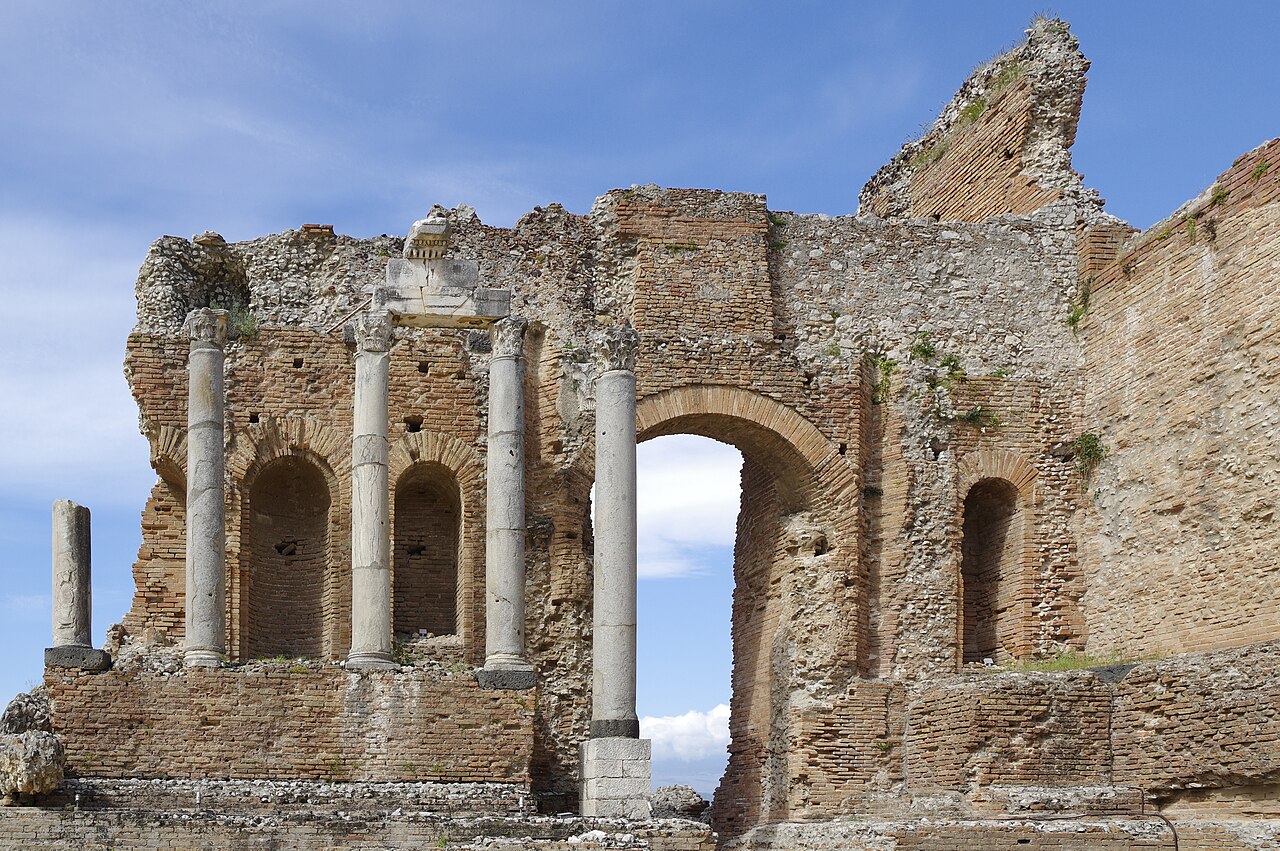
Segesta was a city of the Elymians, one of the island's pre-Greek peoples, and it never stopped quarrelling with its Greek neighbours at Selinunte. At some point in the late fifth century BC its people began a monumental Doric temple on a ridge outside the town, and for reasons still debated the work was never finished. The columns stand without fluting, the roof was never added, and the stone steps are rough. Yet the effect is magical: thirty-six great columns carry a complete entablature, alone in a landscape of golden hills, with no modern clutter in sight. Many people consider it the best-preserved Greek-style temple in Sicily after Concordia at Agrigento. Higher up Monte Barbaro, a shuttle bus or a steep walk takes you to the site of the ancient town, where a theatre carved into the hillside looks out over the valley and across to the Gulf of Castellammare. It is smaller than Taormina's, but the setting is superb, and concerts and classical plays are staged here in the warmer months. Together the temple and theatre make a satisfying half-day visit, and the combination of scenery and antiquity makes it popular with photographers.
Why was the temple never finished? The most common theory is that Segesta's alliance with Athens collapsed after the Athenian defeat at Syracuse, and the money and momentum disappeared, though other explanations point to war with Selinunte. Whatever the reason, the incomplete state teaches you something. You can see the bosses on the blocks that were used for lifting stone, and the columns that would have been fluted if the work had continued.
It is a rare chance to see how a Greek temple looked before it was finished, and it has an austere, timeless character as a result.
Visiting
The temple sits a short walk from the entrance and car park, so even those with limited time can see it, while the theatre and town site are reached by shuttle or a climb of around twenty minutes. There is little shade, so in summer go early or late and bring water, sun protection and sturdy shoes.
In spring the hillsides are green and wildflowers bloom, which makes the temple especially beautiful. Entry hours change by season, and the theatre can be closed or restricted around performances, so check before you plan around a particular time.
Combining it with other stops
Segesta lies roughly an hour from Palermo, and it is often paired with the hilltop town of Erice, the salt pans of Trapani or the coast at Castellammare del Golfo. Some travellers add the Greek ruins of Selinunte for a Greek-temple double. A rental car makes the trip simplest, though guided excursions are common from Palermo, and the nearest railway station is some distance away.
Aim for a morning start, enjoy a lunch of local pasta with sardines or couscous in the area and return in the afternoon with a sense of how many layers of history Sicily holds.
If you have an extra hour, linger at the temple rather than rushing on. The light changes quickly across the valley, and the columns look different in the morning haze than at the end of the day. Walk a little way along the path to see the temple from different angles, and notice how the ridge frames it against the sky. Many visitors find that this quiet pause, with only wind and birdsong for company, is the part of the day they remember best.
What to expect
The experience
A self-guided visit to the temple, followed by a shuttle or climb to the hilltop theatre and ancient town.
Best time
Spring for green hills and wildflowers, or early morning and late afternoon in summer when the light is soft and the heat lower.
How long
Two to three hours, longer if you walk to the theatre and linger.
Tips
There is little shade, so bring water, a hat and good shoes, and check seasonal hours.
Quick picks
- Best for
- Anyone who loves ancient ruins in dramatic landscapes and wants a quieter alternative to the busiest sites.
- Families
- Open spaces suit children, but the heat and the climb to the theatre can be tiring.
- Couples
- Golden-hour light on the temple is as romantic as ancient sites get.
- Pair with
- Erice, the Trapani salt pans or a drive to Monreale.
- Time needed
- Half a day, or a full day with Erice.
Good questions
Why is the temple unfinished?+
No one knows for certain. The most popular theory is that war and the loss of Athenian support halted the work in the late fifth century BC.
Is it worth climbing to the theatre?+
Yes, the setting is superb and the views are wide. A shuttle bus makes it easy if you do not want to walk.
How far is Segesta from Palermo?+
Roughly an hour by road, which makes it an easy day trip, often combined with Erice or the Trapani salt pans.
Are there events at the theatre?+
Concerts and classical plays are staged in the warmer months. Check the programme and note that parts of the site may close on event days.
What should I bring?+
Water, sun protection and sturdy shoes, since there is little shade and the ground is uneven.