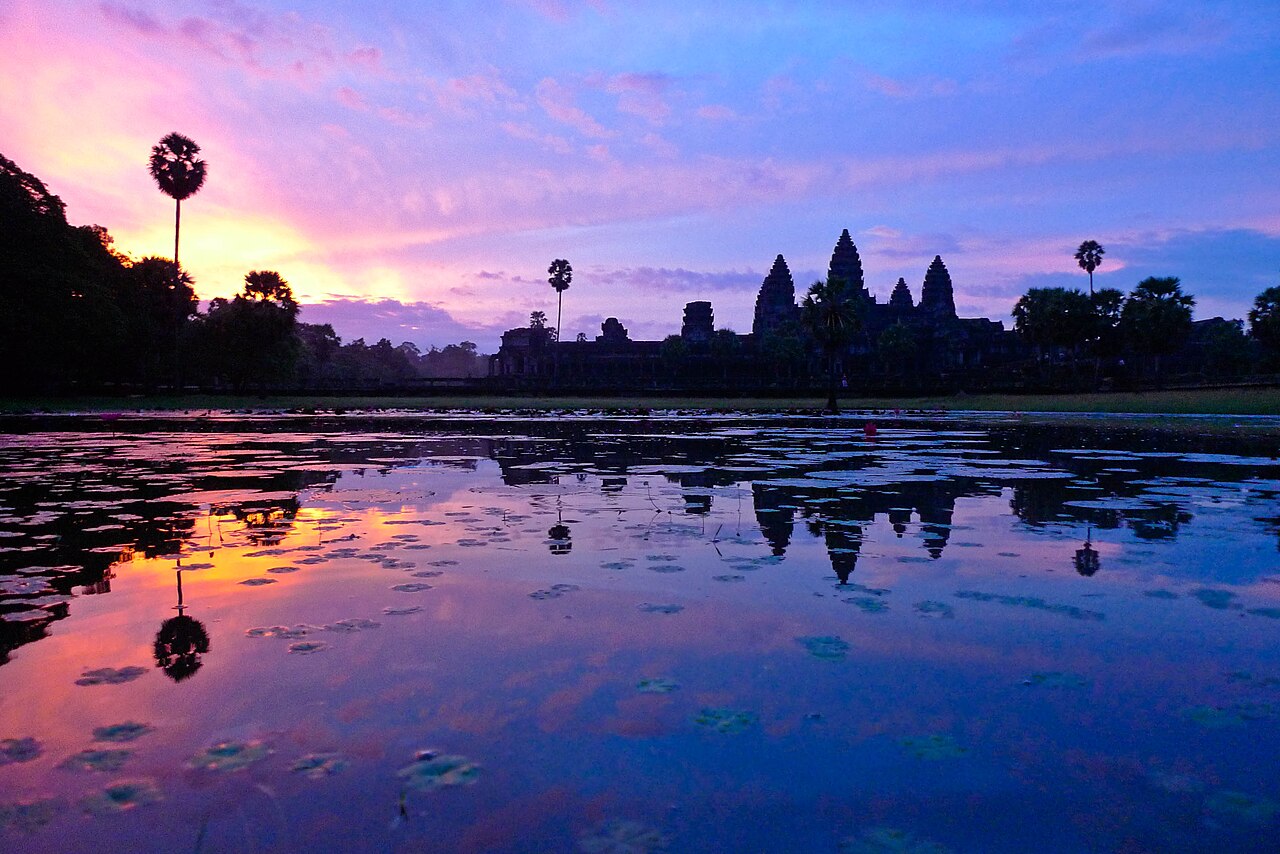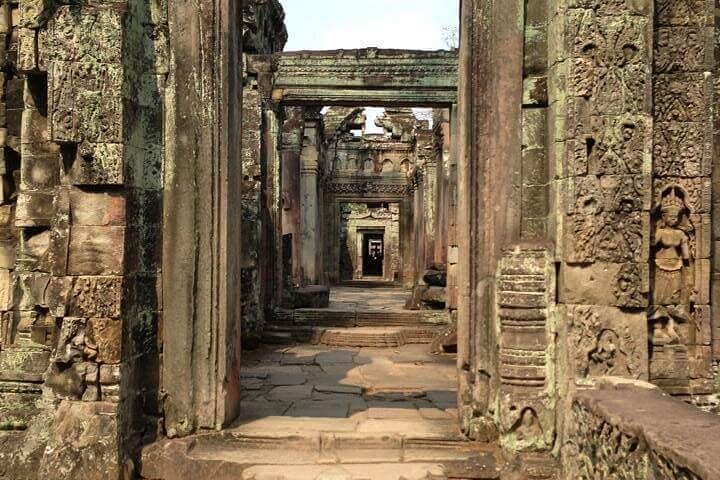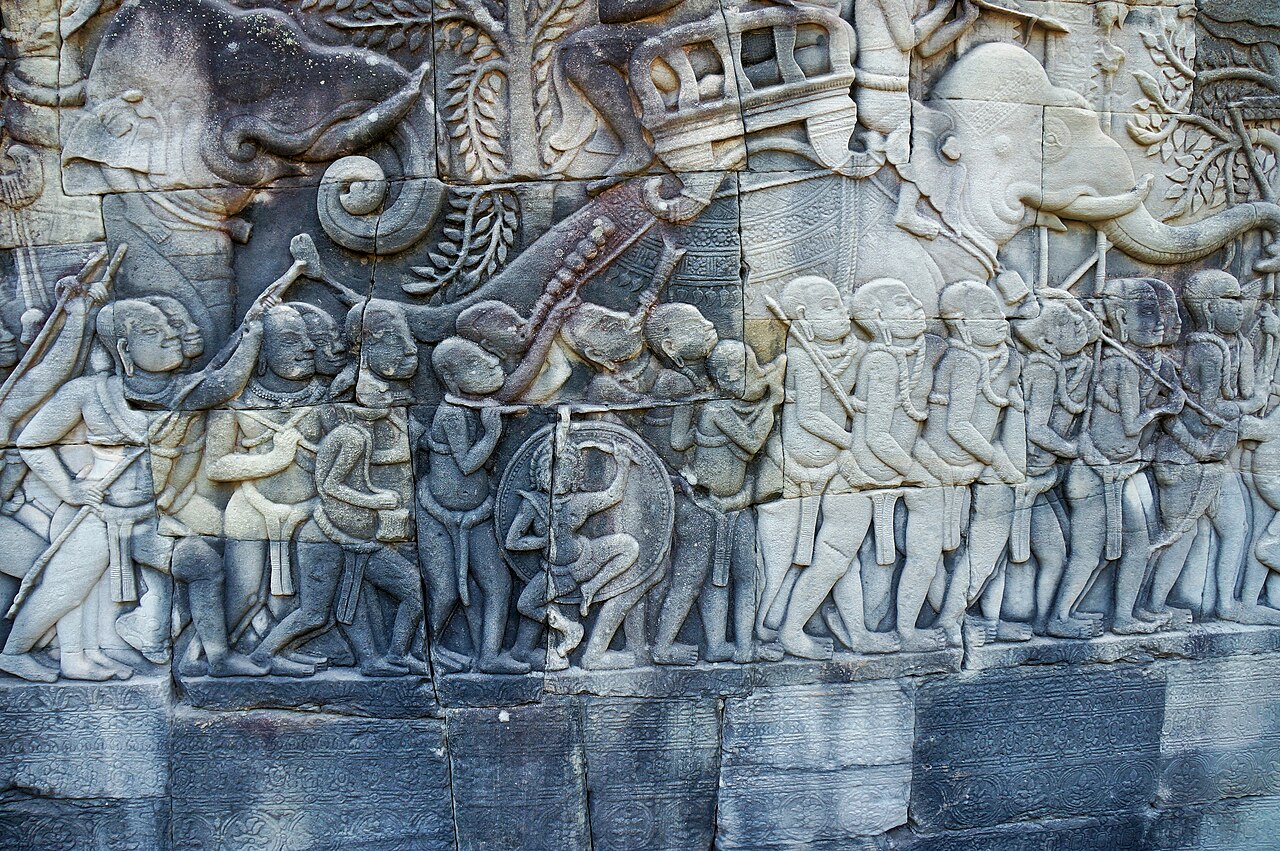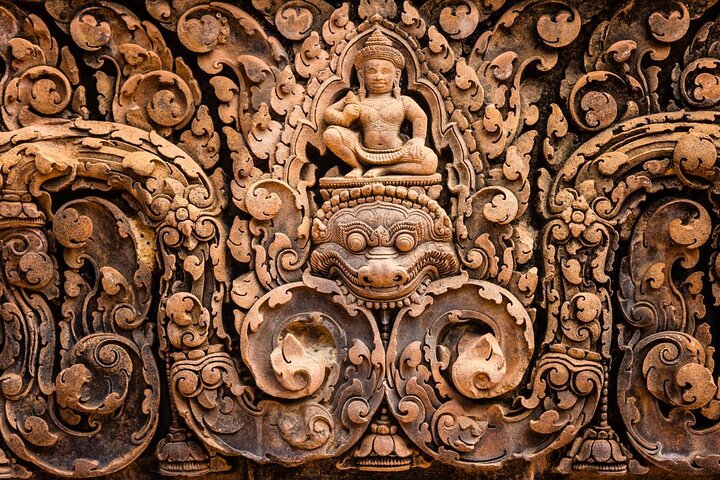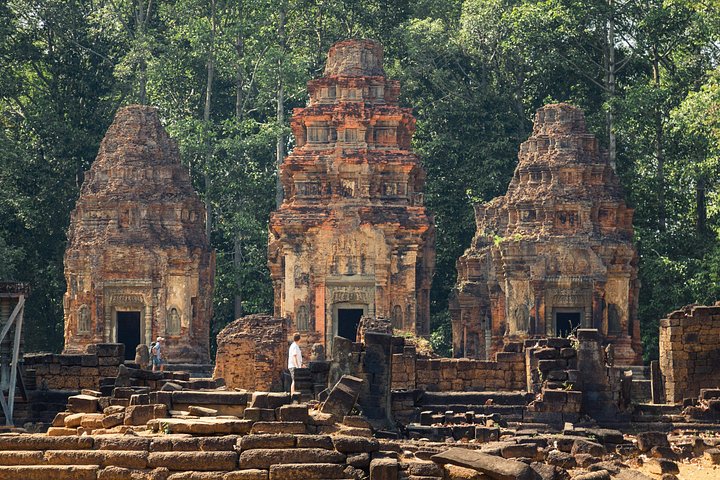
Long before Angkor Wat, the Khmer kings ruled from Hariharalaya, a capital about fifteen kilometres south-east of today’s Siem Reap, and its temples at Roluos are the earliest large monuments of the Angkorian age. They show the Khmer style forming: brick towers with carved sandstone doorframes, lintels crowded with leaves and mythical beasts, and the first true temple-mountains. Preah Ko, dedicated in the late ninth century, has six brick towers in two rows, with stucco still clinging to some of them, and guardian lions and a sacred bull that give it its name, which means Sacred Ox. Bakong, the largest of the group, was the state temple of King Indravarman I. It rises in five sandstone tiers like a stepped pyramid, with eight brick towers at the base and a later central sanctuary on top, and it is the template that Angkor Wat’s builders would perfect three centuries later. Lolei stands on what was once an island in a vast reservoir, now dry, and its four brick towers are best seen in the soft light of the late afternoon. The area around the temples is still a living village, with monks at Bakong’s working monastery and children selling bracelets at the gates.
How to visit
The Roluos Group lies on the road to Phnom Penh, a drive of roughly thirty minutes from the centre of Siem Reap, so it is easy to fit into a half day. The temples are inside the Angkor Archaeological Park, so you need an Angkor Pass, which is not included in the tour and is sold only by Angkor Enterprise. Allow around twenty to thirty minutes at each of the three main temples, longer at Bakong, where you can climb the stepped pyramid.
The tour
The half-day tour covers the main sites in the group with transport and a guide, usually Preah Ko, Bakong and Lolei in order. A guide helps you read what you are seeing: the difference between brick and sandstone construction, the way the carvings of the ninth century differ from the later Bayon and Angkor Wat styles, and the story of Indravarman’s great reservoir. Confirm pickup times, group size and inclusions when booking, as these can vary by operator.
Making the most of it
Start at Preah Ko when the light is low, then spend time at Bakong, where the tiers are steep but not crowded, and finish at Lolei in the late afternoon. The Roluos temples are particularly rewarding if you have already seen Angkor Wat and the Bayon, because the contrast shows you how far Khmer architecture travelled in three hundred years. Bring water and a hat, wear covered shoulders and knees at the active monastery, and ask your guide about the village life around the temples.
Children and keen photographers often enjoy Roluos more than they expect, because the sites are small, the paths are short and there is room to look around without a crowd at your elbow. If you have a three-day pass, Roluos is a natural fit for a slow morning on day three, and you can combine it with a visit to a stilt village on the Tonle Sap in the afternoon.
What to expect
The experience
A guided half-day trip east of Siem Reap to the ninth-century temples of Preah Ko, Bakong and Lolei.
Best time
Early morning or late afternoon, with the dry months from November to February the most comfortable for walking.
How long
About four hours with transport, including twenty to thirty minutes at each temple and a little longer at Bakong.
Tips
Carry your Angkor Pass, cover shoulders and knees, bring water and a hat and wear shoes you can climb steps in.
Quick picks
- Best for
- History lovers who want to see where the Khmer style began, and travellers who prefer quiet sites to crowded ones.
- Families
- The short stops and the climbable stepped pyramid at Bakong suit children who are tired of long temple days.
- Couples
- A quiet, unhurried late-afternoon visit with golden light on the brick towers, away from the sunset crowds.
- Pair with
- A Tonle Sap stilt-village visit in the afternoon, or Angkor Wat at sunrise the same day.
- Time needed
- Half a day.
Good questions
What are the Roluos temples?+
The Roluos Group is a set of late ninth-century temples, including Preah Ko, Bakong and Lolei, that stood in the Khmer capital of Hariharalaya. They are the earliest large monuments of the Angkorian age.
How far is Roluos from Siem Reap?+
The temples are around fifteen kilometres to the south-east, a drive of roughly thirty minutes on the road towards Phnom Penh.
Do I need an Angkor Pass for Roluos?+
Yes, the Roluos Group is inside the Angkor Archaeological Park, and the pass is not included in the tour. Buy it online or at the ticket office on Road 60.
Can I climb Bakong?+
Visitors can usually climb the steps of the central pyramid, although some sections may be closed for conservation work. The steps are steep, so wear shoes with grip.
Is Roluos worth visiting after Angkor Wat?+
Yes, because it shows where Khmer temple architecture started, and the sites are much quieter. It makes a good contrast to the grand temples of the main circuit.