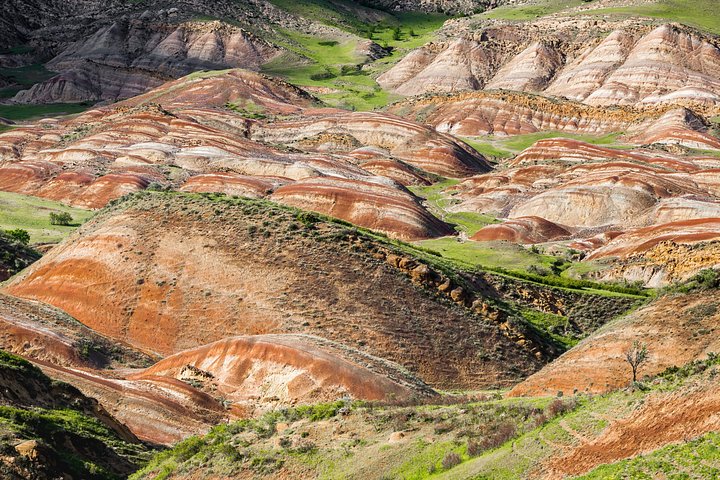
David Gareja is the strangest and most atmospheric excursion within reach of Tbilisi. Out beyond the last vineyards, the green Georgia of the postcards gives way to bare, wind-scoured steppe, and on a rocky ridge stands a monastic complex whose cells, chapels and refectories were hollowed out of the rock by monks from the sixth century onward. The community was founded by Saint David, one of the Assyrian fathers said to have brought monastic life to Georgia, and over the centuries it grew into a chain of cave monasteries, painted churches and hermit cells that was sacked more than once and restored again. Monks still live at the lower monastery today. Beyond the main buildings, the hills show layered bands of rust, ochre, mauve and grey, which is where the Rainbow Mountains get their name, and the best views come at golden hour on the ridge walk.
How to visit
The complex lies roughly two hours by road from the capital, and the last stretch is a rough track, so most visitors go with a driver-guide rather than driving themselves. The group tour runs about seven hours and leaves from central Tbilisi. There is almost no shade and no shop on the ridge, so bring water, a hat, sun cream and a snack.
The paths between the caves are steep, loose and uneven, so wear shoes with grip rather than sandals. The complex runs along the frontier with Azerbaijan, so follow your guide’s instructions about which paths and viewpoints you can use.
What to expect
You walk through the working monastery, where modest dress is required, with shoulders and knees covered and a scarf for women, then climb to the ridge above for the long view across the plain and the striped hills. Inside the caves you see plain cells, small chapels and traces of faded frescoes, and the guide explains how the monks lived, how invaders and later the Soviet military, which used the surrounding steppe as a firing range, left their mark, and why the site matters to Georgian identity. Photographers should plan for the late-afternoon light, when the colour in the hills deepens.
Making the most of it
Spring and autumn are the best seasons, when the grass is green or the air is clear and the temperature is comfortable. Summer is hot and dry, and the track can turn to mud after rain in winter. Pair it with a quiet evening in Tbilisi, or combine it in your own plans with a Kakheti day on another date, since the two trips complement each other well.
What to expect
The experience
A guided small-group day trip by minibus to the David Gareja cave monastery complex, with time on the ridge and a stop at the striped Rainbow Mountains.
Best time
Spring and autumn for comfortable temperatures and clear air; in summer go early, and expect mud on the track after winter rain.
How long
About seven hours, including roughly two hours of driving each way.
Tips
Bring water, a hat and sun cream, wear shoes with grip, cover shoulders and knees for the monastery and follow your guide’s directions on the ridge.
Quick picks
- Best for
- Travellers who want an unusual landscape and a very different side of Georgia from the mountains and vineyards.
- Families
- Older children enjoy the caves and the open space, but there is no shade or food on site and the ridge paths are steep.
- Couples
- Late light over the striped hills is one of the most photogenic moments in eastern Georgia.
- Pair with
- A Kakheti wine day on another date for the greenest and driest sides of eastern Georgia.
- Time needed
- A full day, with an early start recommended in summer.
Good questions
How far is David Gareja from Tbilisi?+
It is roughly two hours by road from the capital, and the final stretch is a rough track. Most visitors go with a guided tour rather than self-driving.
What are the Rainbow Mountains at David Gareja?+
They are dry hills near the monastery whose layered rock shows bands of rust, ochre, mauve and grey. They look best in the low light of late afternoon.
What should I wear at David Gareja?+
Cover shoulders and knees for the working monastery, and women are asked to cover their hair. Wear sturdy shoes, as the paths between the caves are steep and loose.
When is the best time to visit David Gareja?+
Spring and autumn are the most comfortable, while summer is hot and shadeless. Winter rain can make the approach track muddy.
Is there food at David Gareja?+
There is no shop or restaurant on the ridge, so bring water and snacks. Tours usually build in a meal or stop on the way back, so check the inclusions before you go.