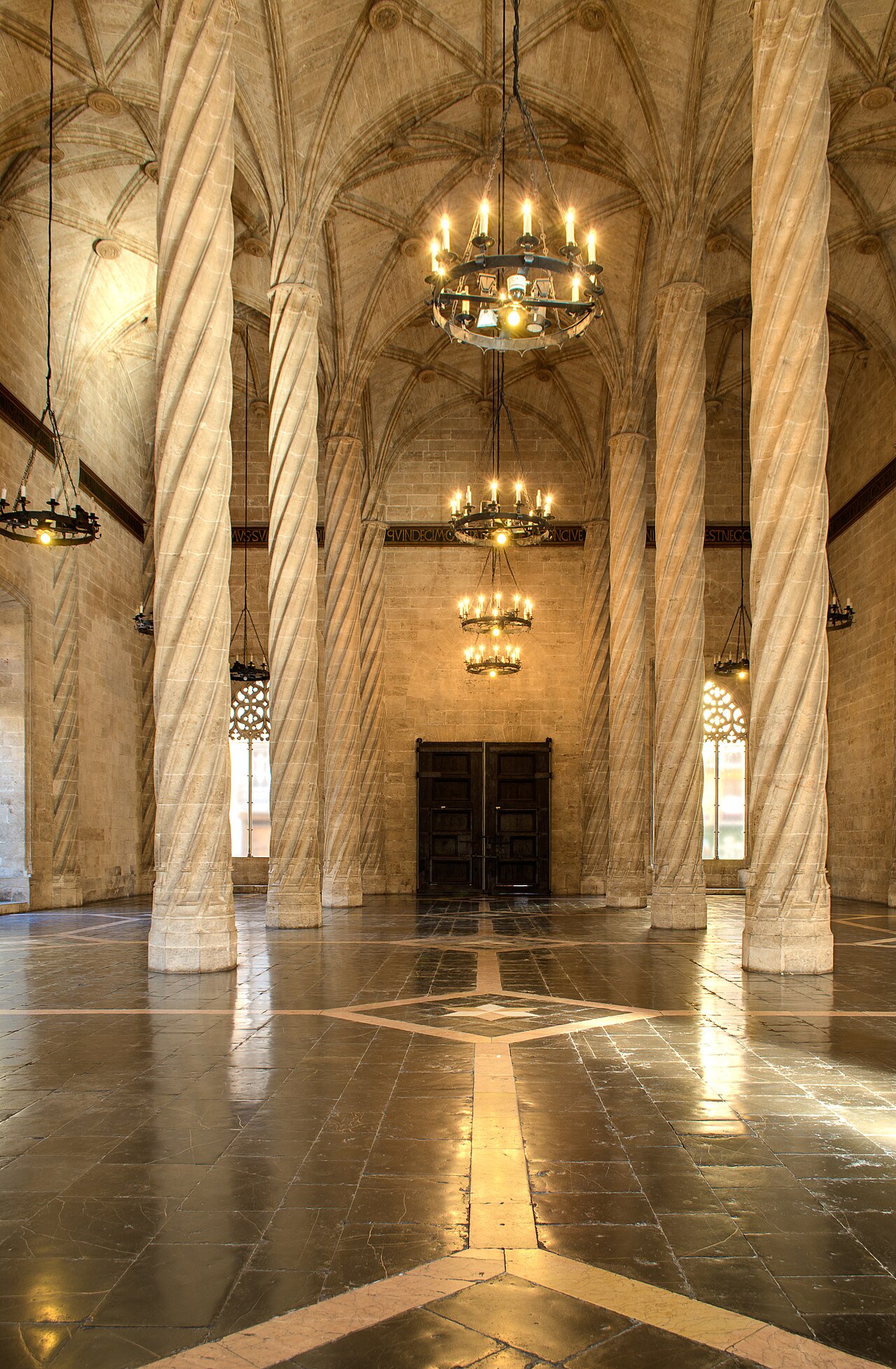
In the late fifteenth century Valencia was one of the richest trading cities in the Mediterranean, and La Lonja de la Seda was built to show it. The Silk Exchange is one of the finest civil Gothic buildings in Europe and has been a UNESCO World Heritage Site since 1996. Its centrepiece is the Hall of Columns, the old trading floor, where slender spiral columns twist up to a ribbed vault like the trunks of palm trees, and where merchants once sealed deals in silk, cloth and spices. Look down and the floor is laid in coloured marble; look up and the vault seems almost weightless. A tower holds the old cells once used to lock up merchants who defaulted on their debts, and the Consulate of the Sea wing upstairs has a magnificent coffered wooden ceiling brought from the old city hall. Between the wings lies a quiet courtyard planted with orange trees, and the outside walls are lined with carved gargoyles and figures, some of them surprisingly rude. Entry is a modest fee, the building is compact, and it sits directly opposite the Central Market, so it fits easily into any old town morning.
How to see it: enter from the main façade on the Plaza del Mercado, spend time in the Hall of Columns, then cross the orange-tree courtyard to the Consulate of the Sea and climb to its upstairs hall for the ceiling. Before you leave, walk all the way around the outside to spot the gargoyles, which include animals, monsters and some cheeky scenes that make children giggle. Information panels explain the history, and audio guides and guided walks are available.
What to expect: the visit takes 45 minutes to an hour, longer if you join a guided tour. Mid-morning, when tour groups come through on the way to the market, is the busiest time; the first hour and the late afternoon are quieter and the light through the high windows is lovely. There are some steps, and the upper hall is reached by stairs.
Making the most of it: time your visit with the Central Market across the road, which closes in the afternoon, so do the Lonja first and the market second, or the other way round before lunch. The guided Valencia Essential walking tour sold on the same Tiqets page includes entry to the Silk Exchange if you prefer the story told in person.
What to expect
The experience
A self-guided or guided visit through the Hall of Columns, the orange-tree courtyard and the Consulate of the Sea in a Gothic trading hall.
Best time
At opening or in the late afternoon, outside the mid-morning group rush.
How long
About an hour.
Tips
Walk the outside walls to find the gargoyles, and visit the Central Market across the road while it is still open.
Quick picks
- Best for
- Architecture lovers and anyone who wants Valencia’s finest Gothic interior in under an hour.
- Families
- Short and striking, and the gargoyle hunt outside keeps children busy.
- Couples
- A quiet late-afternoon visit, then tapas in the lanes around the market.
- Pair with
- The Central Market, the cathedral and the Church of San Nicolás.
- Time needed
- One hour.
Good questions
Why is La Lonja a UNESCO World Heritage Site?+
It is an outstanding example of late Gothic civil architecture and a symbol of Valencia’s wealth as a Mediterranean trading power. It was inscribed on the World Heritage List in 1996.
What is the Hall of Columns?+
It is the old trading floor, where twisting spiral columns rise to a ribbed vault like palm trees. Merchants traded silk and other goods here.
How long does a visit take?+
Most visitors spend 45 minutes to an hour. A guided walking tour that includes the Lonja takes about two hours with other old town sights.
Is La Lonja near the Central Market?+
Yes, it stands directly opposite the Central Market on the Plaza del Mercado. Visiting both in one morning is easy.
Is there an entry fee?+
Yes, a modest entry fee applies, with reductions for students and seniors. Guided tours and audio guides cost a little more.