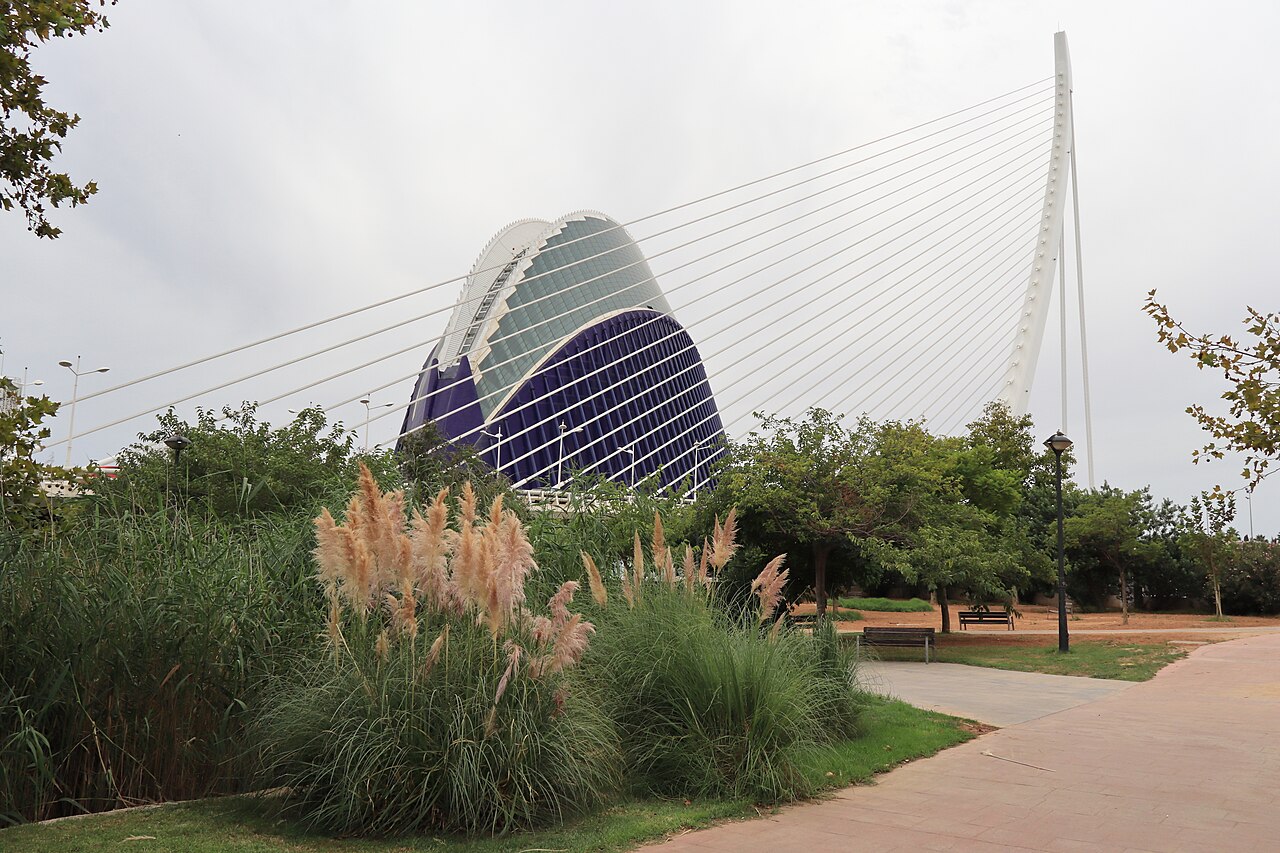
The Turia Gardens are Valencia’s great green spine and one of the most original city parks in Europe. The Turia river once ran right past the old town, until a catastrophic flood in 1957 led the city to divert it south. The empty riverbed was earmarked for a motorway, but residents campaigned for a park instead, and the gardens opened in stages from the 1980s. Today they run for about nine kilometres in a curving green ribbon from the Parque de Cabecera and Bioparc in the west to the City of Arts and Sciences in the east, sunk below street level and crossed by 18 bridges, some of them centuries old. Inside you find orange trees and palms, pine groves, fountains, ponds and rose gardens, running and cycling paths, football and baseball pitches, and the Gulliver playground, where children climb over a giant figure of the shipwrecked traveller. The Palau de la Música concert hall stands beside the gardens too. Locals use it all day for running, cycling, picnics and Sunday family walks, and for visitors it is the most pleasant way to cross the city. Entry is free and the gardens are open every day.
How to see it: the best way is by bike, using the city’s Valenbisi bike share or a rental shop near the old town. Ride the full length from Bioparc to the City of Arts and Sciences, stopping at the Torres de Serranos gate, which overlooks the gardens on the old town side, and at the Gulliver playground with children. On foot, pick a stretch near your hotel and walk between two or three bridges.
What to expect: the gardens are flat, shady in many sections and lively with joggers, cyclists and families, especially at weekends. Paths for walkers and cyclists are mostly separated, but keep an eye out at crossings. There are cafés and kiosks along the way and public toilets in some sections, and access is by ramps and stairs from the bridges.
Making the most of it: use the gardens as your route between sights instead of taking buses: the old town, the Palau de la Música, the City of Arts and Sciences and Bioparc all sit on or beside the park. A sunset ride east towards Calatrava’s white buildings is one of the best free experiences in Valencia.
What to expect
The experience
A free, flat park in a former riverbed, explored on foot or by bike, with playgrounds, sports pitches and historic bridges.
Best time
Early morning or late afternoon into sunset, avoiding the strongest summer sun.
How long
One hour for a walk, two to three hours for the full ride.
Tips
Rent a bike, ride east at sunset towards the City of Arts and Sciences and stop at the Gulliver playground with children.
Quick picks
- Best for
- Everyone: it is the green heart of the city and the best way to get around.
- Families
- The Gulliver playground, open lawns and traffic-free paths make it ideal.
- Couples
- A sunset bike ride to the City of Arts and Sciences.
- Pair with
- Bioparc at the western end and the City of Arts and Sciences at the eastern end.
- Time needed
- Two hours by bike.
Good questions
Why is there a park in the river in Valencia?+
After a devastating flood in 1957, the Turia was diverted south of the city. Residents campaigned to turn the empty riverbed into a park instead of a motorway.
How long are the Turia Gardens?+
They run for about nine kilometres from the Parque de Cabecera to the City of Arts and Sciences. Eighteen bridges cross the park.
Can you cycle in the Turia Gardens?+
Yes, there are dedicated cycle paths along most of the park. Bikes can be hired from shops or through the Valenbisi bike share.
What is the Gulliver playground?+
It is a huge play structure shaped like Gulliver tied down by the Lilliputians, with slides and ramps over his body. It is one of the most popular spots for families.
Are the Turia Gardens free?+
Yes, the gardens are free and open every day. Only attractions such as Bioparc and the City of Arts and Sciences charge entry.