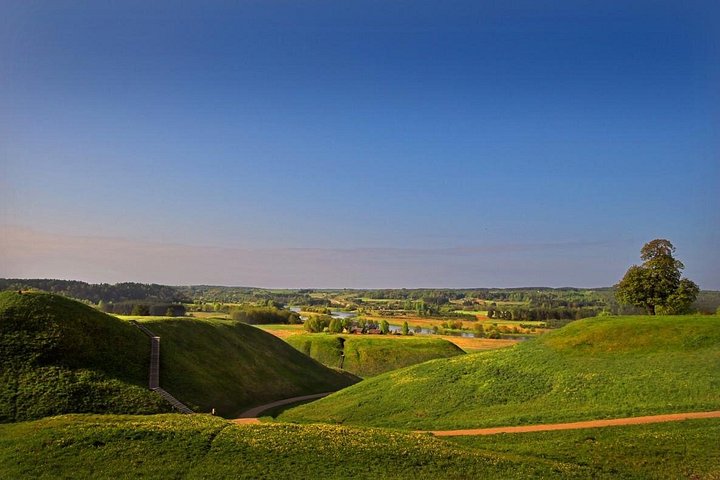
Kernavė is one of the quiet treasures of Lithuania: a tranquil stretch of the Neris valley, about thirty-five kilometres from Vilnius, where five grassy hillforts rise above a field that was once a medieval town. In the thirteenth and fourteenth centuries it was a major centre of the early Lithuanian state and, in the Grand Duchy’s early years, one of its capitals, which is why it is sometimes called the Troy of Lithuania. It was burned by the Teutonic Order in 1390 and never rebuilt, so the archaeological layers lie preserved beneath the meadows. UNESCO inscribed the site on the World Heritage List in 2004 for its testimony to a vanished medieval culture. What you see now is a landscape rather than a ruin. The mounds are climbable, the valley is green, and walking paths link viewpoints over the river. A museum at the site displays finds from the digs, including tools, jewellery and weapons that show what daily life looked like seven centuries ago. The setting is calm, the crowds are small and the experience suits anyone who likes history and open air. The day tour is a full-day trip that visits Paneriai memorial park and Trakai castle as well as Kernavė, so you cover three very different sites in one outing.
How it works
The product is a small-group or private day tour from Vilnius that includes transport and a guide, and it visits the Paneriai memorial, Trakai Castle and the medieval site of Kernavė in one day. The tour is billed as a full-day trip, so expect early departure and a late return. Admission fees for individual sites may or may not be included, so check the product page for details. If you prefer to focus on Kernavė, you can ask the operator about customised options or travel independently by car.
What to expect
Kernavė involves outdoor walking on grass and gravel paths, with some climbing if you choose to ascend the mounds, so comfortable shoes and weather-appropriate clothing are essential. The valley is most attractive from late spring to early autumn, when the grass is green and the river is calm, and winter days can be cold and bare but atmospheric. The Paneriai stop is a sombre memorial to the victims of mass killings during the Second World War, and Trakai is the island castle on Lake Galvė, so the day mixes remembrance, medieval history and scenery.
Making the most of it
Choose this tour if you want to see more of Lithuania than Vilnius and have a full day free. It works well for history lovers, photographers and anyone who wants a quieter alternative to the Trakai crowds. Bring water, a hat in summer and some cash for small purchases. If you only have time for one excursion, the Trakai castle visit is the classic, but this tour adds depth for travellers who want to understand the longer story of the Grand Duchy and the places where it began.
What to expect
The experience
A guided full-day trip by road from Vilnius with stops at the Paneriai memorial, Trakai Castle and the hillforts of Kernavė.
Best time
Late spring to early autumn for green hills and comfortable walking.
How long
A full day.
Tips
Wear sturdy shoes, bring water and check whether site admissions are included.
Quick picks
- Best for
- History lovers who want a deeper look at medieval Lithuania.
- Families
- Good for children who like climbing hills; the Paneriai stop is sombre.
- Couples
- A scenic, peaceful day out in the valley of the Neris.
- Pair with
- Trakai Island Castle and the Old Town walk.
- Time needed
- A full day.
Good questions
What is Kernavė?+
A medieval archaeological site in the Neris valley with five hillforts, once a major centre of the early Lithuanian state.
When was Kernavė made a UNESCO site?+
It was inscribed on the World Heritage List in 2004.
How far is it from Vilnius?+
About thirty-five kilometres, roughly forty-five minutes by road.
What else does the day tour visit?+
The Paneriai memorial park and Trakai Castle.
When is the best time to go?+
Late spring to early autumn, though winter has its own bare, atmospheric beauty.