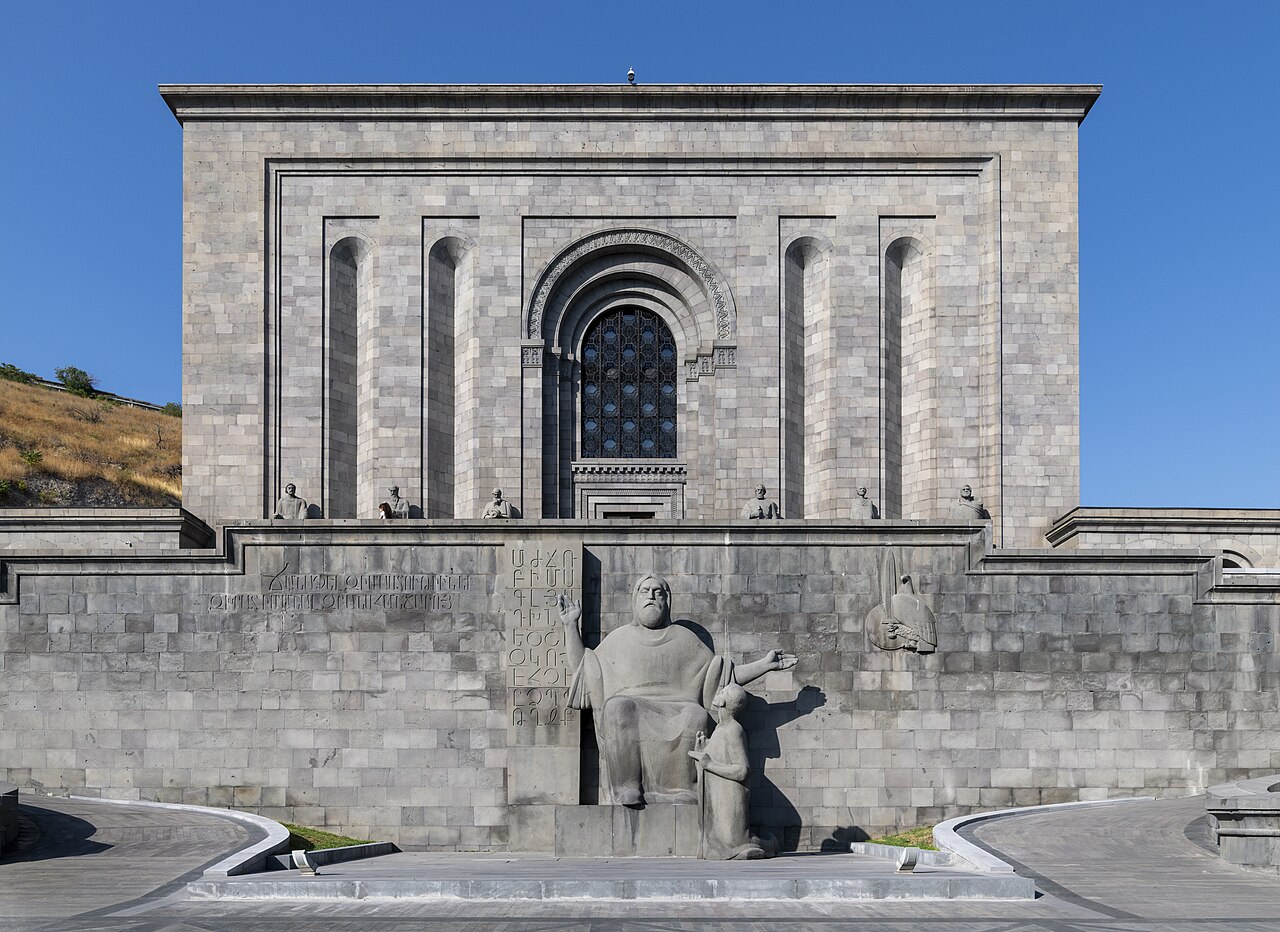
The Matenadaran is the national repository of ancient manuscripts, a severe, grey-basalt building at the head of Mashtots Avenue with statues of scholars and the alphabet's inventor, Mesrop Mashtots, in front. Inside, the museum displays a fraction of one of the world's richest collections of hand-written books. The most beautiful are the illuminated gospels, with gold, lapis and saturated pigments still bright after centuries, and you will also see medieval treatises on medicine, astronomy, mathematics and law, along with maps and translations of classical works that survive nowhere else. The galleries are arranged so that you see the sweep of Armenian book art from the earliest centuries of the Armenian alphabet to the later Middle Ages. Exhibits are labelled in several languages and the building also has a research library and reading room for scholars, so it is both a museum and a working institute. It is compact enough to visit in an hour or two, and it is the clearest window onto the Armenian written tradition, which is why it features on almost every city tour.
The collection grew from the manuscripts that were carried out of monasteries and across borders during centuries of invasion, hidden in walls, wells and caves, and eventually gathered into a national institution in the twentieth century. The building that houses it was completed in the Soviet period and its monumental style is deliberate: it was meant to look like a temple of the book. The statues of the great medieval scholars on the front terrace are a good place to start, with Mashtots himself seated in front of the steps.
Practical details matter here. The museum currently opens Tuesday to Saturday, from the morning until evening, and the booking office keeps the same hours. Adult tickets are modest by international standards, with cheaper rates for children, students and some local categories. Guided tours in English and several other languages are available by reservation and are worth it, because a guide explains the symbols and the way manuscripts were made, which labels alone cannot do. Large cameras and filming need the director's permission.
Do not rush. Take time at the illuminated gospels and the oldest items, and look for the miniature paintings, the gold-leaf initial letters and the binding. Combine the visit with the Cascade and the Opera district, because the Matenadaran sits on a rise just a short walk or taxi ride from Republic Square. It is a good rainy-day choice because it is indoors.
What to expect
The experience
A museum of illuminated manuscripts, maps and scientific texts in a basalt building, visited on a self-guided route or with a reserved guide.
Best time
Mid-morning on a weekday, when the galleries are quiet and the guides are available.
How long
Around ninety minutes with a guide, an hour on your own.
Tips
Reserve a foreign-language guide ahead, bring ID if you claim a discount, and check the official page because Monday and Sunday are not regular visiting days.
Quick picks
- Best for
- Culture and history travellers who want to understand Armenia's written heritage.
- Families
- Best for older children who enjoy books, art or maps; younger ones may tire after the first rooms.
- Couples
- A calm, atmospheric stop before lunch in the centre, followed by the Cascade at sunset.
- Pair with
- The Cascade, a private city tour and the Genocide Memorial.
- Time needed
- Allow two hours with a guide.
Good questions
When is the Matenadaran open?+
The official page lists Tuesday to Saturday, from morning until about six in the evening. Check it before you go because holidays and special events can change the schedule.
How much is entry?+
Adult admission is a small fee in Armenian dram, with lower prices for children, students and certain local groups. Guided tours cost extra and need a reservation.
Are guided tours available in English?+
Yes, foreign-language guides are offered in English and several other languages for small groups. Book ahead because they are subject to availability.
Can I take photos?+
The official page mentions permission only for professional cameras and filming. Ask at the entrance about phone photography in individual galleries.
Is it worth it if I cannot read Armenian?+
Yes, because the manuscripts are visual art first, with colourful miniature paintings and gold lettering. A guide or the labels explain what you are looking at.