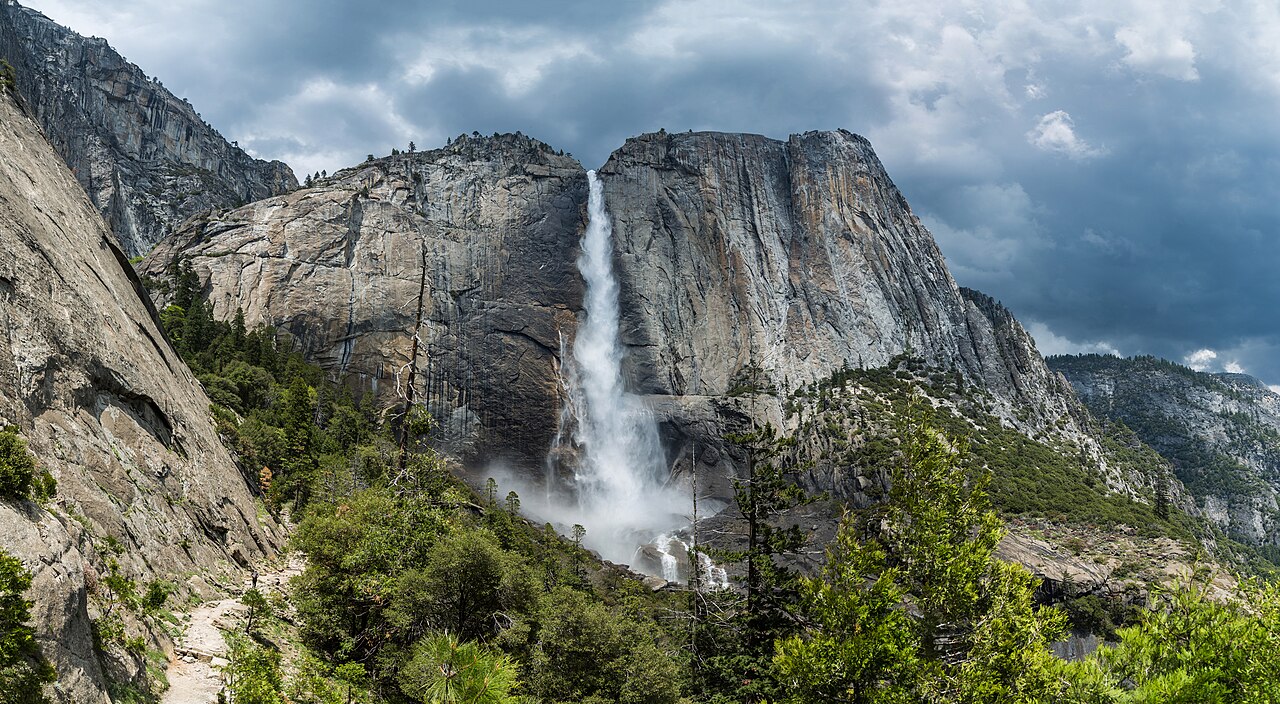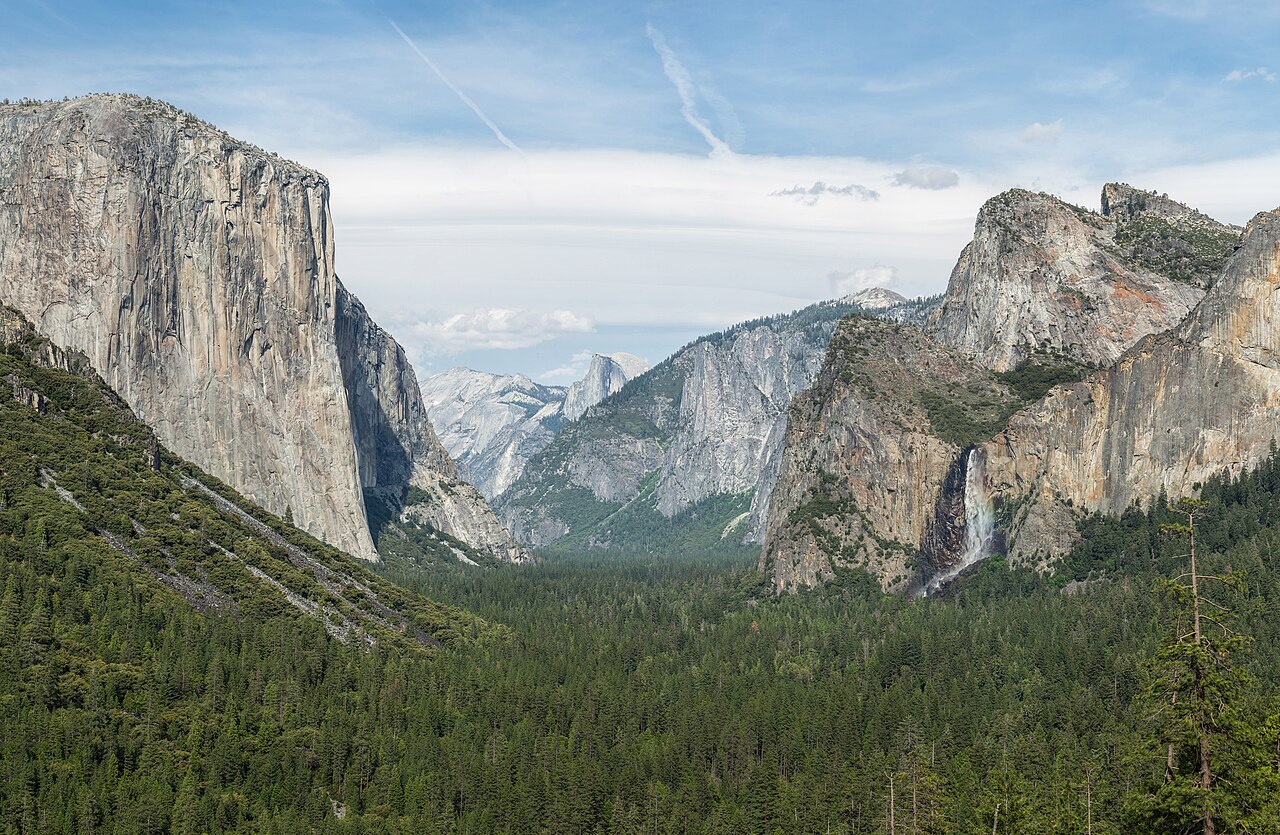
Tunnel View is where most people meet Yosemite Valley, and nothing in the park prepares you for it. You come out of the dark of the Wawona Tunnel on State Route 41 and the whole valley opens at once: El Capitan's sheer granite wall on the left, Bridalveil Fall dropping from its hanging valley on the right, Sentinel and Cathedral Rocks along the south rim, and Half Dome closing the view in the far distance. It is the classic composition that photographers have worked for nearly a century, and the pull-outs on both sides of the road are busy at every hour for good reason. Park in the signed lots rather than stopping in the tunnel approach, cross carefully, and give yourself time — the light changes constantly, and the scene in a clearing winter storm or a spring flood year is unforgettable. A few minutes below, on the way into the valley, a signed parking area serves Bridalveil Fall itself. The National Park Service lists it at about 620 feet, flowing year-round with its peak in May, and the trail to the base is only about half a mile round trip with roughly 80 feet of gain; part of the route is wheelchair accessible. In spring the spray soaks everyone on the viewing platform, and in late summer and fall the fall thins to a wind-blown veil — the reason for its name. Ribbon Fall, the tallest single drop in the valley at about 1,612 feet, is visible from the road just past the Bridalveil turn in spring. Together, Tunnel View and Bridalveil make the ideal first stop on any arrival from the south, and a natural last look on the way out. Both are free beyond the park entrance fee, and both work in every season, including winter, when the valley is often dusted white and the crowds thin dramatically.
The view is engineered as much as it is natural. The Wawona Tunnel opened in the early 1930s as part of a new road into the valley, and the overlook at its eastern portal was laid out so that drivers would emerge to exactly this panorama. Ansel Adams made his most famous images from the slopes around it, and the scene has appeared on everything from postage stamps to computer screens. What you are looking at is a glacial story: ice carved a narrow river canyon into the broad U-shaped valley you see now, leaving side valleys such as Bridalveil Creek hanging high above the floor, which is why the fall leaps rather than cascades. El Capitan rises roughly 3,000 feet from the valley floor, and Half Dome, eight miles away, is the sheared granite dome every visitor learns to recognize.
Timing makes the difference. Morning brings soft light on El Capitan and Half Dome with the sun behind you on clear days; late afternoon lights the face of El Capitan and sets Bridalveil glowing in its mist; and the hour after a winter storm, when clouds lift off the walls, is the moment photographers wait days for. Sunset is popular but often backlit; the best shots usually come earlier. Avoid midday on summer weekends if you can, when the lots fill and the overlook is shoulder to shoulder. For the Bridalveil walk, wear shoes with grip — the final rocky section near the base is slick with spray in spring and can ice over on winter mornings. The NPS notes that some waterfalls freeze along their edges on cold nights, and Bridalveil's spray often coats nearby rocks with rime.
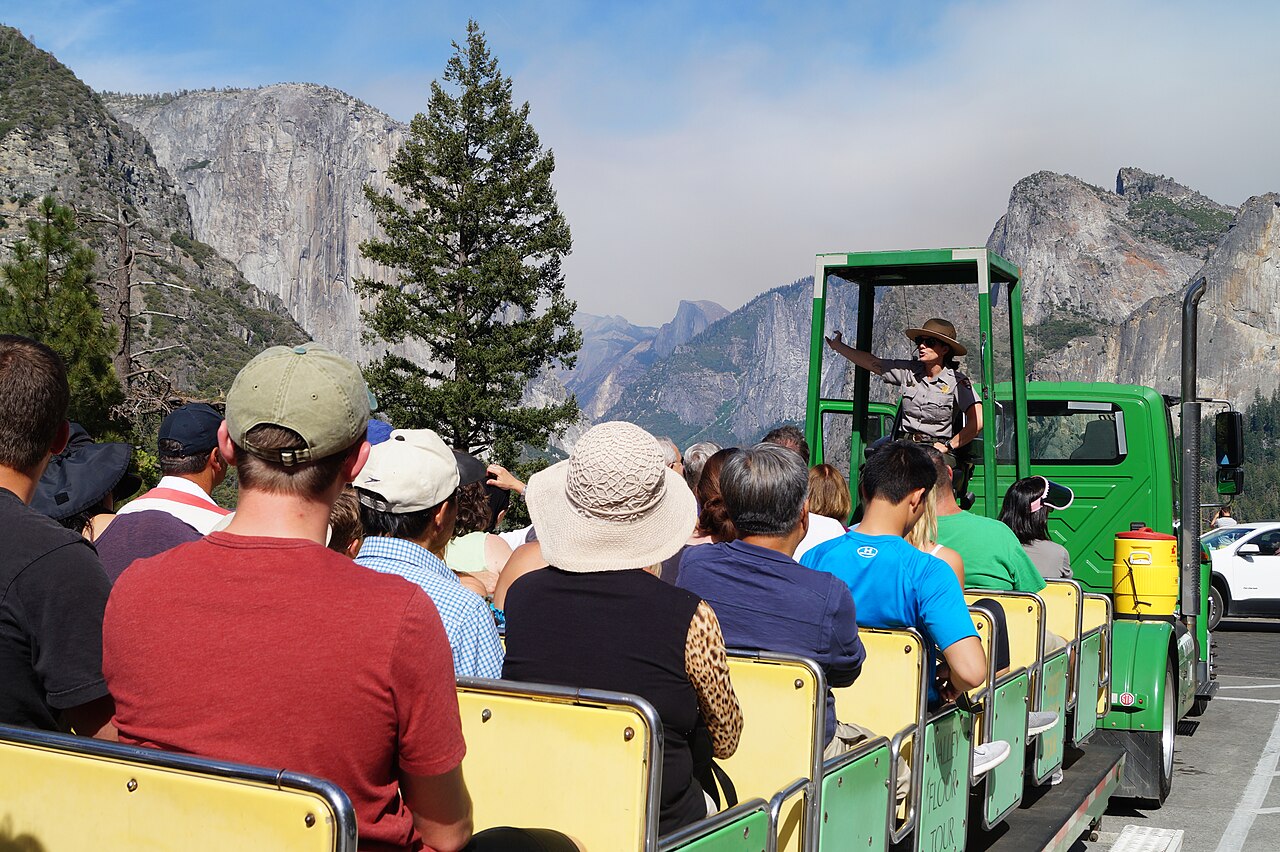
Fitting it into a trip. If you enter by the South Entrance from Oakhurst or Fish Camp, Tunnel View is your first sight of the valley, about an hour after the gate. If you enter from Mariposa and El Portal on Highway 140 or from Groveland on Highway 120, drive up to the tunnel after you reach the valley floor; it is only a short climb from the Bridalveil junction. Many people return at the end of a day for the evening light. The Valley Floor Tour stops here with a ranger-style narrative, which is a good option in winter if you prefer not to drive icy roads. Pair the view with the Bridalveil walk, a drive along Southside Drive past Cathedral Rocks and El Capitan Meadow, and a stroll to Lower Yosemite Fall for the classic first afternoon.
What to expect
The experience
A roadside overlook at the eastern mouth of the Wawona Tunnel on Highway 41, plus a short half-mile round-trip trail to the base of Bridalveil Fall from its signed parking area below.
Best time
Morning or late afternoon for side light on El Capitan and the fall; the hour after a winter storm for clearing clouds; spring for full flow and spray.
How long
Twenty minutes at the overlook, half an hour for the Bridalveil walk.
Tips
Park only in the marked lots and cross with care. Expect spray at Bridalveil in spring and ice on winter mornings. Come back at the end of the day for different light.
Quick picks
- Best for
- Every first-time visitor — this is the view that explains Yosemite in one frame.
- Families
- Easy and short, with an accessible section of the Bridalveil trail; hold small hands near the road.
- Couples
- A late-afternoon stop with El Capitan glowing, then dinner in the valley.
- Pair with
- El Capitan Meadow and Lower Yosemite Fall for a classic first afternoon.
- Time needed
- An hour for both stops.
Good questions
Where is Tunnel View?+
At the eastern end of the Wawona Tunnel on Highway 41 (Wawona Road), just above the valley floor. Coming from the South Entrance it is your first look at the valley; from Highways 140 or 120, drive a few minutes up from the Bridalveil junction.
How tall is Bridalveil Fall?+
About 620 feet, according to the National Park Service. It flows all year, peaks in May, and thins to a windblown veil by late summer.
How long is the Bridalveil Fall trail?+
About half a mile round trip with roughly 80 feet of elevation gain. Part of it is wheelchair accessible, and the final stretch can be wet or icy near the base.
Is Tunnel View open in winter?+
Yes. Wawona Road is kept open year-round, though chain controls can apply during storms. Winter is one of the best times for photographs, especially as clouds clear after snow.
Does it cost extra to visit?+
No. Both stops are covered by the park entrance fee, and there is no separate charge for parking.