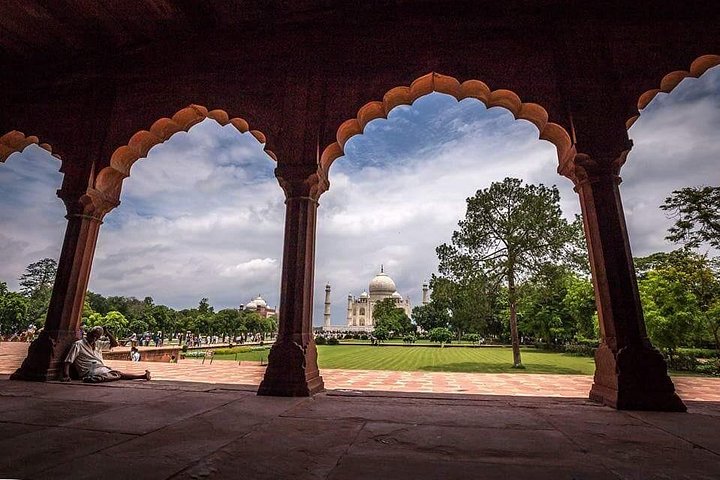
Chini Ka Rauza, sometimes called the China Tomb, is the mausoleum of Afzal Khan Shirazi, a poet and scholar who served as a minister at the court of Shah Jahan. It stands on the east bank of the Yamuna in the Etmadpur area of Agra, only about a kilometre from the tomb of Itmad-ud-Daulah, and was built in the early seventeenth century. The name means the tomb of the glazed tile, because its walls were once covered in bright blue, green and yellow glazed tiles that gave a distinctly Persian look. Time has worn much of the surface, but traces of the tilework and the painted floral decoration inside survive, and the tall dome and arched portals are still impressive. It is a peaceful place, usually almost empty, and offers a glimpse of Mughal architecture as it developed between the red sandstone of Akbar and the white marble of Shah Jahan.
The tomb is a single square building with a tall central dome, set in a modest garden enclosure by the river. The facade is divided by deep arched recesses, and fragments of the original glazed tile can be seen on the upper levels and around the dome. Inside is a hall with the cenotaph of the nobleman, with remains of painted plasterwork and floral patterns on the walls. The decoration is more Persian than the inlay on the better known Mughal tombs, which is exactly why architecture lovers enjoy it.
Visiting is simple. The site is open daily from sunrise to sunset, entry is modest, and you can see it in half an hour to an hour. The nearby Itmad-ud-Daulah and the old Ram Bagh garden fit easily into the same outing, and many drivers will offer the three as a short loop, usually by tuk-tuk or car from the Taj Mahal area. Check the current ticket rules with the Archaeological Survey of India before you go, since prices and online ticketing for different monuments change.
Make the most of the setting. Go in the late afternoon, when the low sun brings out the colour in the surviving tilework, or in the early morning when the riverside is calm. The surrounding lanes are rural and unpolished, so wear shoes you do not mind getting dusty, and carry water. The tomb is not a headline sight, and it is best enjoyed as a quiet add-on to a day that includes the Baby Taj, rather than as a destination on its own.
Photographers will appreciate the detail on the dome and the empty courtyard, and anyone interested in the Persian influence on Mughal art will find it a useful comparison with the larger monuments across the river.
Treat it as a small piece of a bigger riverside circuit. The east bank of the Yamuna holds several of the quieter Mughal sites of Agra, and visiting them together shows how the city's builders moved between Persian and Indian styles. Chini Ka Rauza sits near the old Ram Bagh garden, one of the earliest Mughal gardens in India, and the area is also close to Itmad-ud-Daulah and Mehtab Bagh.
If you travel by tuk-tuk, agree the route and waiting time before you set out, and keep an eye on the clock so you finish at Mehtab Bagh before sunset. If you are interested in tilework, the Taj Mahal and other monuments in Agra use inlay rather than glaze, so this tomb offers a useful point of comparison.
What to expect
The experience
A self-guided visit to a small tomb with a tall dome, surviving glazed tilework and a quiet riverside garden.
Best time
Late afternoon for warm light on the tilework, or early morning for calm; open daily from sunrise to sunset.
How long
Thirty minutes to an hour, longer if combined with the nearby Baby Taj.
Tips
Combine it with Itmad-ud-Daulah, carry water, and check current ticket rules before you go.
Quick picks
- Best for
- History and architecture lovers who want to see Mughal art without crowds.
- Families
- A short, easy stop, though there is little to occupy small children for long.
- Couples
- A quiet, atmospheric stop in soft late-afternoon light.
- Pair with
- Itmad-ud-Daulah and Ram Bagh, all within a short ride of each other.
- Time needed
- About an hour including travel from the Baby Taj.
Good questions
Who is buried at Chini Ka Rauza?+
It is the tomb of Afzal Khan Shirazi, a poet and minister at the court of the emperor Shah Jahan.
Why is it called the China Tomb?+
The name refers to the glazed tiles, known as chini work, that once covered its walls in blue, green and yellow.
Is it open every day?+
It is open daily from sunrise to sunset. Check current ticket rules and any Friday differences before you go.
How far is it from Itmad-ud-Daulah?+
It is about a kilometre away, so the two are easy to visit together on the same outing.
How long do I need?+
Thirty minutes to an hour is enough for the tomb itself.