Wadi Rum's reputation for night skies is well earned. Away from city lights, the desert air is dry and clear, and on a moonless night the Milky Way arcs from horizon to horizon. This stargazing experience takes you out after dark with a guide who knows where to find the best views and helps you pick out constellations, bright planets and shooting stars. It is a simple idea done well: a quiet spot, a warm drink, a few blankets and a long look upward. Because the outing is built around the night rather than the landscape, it suits travellers who may not want an overnight in a camp but still want a memorable evening. It also works well for families and couples who can combine it with a sunset tour and dinner, and for photographers who want help with long exposures. Operators describe the activity as a stargazing adventure in Jordan, and the usual setting is the dark desert around Wadi Rum, but confirm the meeting point and the exact location with the operator when you book.
What to expect
You meet your guide near dusk or after dark and drive or walk to a spot away from lights. A typical session lasts a couple of hours. The guide may use a laser pointer or a stargazing app to trace constellations, share stories from Bedouin and Greek traditions and show planets that are visible that night. Some operators offer a telescope, binoculars or help with astrophotography, so ask what is available. Tea, coffee or light refreshments are often part of the experience, and blankets or cushions may be provided in cold weather.
Choosing the night
The moon matters. A new moon or thin crescent gives the darkest sky and the best views of the Milky Way, while a full moon brightens the landscape and makes the stars less visible, though it can be lovely for night photography of the rock formations. Clear weather is also important, and clouds, dust or haze can reduce visibility, so be flexible and ask the operator what they do if conditions are poor.
Winter nights tend to be crisp and clear but cold, while summer nights are warmer but sometimes hazier. Spring and autumn offer a balance of comfort and visibility.
What to bring
Warm layers even if the day was hot, a hat, gloves in winter, comfortable shoes and a small torch with a red light if you have one. Bring a camera with manual settings and a tripod if you want to photograph the sky, and a power bank because cold drains batteries. Let your eyes adapt for about twenty minutes by avoiding phone screens, and ask your guide to use dim lights. Respect others in the group by keeping noise low, and follow the guide's instructions for safety in the dark.
Making it part of a trip
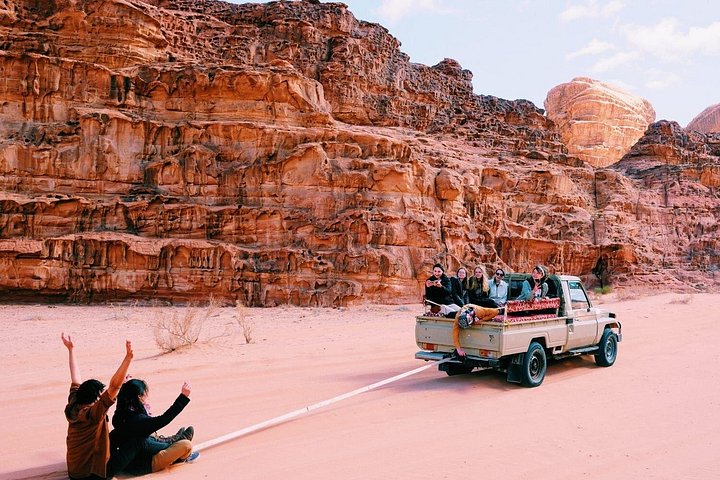
From Aqaba, the drive to Wadi Rum takes roughly an hour, so plan your return journey and think about whether a night in a camp would be easier. Combining stargazing with a sunset jeep tour is a popular pattern, since you arrive before dusk, watch the light fade and then stay for the stars.
If you want to sleep in the desert, the overnight camp or cave camp lets you watch the sky until you drift off. Check the start time, duration, pickup arrangements and inclusions with the operator, and confirm cancellation terms in case of cloud.
What to expect
The experience
A guided evening in the dark desert to look at constellations, planets and the Milky Way, usually with a hot drink.
Best time
Moonless, clear nights; spring and autumn give the best mix of comfort and visibility.
How long
Roughly two to three hours; confirm with the operator.
Tips
Dress warmly, let your eyes adapt for twenty minutes, keep screens dim and bring a power bank for the cold.
Quick picks
- Best for
- Couples, families and photographers who want a night sky without a full overnight.
- Families
- A calm activity for children who can stay up late, with blankets and warm drinks.
- Couples
- Romantic and quiet, especially after a sunset tour and dinner.
- Pair with
- A sunset jeep tour, the overnight camp or a morning balloon flight.
- Time needed
- An evening.
Good questions
When is the best time for stargazing?+
On clear, moonless nights. A full moon brightens the sky and hides fainter stars.
Is it cold?+
Often, even after a warm day. Bring layers, a hat and gloves in winter.
Can I photograph the stars?+
Yes, with a camera that has manual settings and a tripod. Ask whether your guide can help with settings.
Do I need to stay overnight?+
Not necessarily. Check the return transfer, or combine it with a night in a camp.
What if it is cloudy?+
Ask the operator about their weather policy and whether the evening can be rescheduled or refunded.