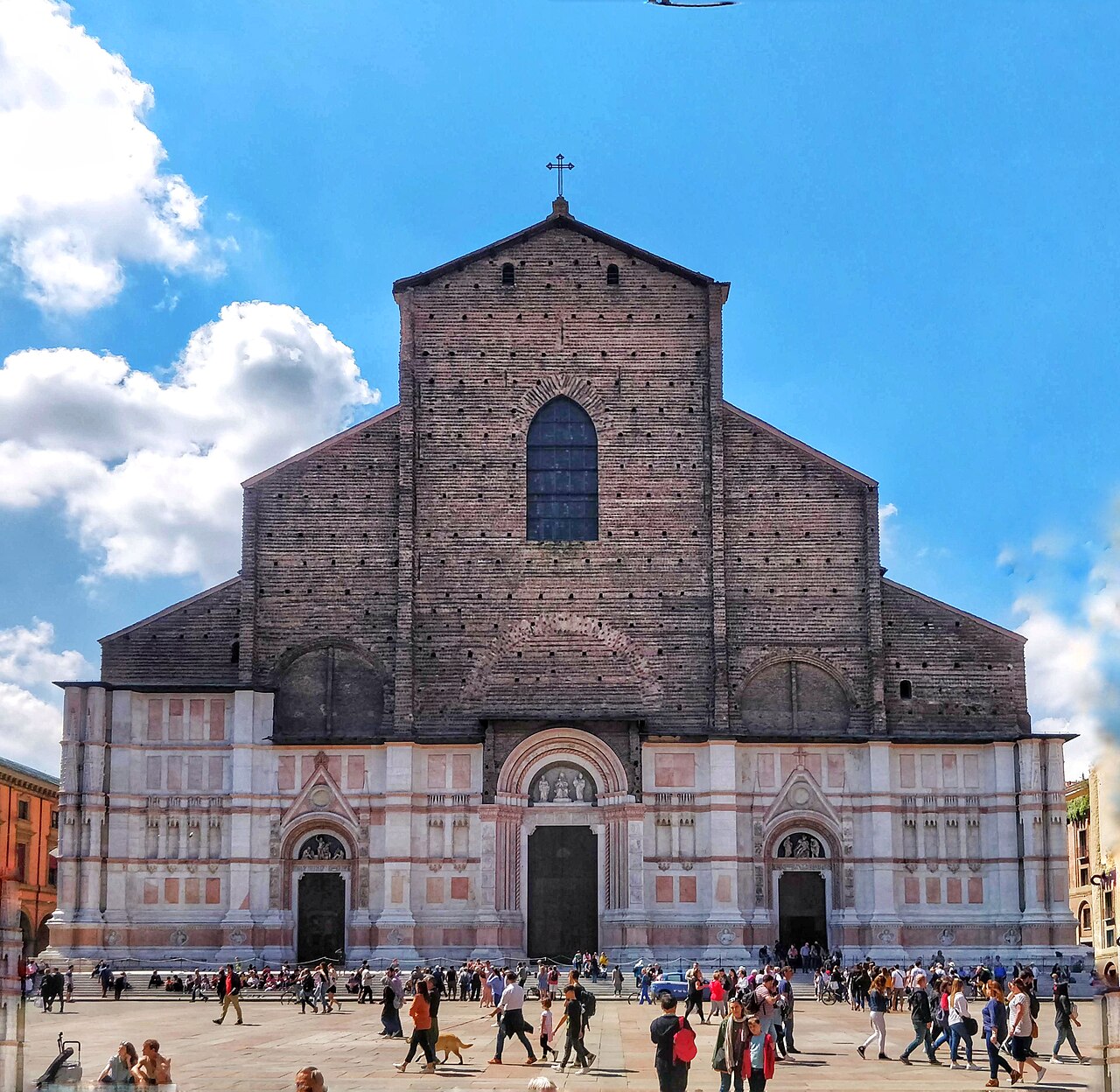
Piazza Maggiore is the living room of Bologna, and the Basilica of San Petronio fills its whole southern side. Work began in 1390 on what was meant to be one of the largest churches in Christendom, and the half-clad facade, marble below and bare brick above, shows how the ambition outran the money. Inside, the scale is breathtaking: a lofty brick nave lined with chapels, light falling through tall windows and, set into the floor, the long brass meridian line laid out by the astronomer Giovanni Domenico Cassini in 1655, still marking solar noon through a hole in the roof. The Bolognini chapel, known as the Chapel of the Magi, keeps vivid fifteenth-century frescoes and has a small separate charge. Out on the square, Giambologna’s bronze Neptune Fountain, restored in recent years, and the town hall of Palazzo d’Accursio complete the city’s grandest set piece. Entry to the basilica itself is free.
How it works: the basilica is open daily from mid-morning to early evening, with last entry shortly before closing, and the small museum is free. The Chapel of the Magi has a modest entry fee. This is a working church, so shoulders and knees must be covered, hats come off, and visits pause during services. Note that the panoramic terrace on the side of the basilica, once a popular viewpoint, is now permanently closed; for a view over the square, climb the Clock Tower of Palazzo d’Accursio instead.
What to look for: walk the meridian line down the left aisle and find the signs of the zodiac set along it, then look up for the tiny hole in the vault that lets the sun through. Check the side chapels for their painted altarpieces and carved screens. Outside, the portal of the central door is carved with Old Testament scenes by Jacopo della Quercia, worth a close look before you go in.
Making the most of it: Piazza Maggiore is where Bologna meets, so sit on the steps of the basilica in the late afternoon and watch the city pass. The Neptune Fountain is a few steps away at the corner of Piazza del Nettuno, and the Archiginnasio and the Quadrilatero are both within two minutes on foot.
What to expect
The experience
A free self-guided visit to a vast Gothic church on the main square, with an optional paid chapel and a small free museum.
Best time
Late morning, when sunlight falls through the windows, or around solar noon on a clear day to see the meridian line at work.
How long
Allow forty-five minutes to an hour inside, and longer if you sit out on the square afterwards.
Tips
Cover shoulders and knees, avoid service times, and skip the old terrace, which is now permanently closed.
Quick picks
- Best for
- First-time visitors, architecture fans and anyone who wants the full drama of Bologna’s main square.
- Families
- Children enjoy hunting for the zodiac signs on the meridian line and running to the Neptune Fountain afterwards.
- Couples
- The steps of San Petronio at dusk, with the square lit up and the city out for its evening stroll, are pure Bologna.
- Pair with
- The Clock Tower in Palazzo d’Accursio for the view over the piazza, and the Archiginnasio just behind the basilica.
- Time needed
- About an hour, more if you linger on Piazza Maggiore.
Good questions
Is the Basilica of San Petronio free to enter?+
Yes, entry to the basilica and its small museum is free. The Chapel of the Magi, with its fifteenth-century frescoes, has a small separate fee.
Can you still go up to the San Petronio terrace?+
No. The basilica says the panoramic terrace is permanently closed. The Clock Tower in Palazzo d’Accursio, on the same square, is the best alternative for a view.
Why is the facade of San Petronio unfinished?+
Construction began in 1390 and stretched over centuries, and the marble cladding of the facade was never completed. The lower part is dressed in marble while the upper part is still bare brick.
What is the meridian line in San Petronio?+
It is a long brass line set into the floor in 1655 by the astronomer Giovanni Domenico Cassini. A beam of sunlight through a hole in the roof crosses it at solar noon.
Is there a dress code for San Petronio?+
Yes, shoulders and knees must be covered and hats removed. Low-cut tops, very short skirts and sheer clothing are not allowed.