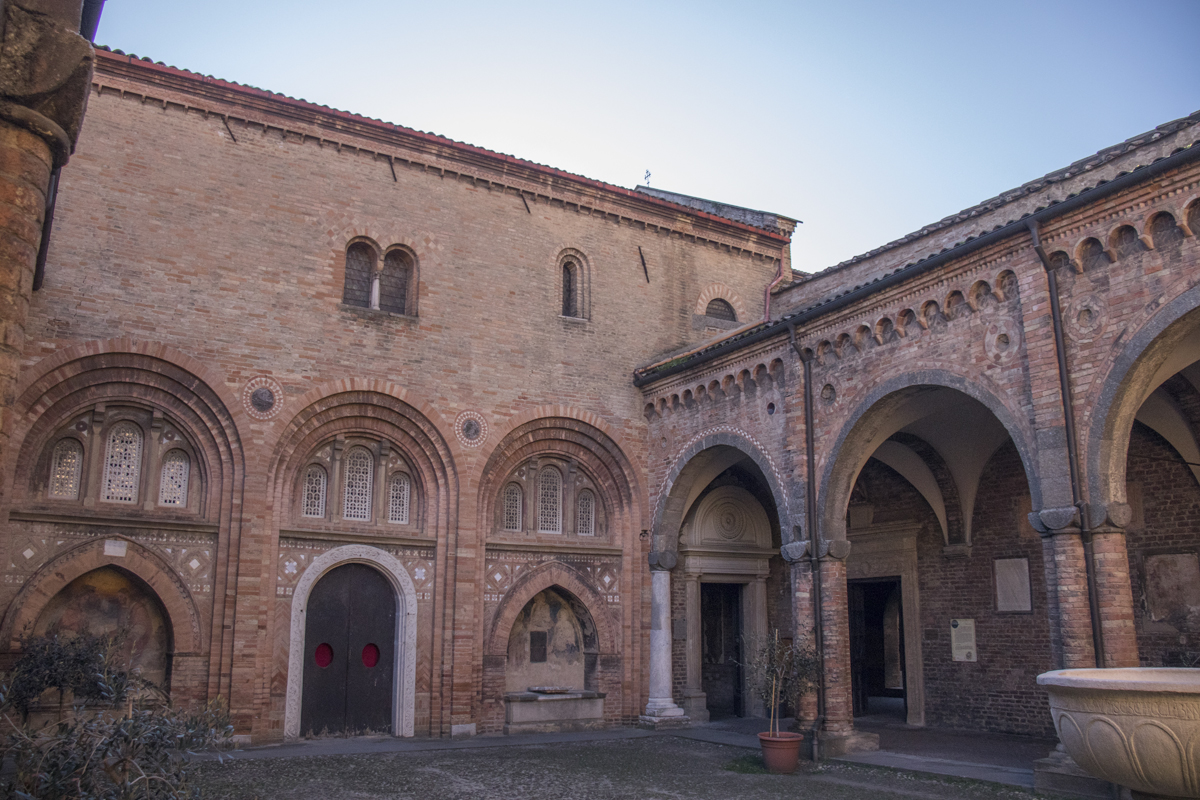
Santo Stefano is the most atmospheric place of worship in Bologna, and one of the oldest. Known as the Sette Chiese, the Seven Churches, it is a complex of linked buildings from different centuries that grew up, by the most accepted tradition, around a reproduction of the Holy Sepulchre in Jerusalem built by the city’s patron saint, Petronius. From the cobbled, triangular Piazza Santo Stefano you step into the Church of the Crucifix and then wander through a sequence of spaces: the round Church of the Holy Sepulchre, the ancient Church of Saints Vitale and Agricola, the Courtyard of Pilate with its marble basin given by Lombard kings, the Church of the Trinity and a Benedictine cloister with a double loggia that is one of the finest Romanesque cloisters in the region. A small museum in the former sacristy holds paintings and sculpture. Entry is free, with a donation welcome.
How it works: the complex opens from Tuesday to Sunday in the morning and again in the afternoon, with a long lunchtime break, and it is closed to visitors on Mondays apart from evening Mass in the Church of the Crucifix. Opening times differ slightly between sources, so check before you make a special trip. Visits are restricted during services, and large groups are asked to use headsets and enter in smaller parties to keep the spaces quiet.
What to look for: in the Holy Sepulchre, look for the tomb of Saint Petronius and the pulpit-like structure at the centre. The plain brick church of Saints Vitale and Agricola feels very old and very still. In the Courtyard of Pilate, find the great basin and the brick patterns on the walls, then sit for a few minutes in the cloister, where the upper and lower loggias have different rhythms of columns.
Making the most of it: come in the late afternoon reopening, when light slants across the piazza and the bars set out their tables. Piazza Santo Stefano is a short walk from the Two Towers along Strada Maggiore or Via Santo Stefano, both lined with porticoes, so it fits neatly into a walk through the eastern side of the old city.
What to expect
The experience
A free, self-guided walk through a sequence of connected churches, courtyards, a cloister and a small museum.
Best time
The late afternoon reopening on a weekday, when the piazza glows and the complex is calm.
How long
Forty-five minutes to an hour, plus time on the piazza outside.
Tips
Avoid Mondays and Mass times, dress modestly, and leave a small donation at the entrance.
Quick picks
- Best for
- Lovers of medieval architecture and quiet spaces, and anyone who wants a break from the busy centre.
- Families
- Children like exploring the maze of linked spaces and the courtyard, and the piazza outside is car-free.
- Couples
- The cloister and the sloping piazza at sunset are among the most romantic corners of Bologna.
- Pair with
- A walk under the porticoes of Strada Maggiore and an aperitivo on Piazza Santo Stefano.
- Time needed
- About an hour.
Good questions
Why is Santo Stefano called the Seven Churches?+
The complex grew over centuries from several linked churches and chapels, traditionally counted as seven. Today you walk through a sequence of churches, courtyards and a cloister joined together.
Is Santo Stefano free to visit?+
Yes, entry is free, though a donation is requested. The small museum inside is also part of the visit.
When is Santo Stefano open?+
It opens from Tuesday to Sunday in the morning and afternoon, with a lunch break. On Mondays it is closed to visitors except for evening Mass.
What is the Courtyard of Pilate?+
It is an inner courtyard in the complex with a large marble basin donated by the Lombard kings Liutprand and Hildeprand. Its brick walls and arches are some of the most photographed in the city.
How far is Santo Stefano from the Two Towers?+
It is a short walk of a few minutes from the Two Towers. Follow the porticoes of Via Santo Stefano to reach the triangular piazza.