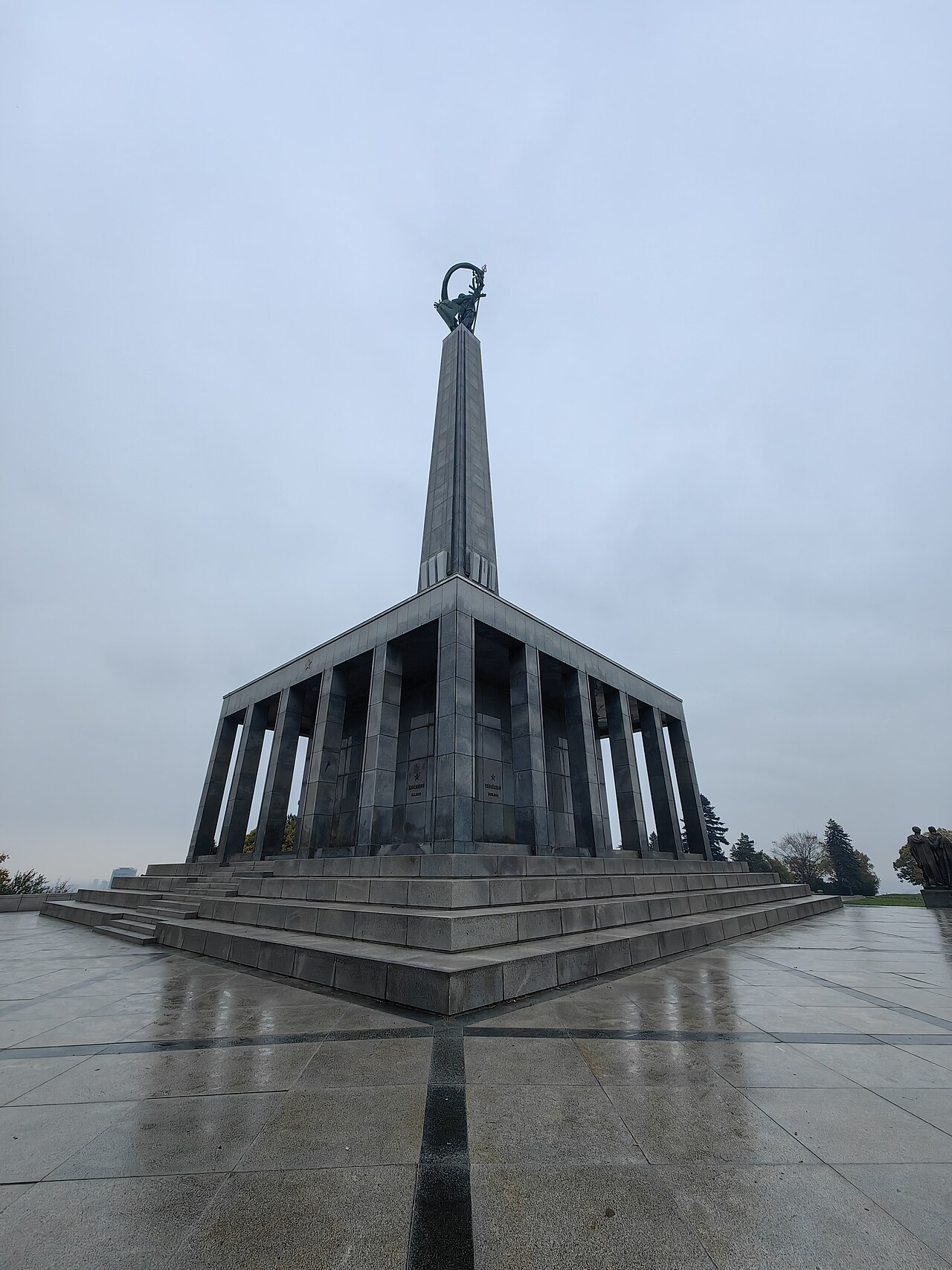
Slavín is the city’s great viewpoint that most visitors never visit. It is a war memorial and military cemetery on a hill above the old town, built between 1957 and 1960 to mark the liberation of Bratislava by the Red Army in April 1945 and the resting place of 6,845 Soviet soldiers who died in the battles for the city and the surrounding region in the last weeks of the Second World War. A central obelisk of close to forty metres rises from the terrace, topped by a statue of a soldier holding a flag, the work of the sculptor Alexander Trizuljak, and the inscriptions around the base name the Slovak towns liberated in the 1944 and 1945 advance. It is a monumental piece of Stalinist-era architecture and was declared a National Cultural Monument in 1961. Whatever you think of the history, the setting is superb: the memorial looks out over the castle, the Danube and the whole of the old town, and the streets around it are part of a calm district of embassies and prewar villas with the woods of Horský Park nearby. It is a free sight, and one of the best ways to see the city laid out below you without paying for a ticket.
How to visit
Slavín is on a hill north of the old town, a steep walk or a short taxi ride from the centre, and the address on the tourism board page is Pažického 3. The walk through the villa streets is part of the appeal, and the map links on that page are the best way to check a route for the day you go. The page publishes no admission charge or opening hours, so treat access as open but check before you go if you need to be sure.
What to expect
A quiet, solemn place. This is a cemetery, so keep voices low and dress sensibly, and remember that visitors from some countries find the memorial complicated given the later history of Soviet presence in Central Europe. The architecture and the views are the draw, and the story is one that Slovakia has debated openly for decades. Bring a camera and a layer, as the terrace is exposed to the wind.
Making the most of it
Go late in the afternoon for the light on the castle and the river, and combine it with a walk through the nearby villa streets or into Horský Park for a different side of Bratislava. It pairs naturally with the castle and the old town, and it makes a good half-hour stop on a day that is otherwise museum-heavy. If you are interested in twentieth-century history, it is an essential stop, particularly alongside a tour of the communist era.
Planning notes
The climb is the main practical consideration, since the hill is steep, and wheelchair users or visitors with limited mobility may prefer to take a taxi to the top. The terrace is exposed, so the wind can be strong even on a mild day, and in winter the paving can be icy.
Bring water in summer. If you are interested in how Slovakia remembers the war and the decades that followed, the monument is a good prompt for conversation, and pairing it with a guided tour of the communist era turns a viewpoint stop into a lesson.
What to expect
The experience
A hilltop memorial terrace and cemetery with a tall obelisk and panoramic views over the old town, the castle and the Danube.
Best time
Late afternoon for the light over the castle.
How long
About an hour including the walk.
Tips
Treat it as a cemetery, bring a layer for the wind and check the route on the map first.
Quick picks
- Best for
- History fans and anyone who wants a free panoramic view.
- Families
- A short, free stop; the steep walk and the solemn setting suit older children best.
- Couples
- A quiet viewpoint at golden hour.
- Pair with
- Bratislava Castle, Horský Park and the old town.
- Time needed
- About an hour.
Good questions
When was Slavín built?+
Between 1957 and 1960, to mark the liberation of Bratislava in April 1945.
How many soldiers are buried there?+
6,845 Soviet soldiers who died in the battles for the city and region at the end of the Second World War.
Is it free?+
Yes, the memorial terrace is a free sight, and the tourism page lists no ticket.
What is the view like?+
Panoramic, over the castle, the Danube and the old town, which is the main draw.
Where is it?+
On a hill north of the old town, at Pažického 3, in a district of villas and embassies.